
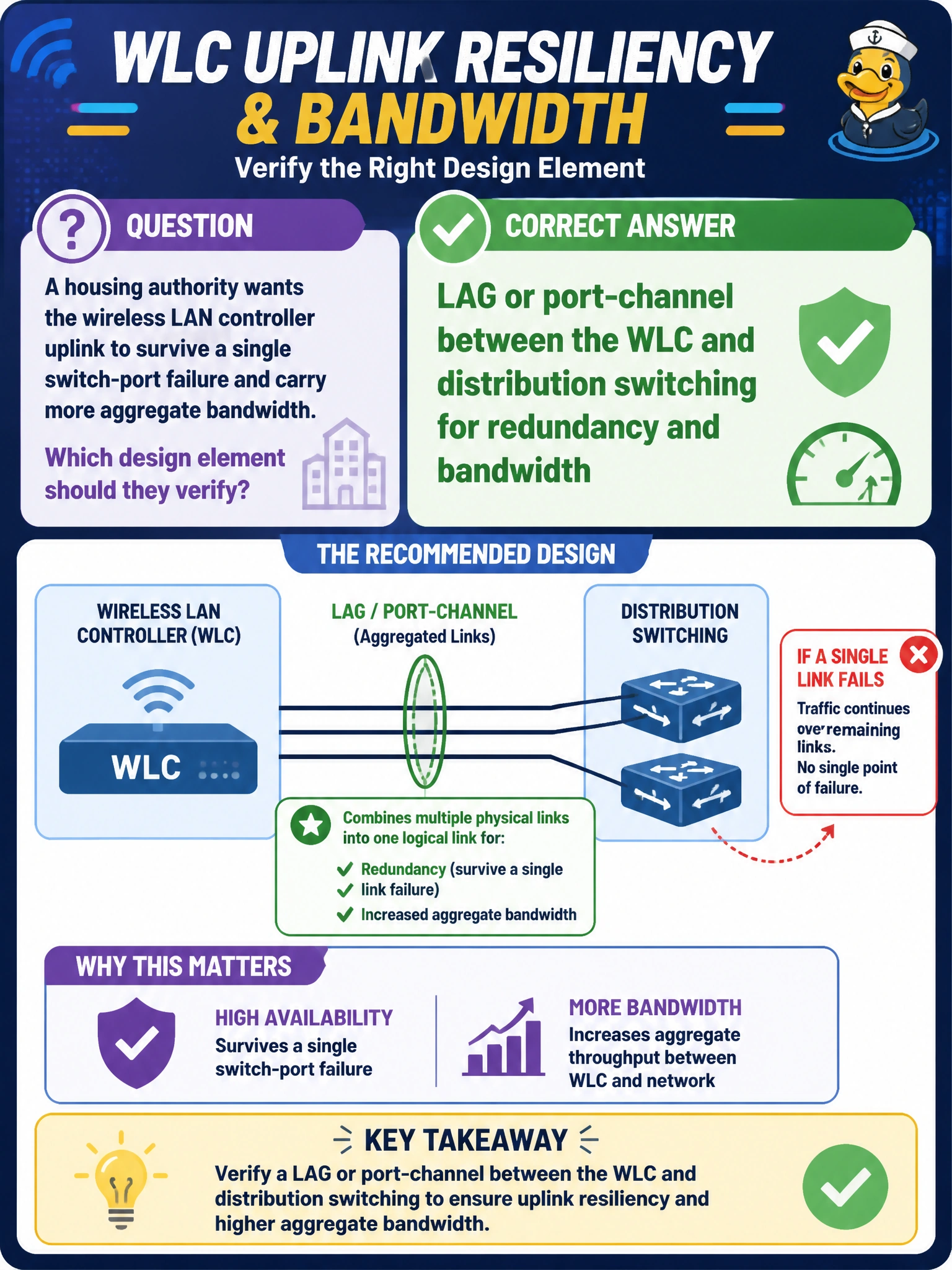
A housing authority wants the wireless LAN controller uplink to survive a single switch-port failure and carry more aggregate bandwidth. Which design element should they verify?
Select an answer to reveal the explanation.
Short Explanation
One skinny cable to the WLC is a single point of failure — trip over it and half the housing Wi-Fi sulks. LAG (a port-channel) bundles links so you get more pipes and survive one failure. That is what to verify on the controller uplink.
Full Explanation
When a housing authority needs the wireless LAN controller uplink to survive a single switch-port failure and to carry more aggregate bandwidth, link aggregation (LAG or port-channel) between the WLC and distribution switching is the design element to verify. Multiple physical members act as one logical uplink: capacity adds up across members, and loss of one member should not take the entire controller off the network if the bundle and hashing are healthy.
A single access port in the guest VLAN with PortFast only is a fragile, mis-roled attachment—guest VLAN and PortFast do not create controller uplink redundancy. Static NAT overload on the WLC management interface addresses address translation, not link resiliency or aggregate bandwidth. Disabling all EtherChannel so the WLC depends on spanning-tree blocking removes the intended redundancy mechanism and can leave capacity stranded on blocked links.
Exam caveat: LAG helps L2/L3 attachment capacity and failover of member links; it is not a substitute for dual controllers, careful AP CAPWAP planning, or correct VLAN design. Also confirm platform support for LAG on the specific WLC model and matching EtherChannel mode on the switch.
Operational check: bundle at least two WLC uplink members, shut one member interface under maintenance control, and confirm CAPWAP APs and management access to the WLC remain up while traffic shifts to remaining members.