
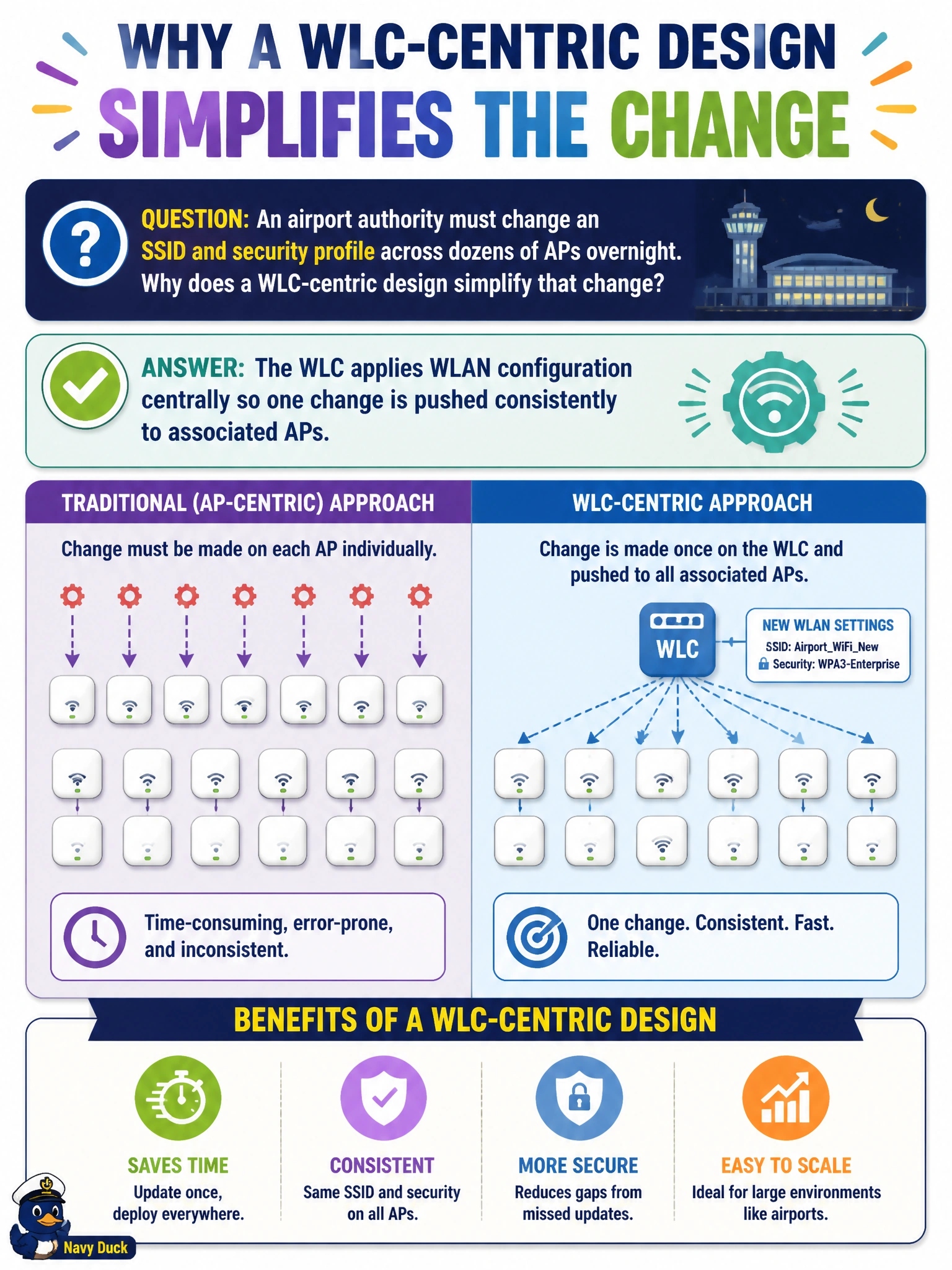
An airport authority must change an SSID and security profile across dozens of APs overnight. Why does a WLC-centric design simplify that change?
Select an answer to reveal the explanation.
Short Explanation
Changing dozens of airport SSIDs one AP at a time is like rewriting every gate sign with a Sharpie. A WLC is the digital signboard controller — update once in the center and the APs follow. That is the payoff of centralized wireless policy.
Full Explanation
A WLC-centric design simplifies overnight SSID and security-profile changes because WLAN definitions live on the wireless LAN controller and are distributed to associated APs. The airport authority edits the WLAN once—SSID string, Layer 2 security, interface mapping—and the controller pushes a consistent result to dozens of APs instead of requiring a manual tour of every closet. That central apply-and-distribute model is the operational reason controller-based wireless exists at scale.
Requiring a unique console password typed by hand on each AP before any SSID can change describes autonomous, per-box administration and defeats the bulk-change goal. Insisting that SSID changes only work after every AP is set to autonomous mode reverses the architecture: autonomous mode is where central push is weakest. Claiming a WLC cannot influence SSIDs and that only DHCP option 150 can rename WLANs confuses AP addressing/boot helpers with WLAN configuration authority.
Exam caveat: DHCP options and DNS may help an AP discover a controller, but they do not define SSIDs. WLAN objects on the WLC do. Also remember that APs must be joined and the WLAN enabled for clients to see the new profile.
Operational check: before the maintenance window, stage the SSID and security change on the WLC in a lab WLAN or scheduled window; afterward, associate a test client at multiple airport gates and confirm the new SSID and security negotiate identically without touching individual AP CLIs.