
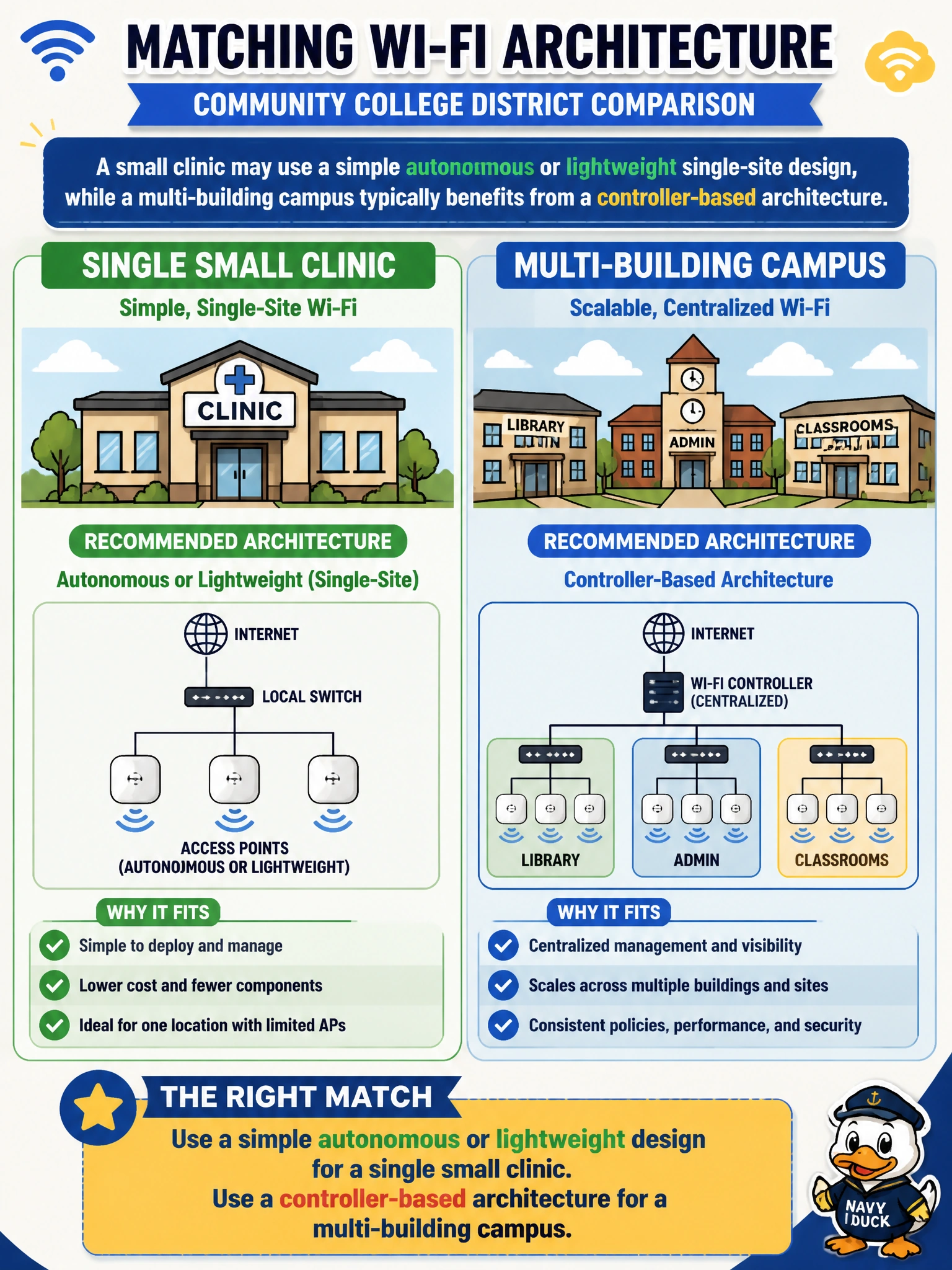
A community college district compares a single small clinic Wi-Fi closet with a multi-building campus. Which wireless architecture match is most appropriate?
Select an answer to reveal the explanation.
Short Explanation
You can keep a small clinic’s Wi-Fi simple, while a multi-building campus usually benefits from a central WLC to keep things consistent. Match the architecture to the number of buildings and access points you need to manage.
Full Explanation
Wireless architecture should match the scale of the site. For a single small clinic Wi-Fi closet, a simple autonomous or lightweight single-site design can be sufficient. A multi-building campus typically benefits from a controller-based architecture, which lets you manage wireless settings consistently across many access points and buildings. The key is to match the design to the scale and management needs of the site, rather than assume one architecture fits every deployment. Requiring only autonomous access points at every site ignores the value of centralized management as a district spans more buildings. Disabling every access point and relying only on wired copper Ethernet drops does not meet the campus’s wireless needs. Claiming scale never matters and SSID names alone determine whether a WLC is required confuses a network name with the factors that guide architecture selection. Exam caveat: CCNA questions often contrast small standalone deployments with enterprise controller-based designs, but there is no universal rule that every small clinic must use autonomous access points or that every campus must use a particular vendor’s appliance. The tested skill is recognizing when centralization is useful. Practical check: inventory the access points and buildings at each site; if keeping SSIDs and security consistent across buildings is difficult, assess whether bringing that site under a WLC would help.