
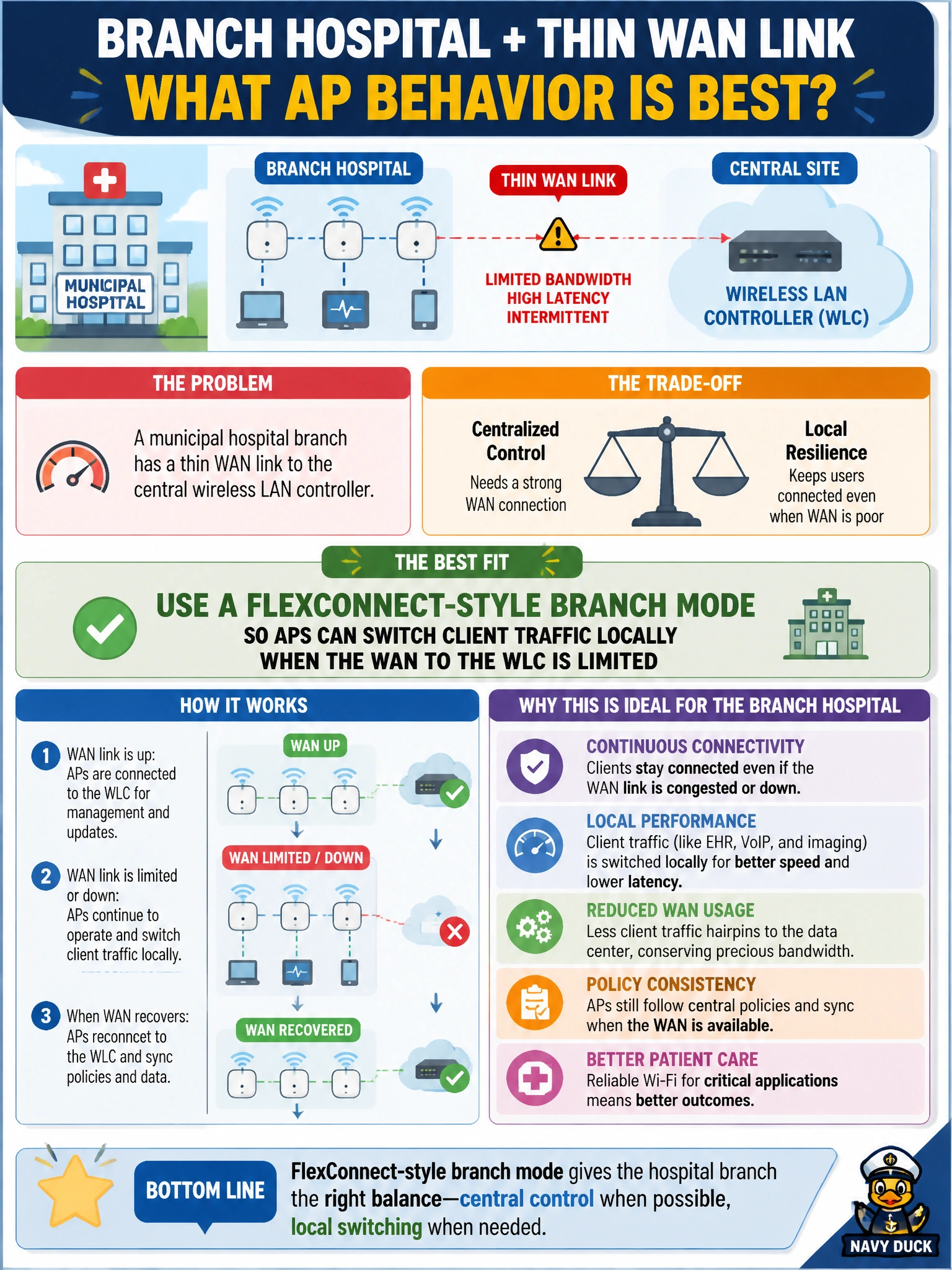
A municipal hospital branch has a thin WAN link to the central wireless LAN controller. Which AP behavior trade-off best fits that constrained reachability?
Select an answer to reveal the explanation.
Short Explanation
When the WAN to the WLC is a skinny straw, you do not want every clinic client packet to drink through it. FlexConnect-style branch behavior lets the AP switch traffic locally while still taking policy cues from the controller — perfect for a thin municipal hospital link.
Full Explanation
A municipal hospital branch with a thin WAN toward the central wireless LAN controller should avoid forcing all client data across that constrained path. FlexConnect-style branch behavior keeps APs in a controller-based architecture for policy and management while allowing client traffic to be switched locally at the branch when WAN bandwidth or reachability to the WLC is limited. That trade-off preserves WLAN consistency without saturating the clinic uplink with hairpinned user packets.
Forcing every branch AP into pure local mode so all client data always hairpins across the WAN worsens the thin-link problem the hospital is trying to solve. Removing the WLC entirely abandons centralized policy and leaves each AP without controller association, which is a different architecture rather than a branch-mode trade-off. Converting the branch to a spine-leaf underlay does not eliminate the need for CAPWAP or address how wireless client traffic should be switched relative to the WLC.
Exam caveat: FlexConnect (and related local-switching branch modes) still typically requires the AP to join or communicate with a controller for configuration; local switching is about the data path under WAN constraints, not about inventing a new campus fabric. Know when centralized local mode is appropriate versus when branch local switching is preferred.
Operational check: place a test client on the hospital branch WLAN, generate traffic to a local branch resource, and confirm the flow stays on the LAN while the AP remains associated to the central WLC—then compare utilization on the thin WAN before and after.