
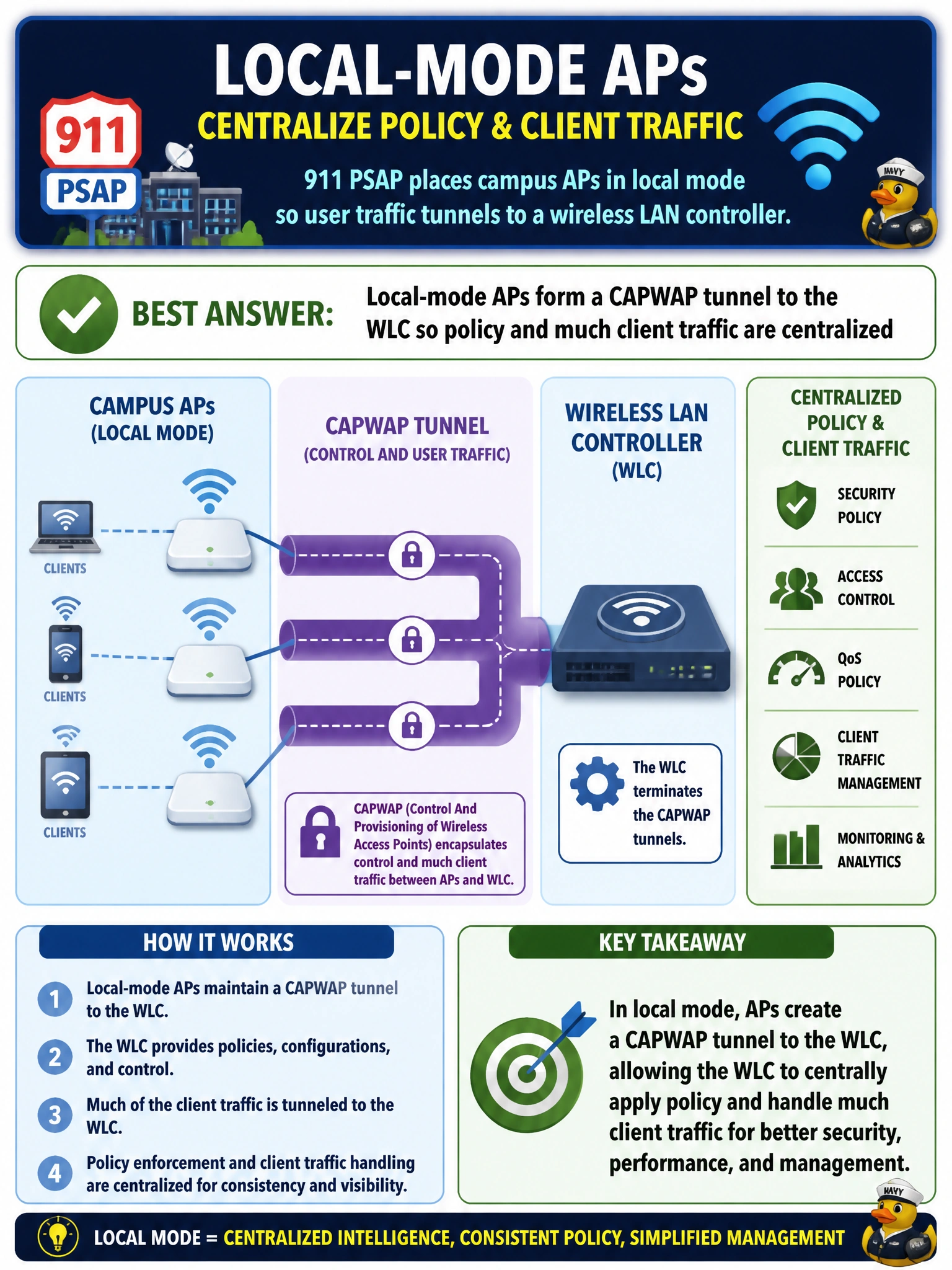
A 911 PSAP places campus APs in local mode so user traffic tunnels to a wireless LAN controller. Which statement best describes that mode?
Select an answer to reveal the explanation.
Short Explanation
Think of local mode as routing dispatch traffic through the central console rather than letting each radio handle it independently. You have the AP form a CAPWAP tunnel to the WLC, centralizing policy and typically much client traffic. An AP that bridges locally without that tunnel or operates autonomously is not using this mode.
Full Explanation
In local mode, you have a controller-based AP form a CAPWAP tunnel to the wireless LAN controller (WLC). The WLC centralizes policy and, by default, much of the client data traffic, allowing the 911 PSAP to apply WLAN policy centrally rather than treating each campus AP as an independent bridge. The AP therefore needs controller reachability to join and support the centralized behavior expected by the design. An AP that locally bridges client traffic directly onto the wired network without a CAPWAP tunnel describes the opposite forwarding arrangement, not local mode. An AP operating autonomously with the full WLAN configuration only in flash describes standalone operation, rather than an AP joined to a WLC through CAPWAP. The claim that local mode leaves the AP powered off until a console cable is attached confuses an operating mode with console access; a console cable is not what powers on or defines the AP. Exam caveat: centralized client traffic can hairpin through the WLC, so confirm that this forwarding path fits the site’s design. Practical check: on the WLC, verify that the PSAP APs are joined in local mode and that CAPWAP is up, then test a client and confirm its traffic follows the expected centralized path rather than being bridged locally at the AP’s switch port.