
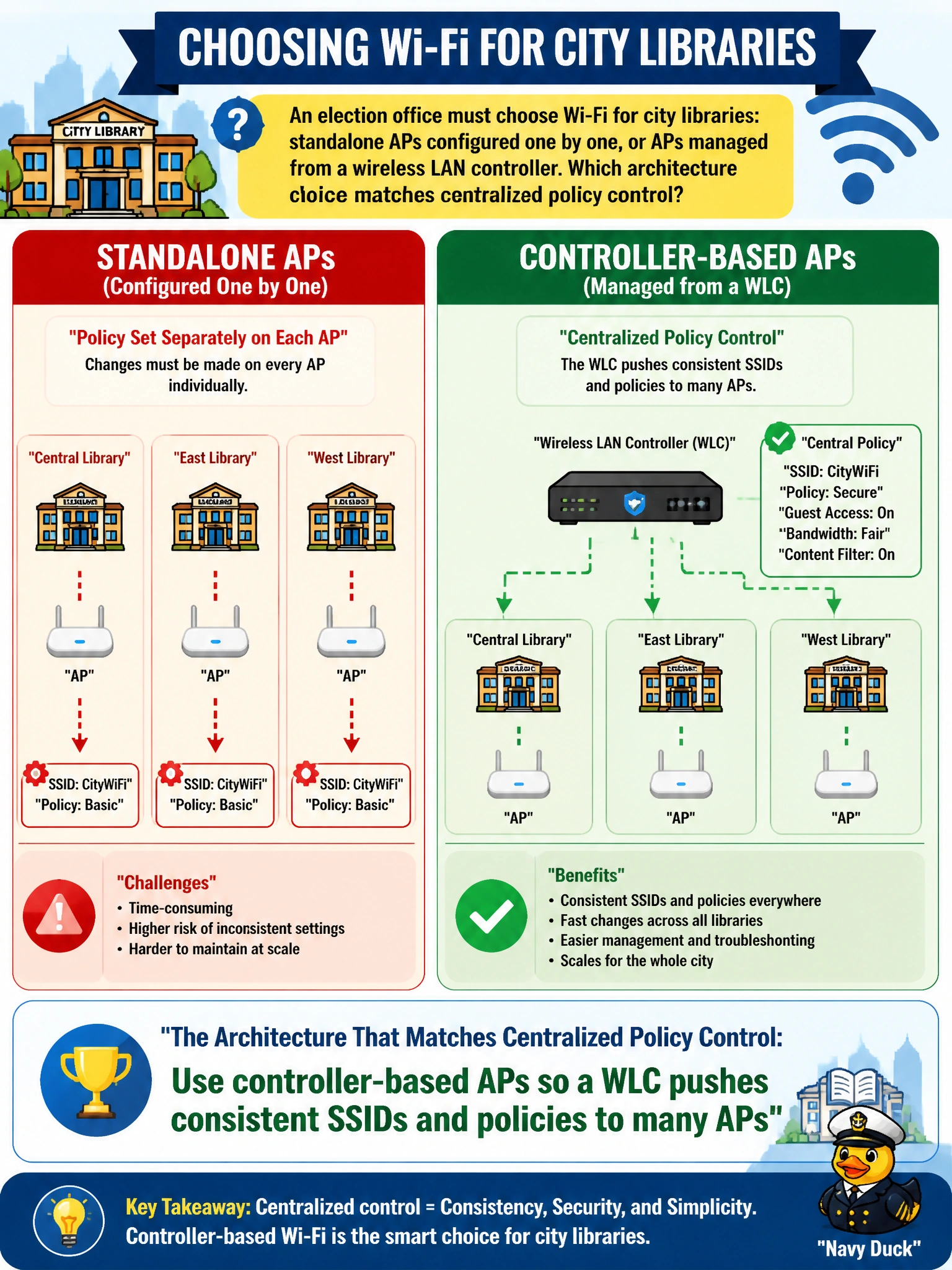
An election office must choose Wi-Fi for city libraries: standalone APs configured one by one, or APs managed from a wireless LAN controller. Which architecture choice matches centralized policy control?
Select an answer to reveal the explanation.
Short Explanation
Think of autonomous APs as each library owning its own thermostat — fine for one room, messy for a whole system. A wireless LAN controller is city hall HVAC: one place sets the policy and the APs follow. That is the controller-based architecture the election office wants.
Full Explanation
Controller-based wireless architecture is the fit when an election office must keep SSID names, security profiles, and RF policies consistent across many city library APs. In that model, lightweight APs join a wireless LAN controller; the WLC holds the WLAN definitions and pushes them so operators change policy once instead of editing each closet independently. Centralized control is exactly what municipal multi-site Wi-Fi needs when libraries share the same staff and guest SSIDs under one governance model.
Autonomous APs store full WLAN configuration locally. They can work for a single closet, but they do not provide the election office with one authoritative policy plane; each library becomes its own configuration domain and drift is inevitable. Replacing APs with unmanaged Layer 2 switches removes the radio system entirely and only floods wired frames, so it is not a wireless architecture choice. Disabling CAPWAP and forcing Telnet-based per-SSID edits on every AP deliberately rejects controller centralization and recreates the operational pain the design is meant to avoid.
On the CCNA Network Access exam, distinguish autonomous (standalone) APs from controller-based (lightweight) APs joined over CAPWAP. Do not assume every small site must use a WLC, and do not assume every large campus must stay autonomous. Scale, consistency, and change control drive the decision.
Operational check: after associating library APs to the WLC, change an SSID or WLAN security setting once on the controller and confirm the same values appear on APs in multiple libraries without per-AP console edits.