
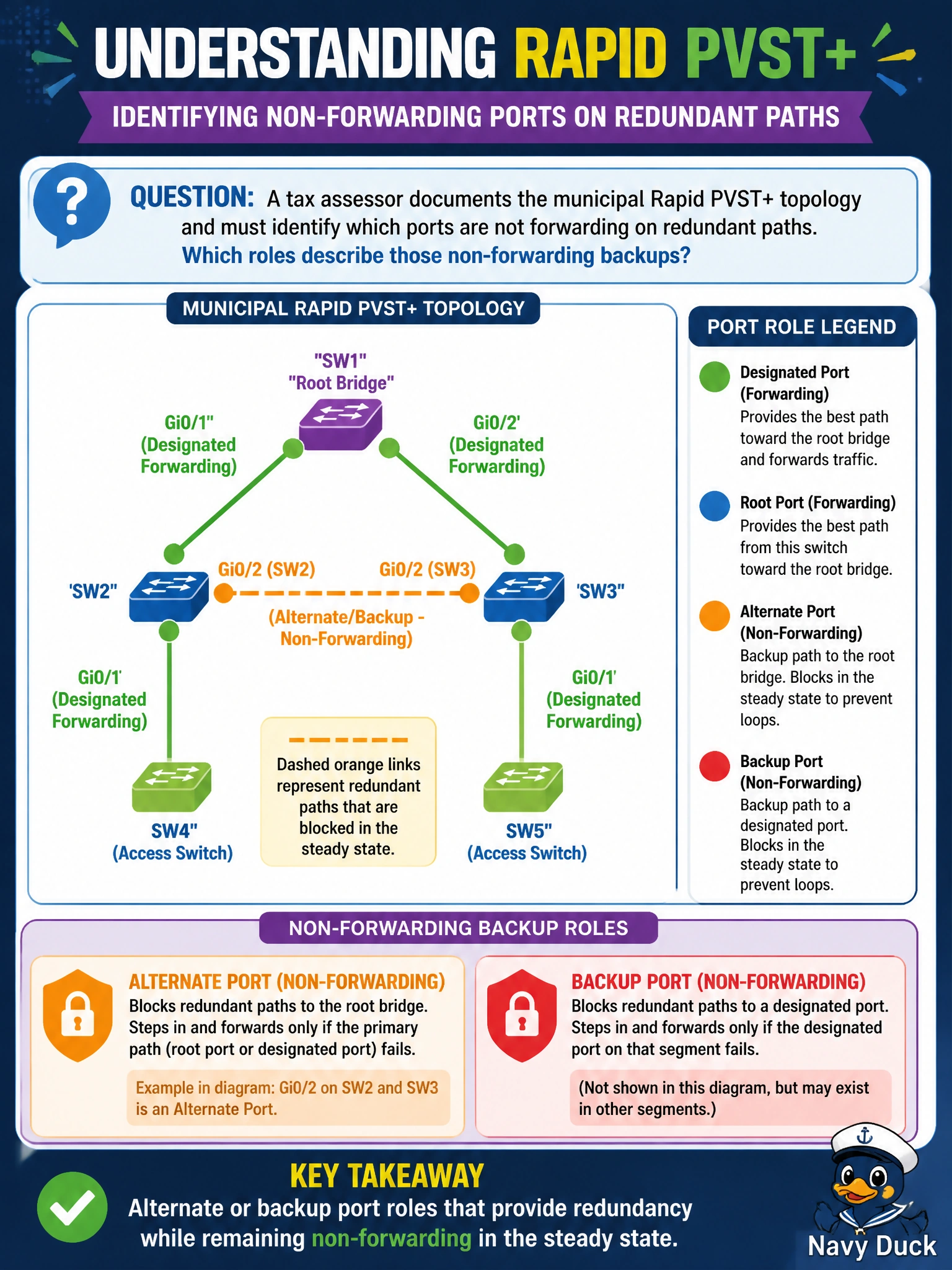
A tax assessor documents the municipal Rapid PVST+ topology and must identify which ports are not forwarding on redundant paths. Which roles describe those non-forwarding backups?
Select an answer to reveal the explanation.
Short Explanation
In a healthy loop-free drawing, some ports are the understudies—alternate or backup—ready if the star uplink fails. They’re not forwarding now, and that’s exactly how STP keeps the municipal LAN from chasing its tail.
Full Explanation
When a tax assessor documents municipal Rapid PVST+ topology, the non-forwarding backups on redundant paths are alternate or backup port roles. Those roles provide redundancy while remaining non-forwarding in the steady state so the active tree stays loop-free. Root and designated ports are the forwarding roles on the working topology; alternate/backup ports are the standby capacity that can take over after a failure.
Claiming only root and designated roles exist because Rapid PVST+ never blocks on redundant links is false—loop-free operation requires non-forwarding ports on redundant Layer 2 paths. LACP standby members are an EtherChannel member-selection concept, not a substitute for STP alternate ports on links that are separate in the spanning tree. Native VLAN ports forwarding untagged frames while all tagged ports remain blocked confuses trunk native-VLAN behavior with STP role assignment.
Exam caveat: alternate versus backup role nuances appear in RSTP/Rapid PVST+ documentation (backup is less common, shared-segment cases). For CCNA practice, recognizing non-forwarding redundant roles versus forwarding root/designated roles is the required distinction.
Operational check: inventory each redundant uplink’s STP role and state per VLAN, label alternate/backup links on the assessor topology diagram, validate failover in a maintenance window, and ensure monitoring alerts when an alternate unexpectedly becomes forwarding outside a planned event.