
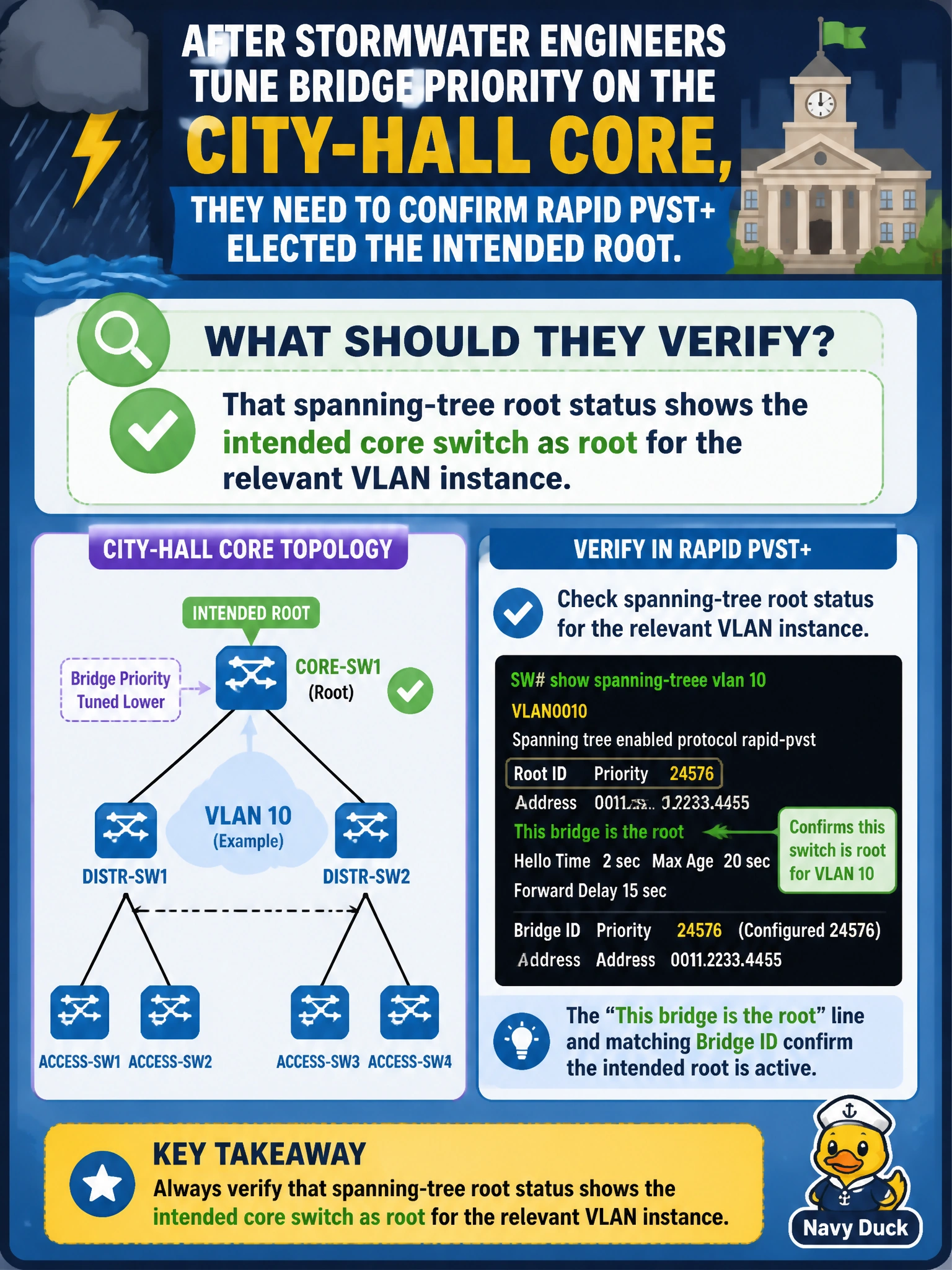
After stormwater engineers tune bridge priority on the city-hall core, they need to confirm Rapid PVST+ elected the intended root. What should they verify?
Select an answer to reveal the explanation.
Short Explanation
Priority changes are just paperwork until you verify the badge on the root. Check spanning-tree root for that VLAN and make sure city hall actually won—not some closet that still thinks it’s in charge.
Full Explanation
After stormwater engineers tune bridge priority on the city-hall core, verification means checking spanning-tree root status for each relevant Rapid PVST+ VLAN instance and confirming the intended core switch is root (with secondary root placement verified where designed). Priority configuration is only paperwork until show-command evidence proves election results match the civic Layer 2 design.
Expecting every access port to show a root role with no designated ports remaining misunderstands roles: access edge ports are typically designated toward hosts, and root ports exist on non-root switches toward the root. Relying on CDP neighbor order to prove root ignores that discovery listing is unrelated to bridge ID election. Changing EtherChannel hash to source-MAC after a priority update does not validate STP root and mixes aggregation hashing with spanning-tree control.
Exam caveat: Rapid PVST+ is per-VLAN. A switch can be root for some VLANs and not others. Always verify the VLAN instances that were tuned, not a single global assumption.
Operational check: after priority changes, run spanning-tree root/status per VLAN, confirm primary and secondary identities, check that closet switches list the correct root port toward city hall, and save outputs with the change record.