
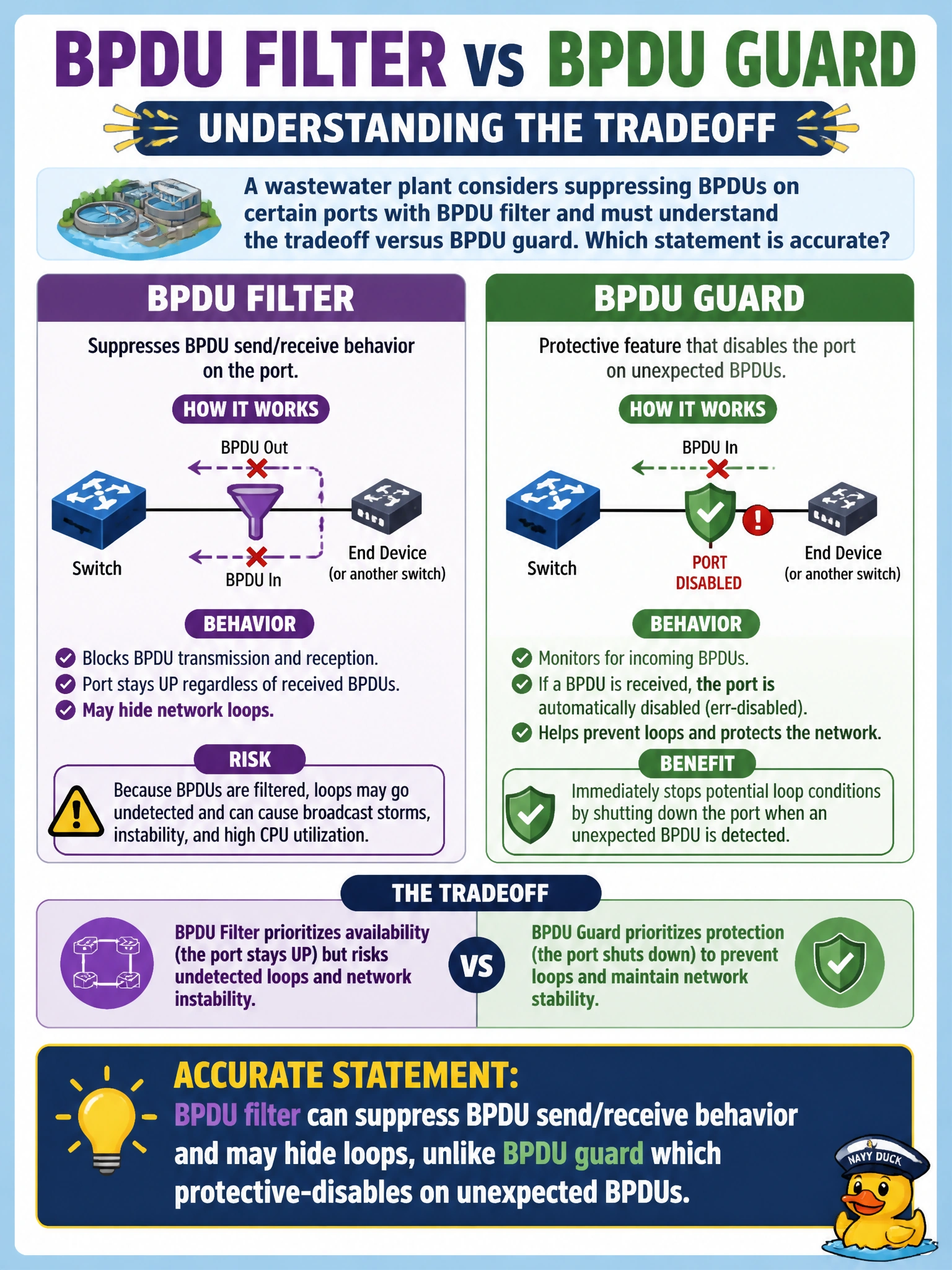
A wastewater plant considers suppressing BPDUs on certain ports with BPDU filter and must understand the tradeoff versus BPDU guard. Which statement is accurate?
Select an answer to reveal the explanation.
Short Explanation
BPDU guard is a smoke alarm that trips the breaker; BPDU filter is taping over the alarm so it stays quiet. Use filter only where you truly must suppress BPDUs—and know you might be blind to a loop.
Full Explanation
At the wastewater plant, BPDU filter suppresses BPDU send and/or receive behavior on a port. That can hide spanning-tree information and, if misapplied, allow loops to form unnoticed—unlike BPDU guard, which protective-disables a port when an unexpected BPDU arrives on an edge. Accurate CCNA-level judgment treats BPDU filter as a higher-risk, narrowly justified tool compared with BPDU guard on ordinary PortFast host edges.
Claiming BPDU filter and BPDU guard are identical because both always err-disable on any BPDU is false; their reactions and intents differ. Saying BPDU filter increases root election speed by flooding superior BPDUs toward access PCs reverses what filtering does—it suppresses BPDUs rather than accelerating election toward PCs. Requiring BPDU filter on every EtherChannel member before LACP can form invents a dependency; LACP negotiation does not require BPDU filter.
Exam caveat: interface-level versus global BPDU filter behaviors can differ on platforms, but the exam concept remains: filtering can disconnect a port from STP awareness, while guard enforces edge assumptions by err-disable.
Operational check: prefer BPDU guard on PortFast edges at the plant, use BPDU filter only where a documented exception requires suppressing BPDUs, review those exceptions periodically, and verify that filtered ports cannot bridge unexpectedly into the Rapid PVST+ domain.