
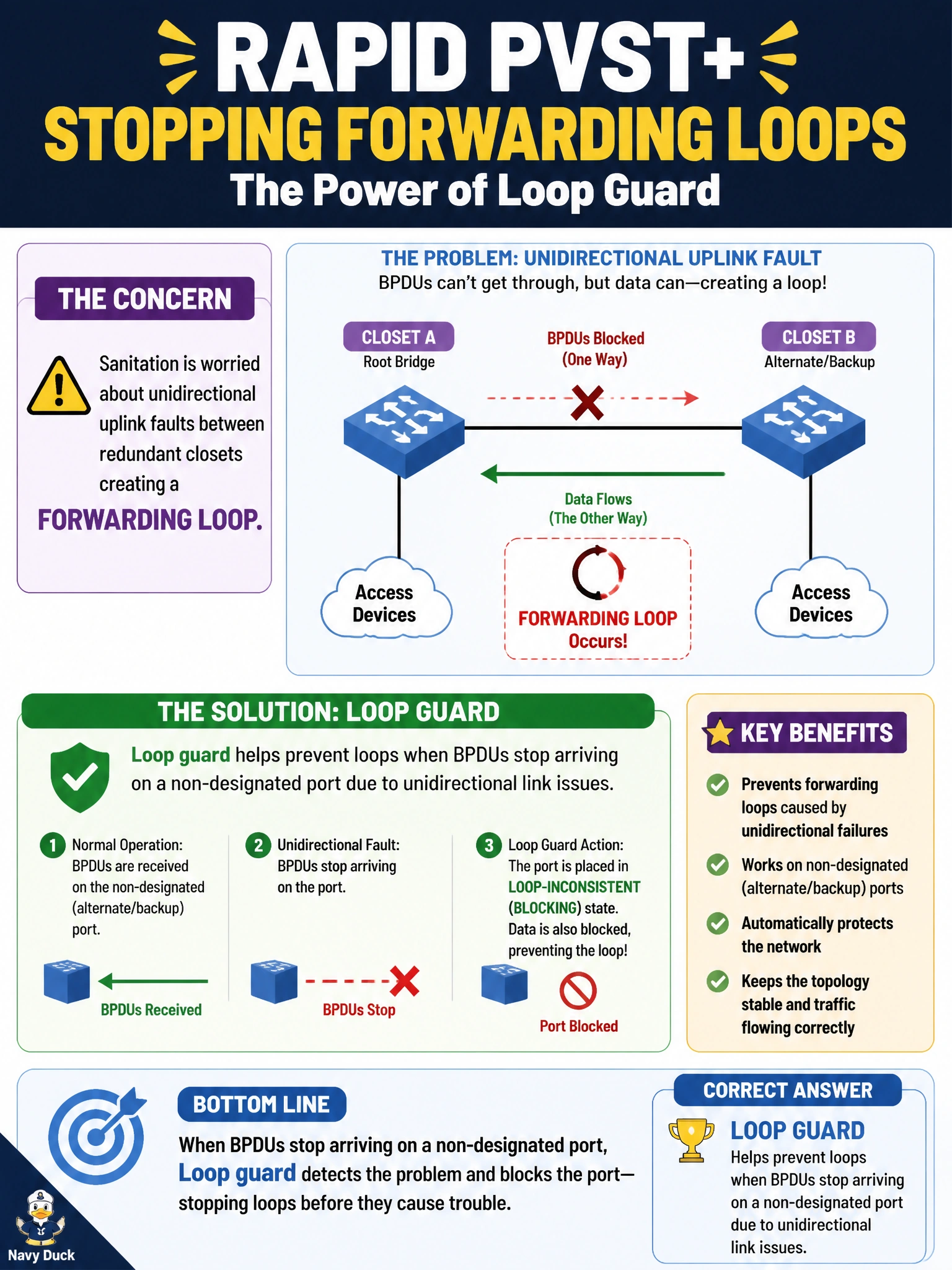
Sanitation is worried about unidirectional uplink faults between redundant closets creating a forwarding loop. Which Rapid PVST+ feature addresses that class of problem?
Select an answer to reveal the explanation.
Short Explanation
Unidirectional fiber trouble is a classic STP gotcha: one side may stop hearing BPDUs while the other keeps forwarding, creating a loop. Loop guard protects the quiet non-designated port until BPDUs resume.
Full Explanation
Sanitation’s concern about unidirectional uplink faults between redundant closets is addressed by loop guard. If a non-designated port stops receiving BPDUs because a link is unidirectional, the port could incorrectly transition to forwarding and form a loop. Loop guard keeps the port in a loop-inconsistent state until BPDUs resume, improving stability on redundant municipal uplinks exposed to one-way fiber failures. PortFast on both ends of every redundant fiber is dangerous on interswitch links: bypassing normal STP checks removes the waiting behavior that helps protect against loops. BPDU filter on both redundant uplinks removes the very signals STP needs to detect loops, so it can hide or create them rather than prevent the fault. Changing the native VLAN hourly is operationally unsound and does not make stale BPDUs expire automatically or provide unidirectional-link protection. Exam caveat: loop guard is for ports expected to keep receiving BPDUs, typically root or alternate ports on redundant links; it is not an edge-port shortcut. Practical check: enable loop guard on redundant sanitation uplinks according to the design, verify alternate ports remain stable, test or review platform behavior for unidirectional-fault detection where possible, and correlate loop-inconsistent logs with physical fiber checks.