
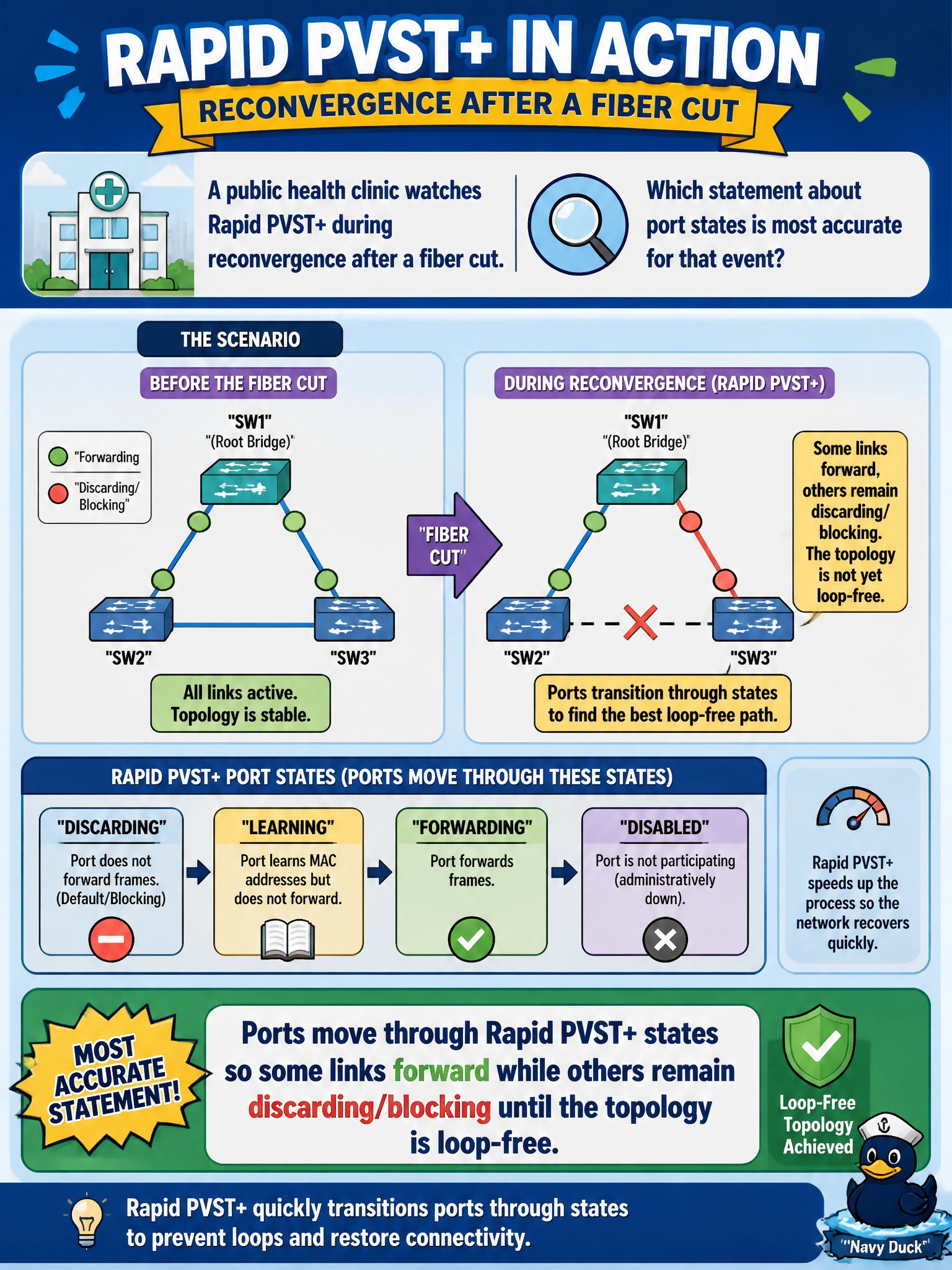
A public health clinic watches Rapid PVST+ during reconvergence after a fiber cut. Which statement about port states is most accurate for that event?
Select an answer to reveal the explanation.
Short Explanation
During a cutover, some doors stay open (forwarding) and some stay shut (blocking/discarding) so you don’t create a switching loop. Rapid PVST+ is just getting those doors latched correctly again after the fiber snaps.
Full Explanation
During public-health-clinic reconvergence after a fiber cut, Rapid PVST+ moves ports through states so the newly selected active path forwards while other ports remain discarding/blocking as needed to keep the topology loop-free. States exist precisely to control learning and forwarding while the tree computes a single active path per VLAN instance. After the cut, reconvergence elects new roles and transitions ports accordingly rather than flooding forever on every link.
Treating blocking and forwarding as identical states that differ only in syslog color codes erases the loop-prevention purpose of non-forwarding states. Claiming all ports immediately flood in both directions forever until counters are cleared describes a broken or looped network, not correct Rapid PVST+ behavior. Saying Rapid PVST+ has no blocking behavior because EtherChannel disables Spanning Tree is false: EtherChannel does not eliminate STP; a port-channel is typically one logical link still subject to spanning tree.
Exam caveat: RSTP/Rapid PVST+ can transition faster than legacy timers, but ‘faster’ is not ‘all ports forward.’ Redundant ports still non-forward in the steady state once reconvergence completes.
Operational check: after a fiber cut in a maintenance test, watch port states and roles on clinic uplinks, confirm only the intended path forwards, verify no broadcast storm indicators, and restore the fiber while confirming the tree returns to the designed steady state.