
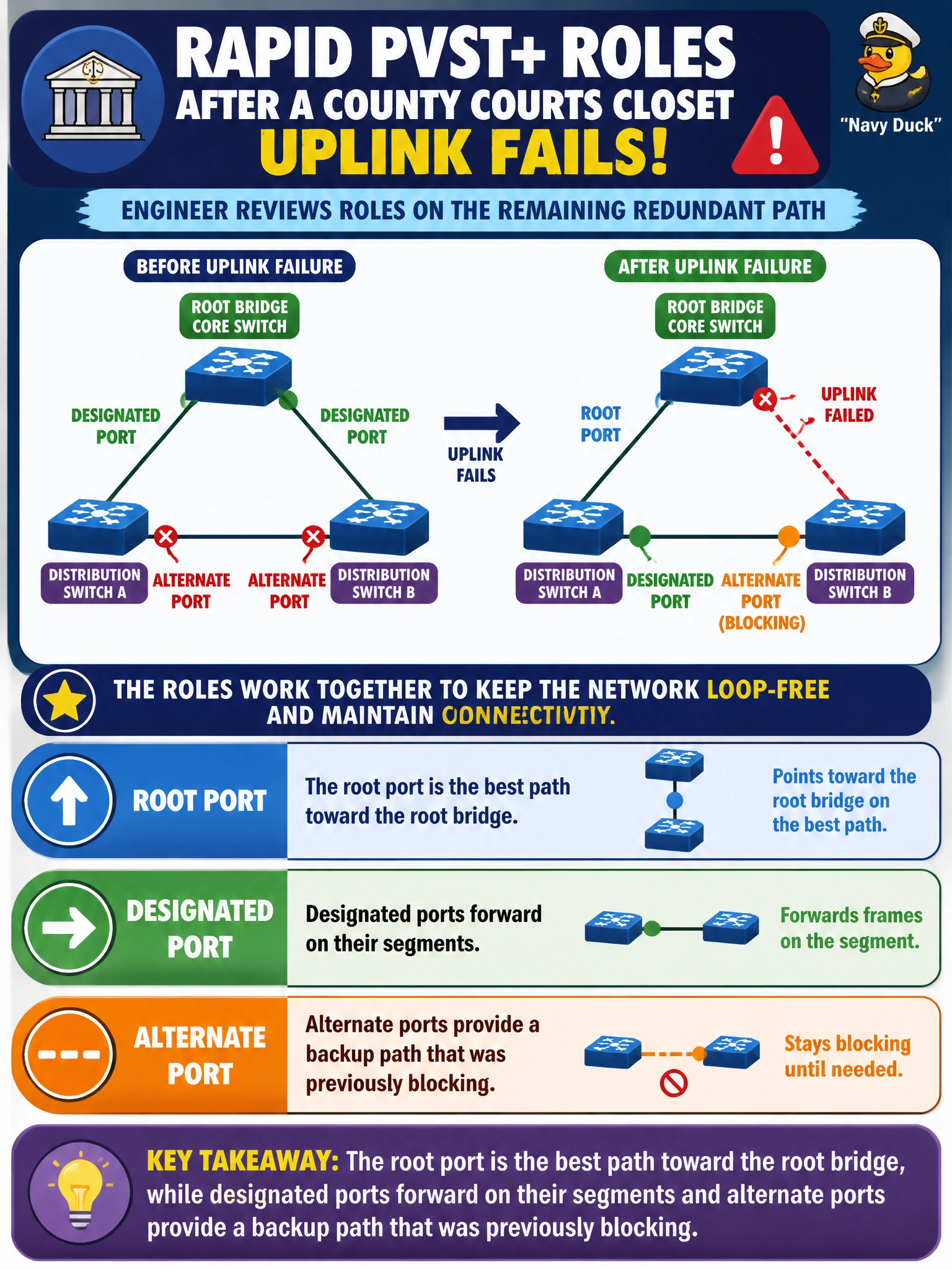
After a county courts closet uplink fails, an engineer reviews Rapid PVST+ roles on the remaining redundant path. Which role description is accurate?
Select an answer to reveal the explanation.
Short Explanation
You can think of the root port as the best way toward the root bridge, the designated port as the forwarding port for its segment, and the alternate port as a backup that was blocking. When an uplink fails, that backup may take over to keep the path available.
Full Explanation
After the county courts closet uplink fails, the accurate role description is that the root port is each non-root switch’s best path toward the root bridge, designated ports forward on their segments, and alternate ports provide a backup path that was previously blocking. These roles let you understand how Rapid PVST+ maintains a loop-free topology while providing a path that can take over after a failure. The description claiming that every switch promotes all active uplinks to root ports and forwards on every redundant path is incorrect: switches elect a single best root path, and forwarding on all paths could create loops. The claim that designated ports exist only on wireless LANs is also incorrect; designated ports are used on wired Ethernet segments in Rapid PVST+. The claim that alternate ports always forward user traffic until BPDU filter converts them to root ports is incorrect because alternate ports provide a backup path that was previously blocking, and BPDU filter does not define that role or conversion. Exam caveat: STP terminology may describe a non-forwarding state as blocking or discarding, but the root, designated, and alternate role concepts remain useful for interpreting topology. Practical check: compare spanning-tree roles and states on the uplinks before and after failure, confirm the expected backup path takes over, verify user VLANs recover, and record the observed failover path in the courts redundancy runbook.