
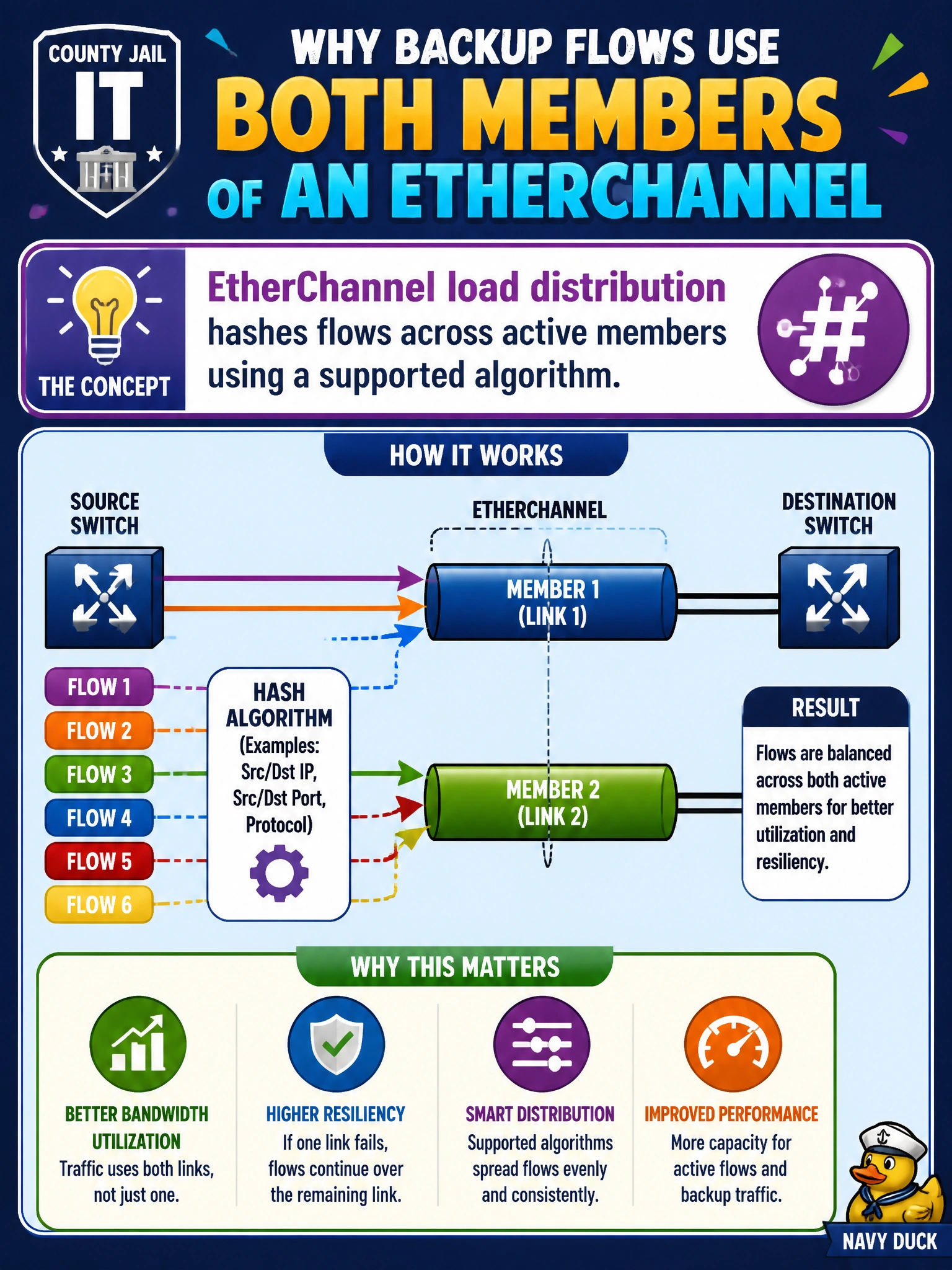
County jail IT wants backup flows to use both members of an EtherChannel rather than pinning everything to one fiber. Which concept explains that behavior?
Select an answer to reveal the explanation.
Short Explanation
The bundle isn’t round-robin every packet like a card dealer—it hashes conversations onto members. Pick a supported load-balance method so backup flows can fan out across both fibers instead of stampeding one link.
Full Explanation
County jail backup flows can use both EtherChannel members because load distribution hashes flows across active members according to a supported algorithm (for example source/destination MAC or IP based hashing, depending on platform and configuration). Each flow is pinned to a member by the hash, so many concurrent flows naturally spread across fibers without requiring STP to treat members as separate forwarding links. That is how aggregated bandwidth is realized for diverse municipal traffic.
STP blocking all but one EtherChannel member describes the pre-bundle problem EtherChannel solves: without bundling, STP would block redundant physical links; with a proper channel, STP sees one logical link and members forward under the load-balance hash. LACP randomly disabling a member every minute is not a load-balancing mechanism and would cause instability. Native VLAN pruning is not a prerequisite for unicast on members and confuses VLAN pruning with EtherChannel hashing.
Exam caveat: a single elephant flow still uses one member because hashing is typically per-flow, not per-packet round-robin on many campus platforms. Uneven utilization with few flows does not mean the channel is broken.
Operational check: confirm both members are active in the channel, note the configured load-balance algorithm, generate multiple distinct flows, observe utilization across members, and adjust hash fields if the traffic profile is chronically polarized.