
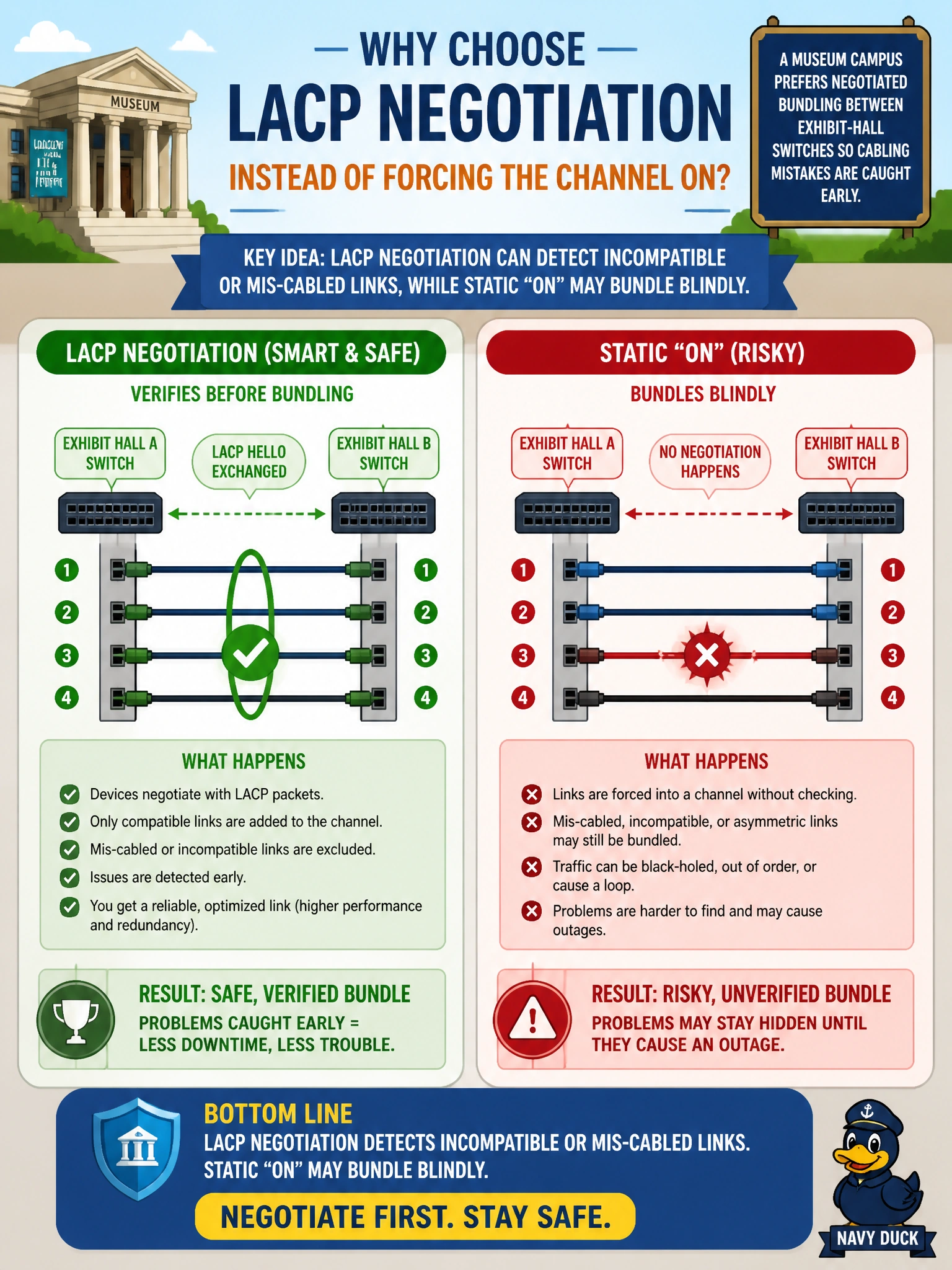
A museum campus prefers negotiated bundling between exhibit-hall switches so cabling mistakes are caught early. Why choose LACP negotiation instead of forcing the channel on?
Select an answer to reveal the explanation.
Short Explanation
Forced-on is like taping two cables together and hoping they’re the right pair. LACP actually asks the other side “are we compatible?”—so a museum hall mispatch shows up as a failed member instead of a silent mess.
Full Explanation
A museum campus that wants negotiated bundling between exhibit-hall switches chooses LACP because negotiation can detect incompatible or mis-cabled links before they silently join a channel. LACP peers exchange protocol data; links that fail negotiation stay out of the bundle instead of forwarding as a false member. Static ‘on’ mode can force interfaces into a channel without that handshake, so a cabling mistake may create a partially functioning or black-holed bundle that looks configured but is unsafe.
Claiming static channel-on always provides stronger encryption than LACP invents a security property EtherChannel modes do not provide—neither mode is a cryptography feature. Saying forced-on is required whenever VLANs exceed a normal range confuses VLAN ID ranges with EtherChannel mode selection. Claiming LACP replaces the need for matching native VLANs on trunked members is false; trunk parameter consistency remains mandatory regardless of LACP versus static mode.
Exam caveat: LACP desirable/active (or equivalent) still requires correct physical connectivity and matching member config. Negotiation helps detect problems; it does not auto-fix speed mismatches or native VLAN disagreements.
Operational check: prefer LACP on exhibit-hall interswitch bundles, verify members reach bundled state only when both sides agree, intentionally test a mismatched cable in a lab window to confirm it stays suspended, and reserve static on for rare cases where LACP cannot be used and cabling is strictly controlled.