
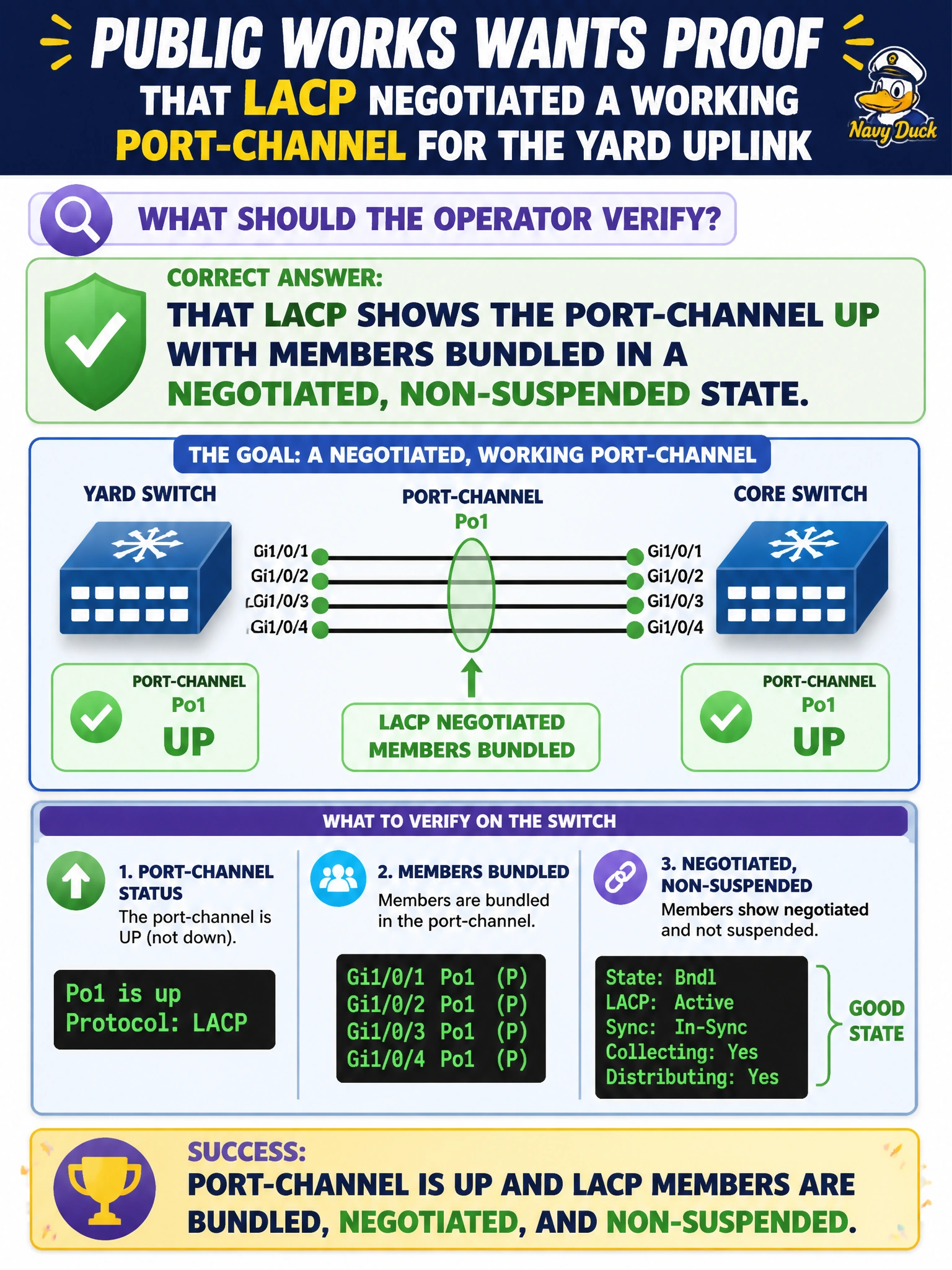
Public works wants proof that LACP negotiated a working port-channel for the yard uplink rather than leaving members suspended. What should the operator verify?
Select an answer to reveal the explanation.
Short Explanation
Don’t assume the duct tape stuck—check the channel. You want the port-channel up and the members happily bundled, not sitting in suspended limbo after a bad negotiation.
Full Explanation
Public works needs operational proof that LACP actually negotiated a working yard uplink: the port-channel should be up with member interfaces bundled in a negotiated, non-suspended state (for example, bundled in LACP current status rather than independent or suspended). That verification shows negotiation succeeded and traffic can use the logical channel, not merely that physical links have light.
Disabling CDP on every member is unrelated to LACP election of a ‘designated port’—designated port is an STP concept, and CDP is discovery, not the LACP bundling control plane. Unique native VLANs per member break trunk consistency and do not help LACP hash per VLAN; members of a Layer 2 channel must share trunk parameters. Enabling Spanning Tree root guard on both members before LACP starts is an STP protection topic, not the validation that LACP negotiated a healthy channel.
Exam caveat: a port-channel can exist while some members remain suspended due to mismatches. Always inspect member state, not only the port-channel interface up/down line protocol summary.
Operational check: use LACP/EtherChannel show commands to confirm channel up, members bundled and in sync, matching keys/modes, then pass test traffic and document the bundle state in the yard uplink acceptance checklist.