
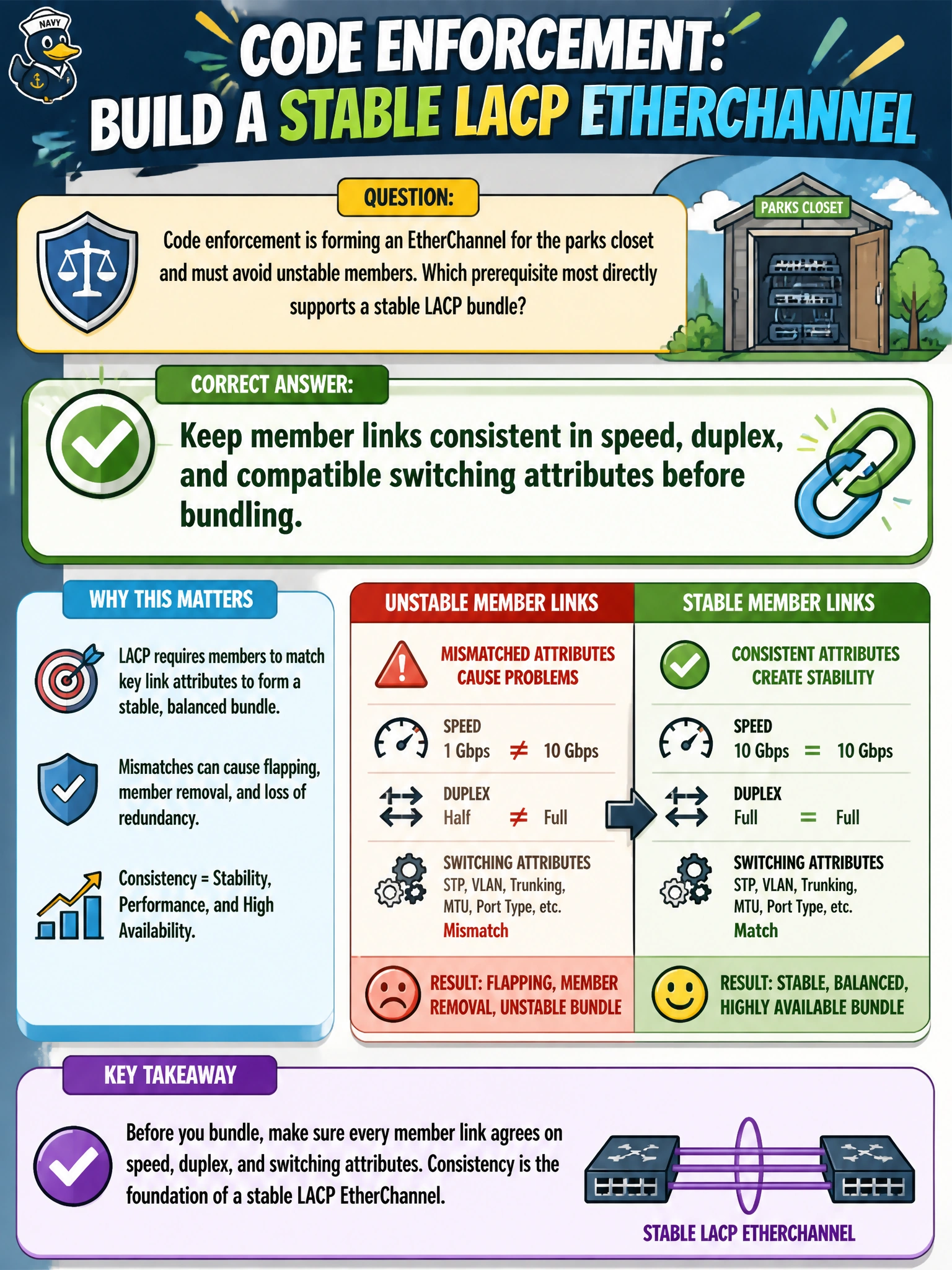
Code enforcement is forming an EtherChannel for the parks closet and must avoid unstable members. Which prerequisite most directly supports a stable LACP bundle?
Select an answer to reveal the explanation.
Short Explanation
Channels hate mismatched twins—one slow, one fast, one access, one trunk. Match speed, duplex, and port personality first, then let LACP glue them into one calm bundle.
Full Explanation
Stable LACP bundles for the parks closet depend on consistent member attributes before bundling. Speed, duplex, and compatible switching characteristics (same trunk/access mode, matching VLANs/native where Layer 2, compatible media and configuration) must align so LACP can negotiate members into the same port-channel. Inconsistent members are suspended or refuse to bundle, producing the unstable channel code enforcement is trying to avoid.
Mixing half-duplex copper with full-duplex fiber in one channel violates consistency and invites negotiation failure. Assigning each member a different speed so LACP ‘prefers the fastest’ is not how EtherChannel member eligibility works—mismatched speeds prevent proper bundling rather than creating a preferred-link design inside one channel. Placing one member in VLAN 10 access mode and the other in trunk mode inside the same channel is a classic misconfiguration that breaks channel consistency and VLAN behavior.
Exam caveat: consistency checks extend beyond speed/duplex to MTU, QoS/policy mismatches on some platforms, and identical EtherChannel mode settings. Passing LACP alone does not excuse mismatched Layer 2 trunk parameters on a Layer 2 channel.
Operational check: standardize member interface templates, verify identical speed/duplex and switchport settings, bring up LACP, confirm all intended members are bundled (not independent or suspended), and load-test before releasing the parks closet uplink to production.