
Animal control needs a bundled uplink between core Layer 3 devices that forwards routed municipal traffic rather than switching VLANs. Which EtherChannel type fits?
Select an answer to reveal the explanation.
Short Explanation
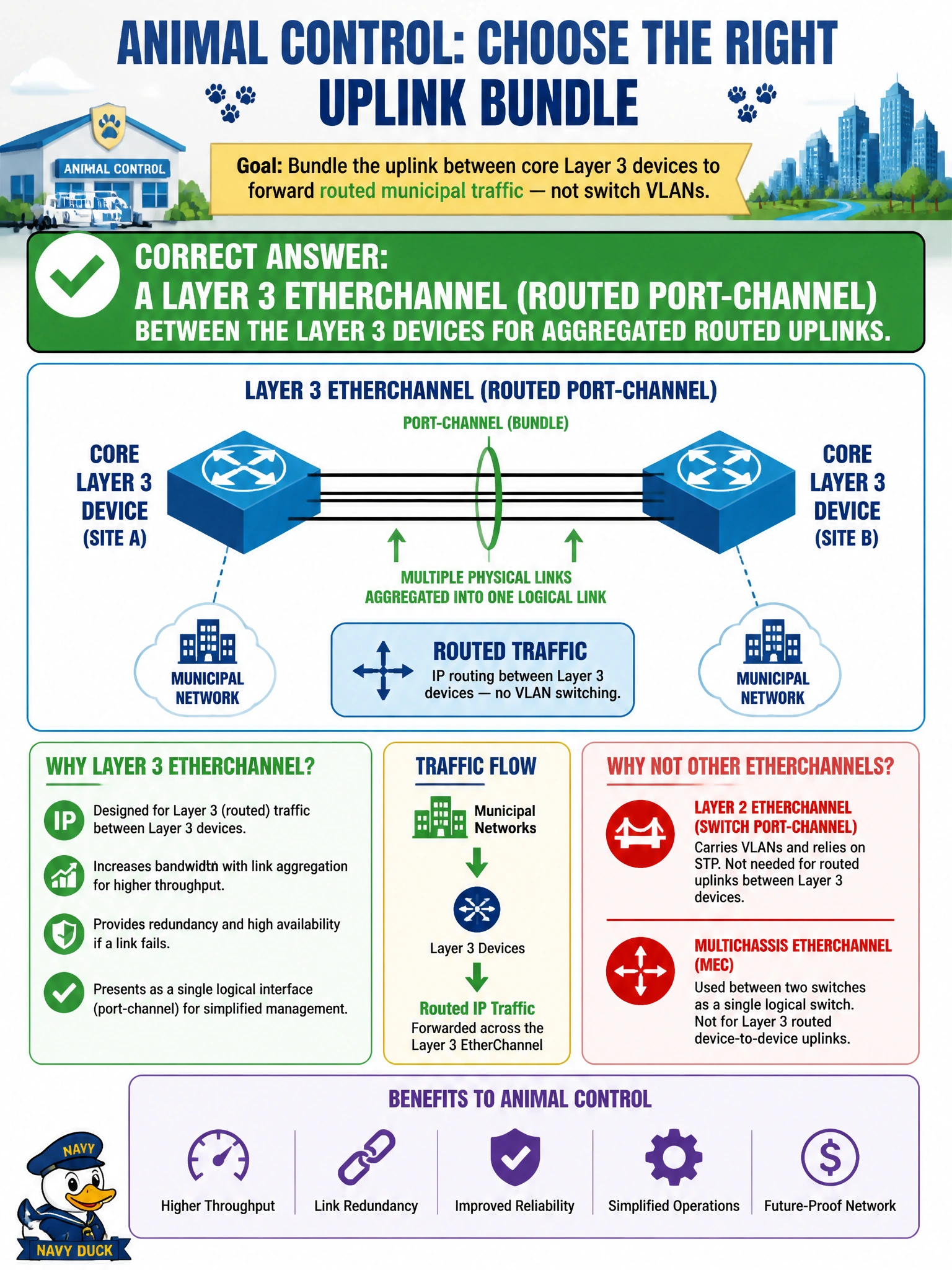
When your core devices are forwarding IP traffic rather than switching VLANs, you want a routed port-channel. It combines the member links into one logical routed interface for the municipal uplink.
Full Explanation
Animal control needs a Layer 3 EtherChannel—a routed port-channel with an IP address—to aggregate physical links between the Layer 3 devices for bandwidth and redundancy while forwarding routed municipal traffic. The logical interface carries routed traffic rather than switched VLANs, making it suitable for a core or distribution routed uplink. A Layer 2 trunk EtherChannel carrying municipal VLANs, even with a native VLAN reserved for management, switches VLAN traffic and does not meet the routed-uplink requirement; that design is appropriate when VLANs must be extended across the bundle. A Layer 2 trunk EtherChannel that relies on STP to block one member permanently defeats the purpose of aggregation: EtherChannel presents the members as one logical link, so STP does not block an individual member as a separate link. An autonomous AP CAPWAP tunnel bonded with LACP on a wireless SSID confuses a wireless overlay tunnel with a switch EtherChannel between Layer 3 devices. Exam caveat: Layer 2 trunk and Layer 3 routed EtherChannels solve different problems; choose based on whether the link must switch VLANs or route IP between Layer 3 nodes. Practical check: configure Layer 3 member interfaces in the routed port-channel, assign addressing and routing as designed, verify LACP members are active and routed reachability works over the channel, then test a member failure.