
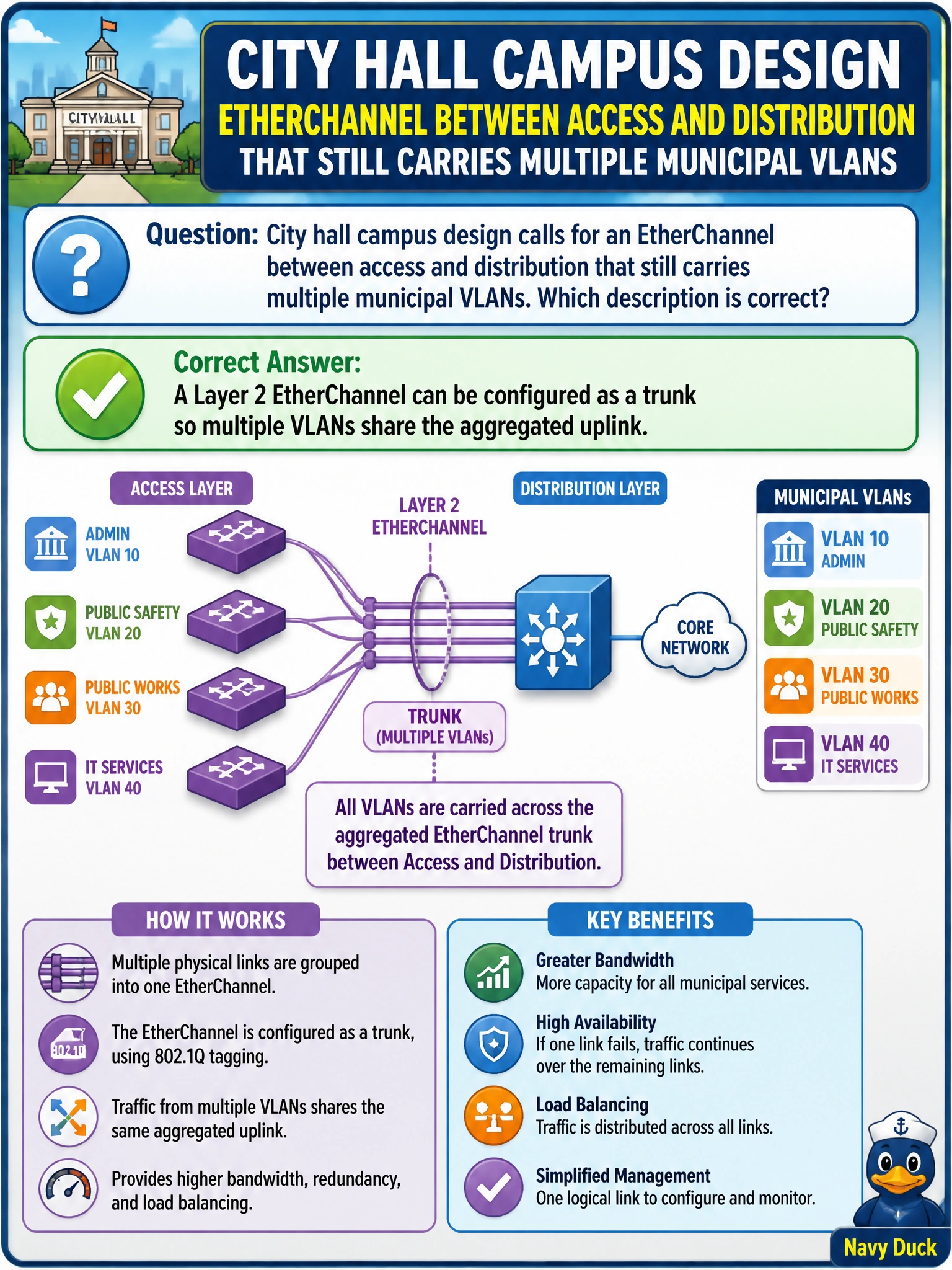
City hall campus design calls for an EtherChannel between access and distribution that still carries multiple municipal VLANs. Which description is correct?
Select an answer to reveal the explanation.
Short Explanation
Think of the port-channel as one fat trunk pipe built from several cables. Keep it Layer 2 and trunk it, and all those city VLANs ride the bundle together between access and distribution.
Full Explanation
City-hall campus uplinks between access and distribution commonly use a Layer 2 EtherChannel configured as a trunk. The port-channel interface (and consistently configured members) carry 802.1Q so multiple municipal VLANs share the aggregated uplink while LACP or static bundling provides more bandwidth and member failure resilience. Layer 2 EtherChannel and trunking are complementary: aggregation is about physical members; trunking is about VLAN tagging on that logical link.
Claiming Layer 2 EtherChannel cannot trunk and that each member must be a routed no-switchport interface confuses Layer 2 bundles with Layer 3 EtherChannels. Saying only Layer 3 EtherChannel can carry 802.1Q tags is false—tagged VLAN transport is a Layer 2 trunk function, while Layer 3 port-channels forward routed traffic without switching multiple VLANs across the channel as a trunk. Claiming EtherChannel replaces VLANs so trunk encapsulation is never configured mixes link aggregation with VLAN segmentation; you still configure trunking when multiple VLANs must cross the bundle.
Exam caveat: member interfaces must match the port-channel’s trunk/access mode, allowed VLANs, and native VLAN. Inconsistent members are a leading cause of suspended links or unstable channels.
Operational check: build the Layer 2 port-channel, set trunk encapsulation and allowed municipal VLANs on the port-channel, keep members consistent, verify LACP bundling, and confirm multiple VLANs pass after a member failure test.