
A school district IT team bundles two fiber uplinks with LACP so a single member failure should not drop the entire path. What outcome should they expect from a healthy EtherChannel?
Select an answer to reveal the explanation.
Short Explanation
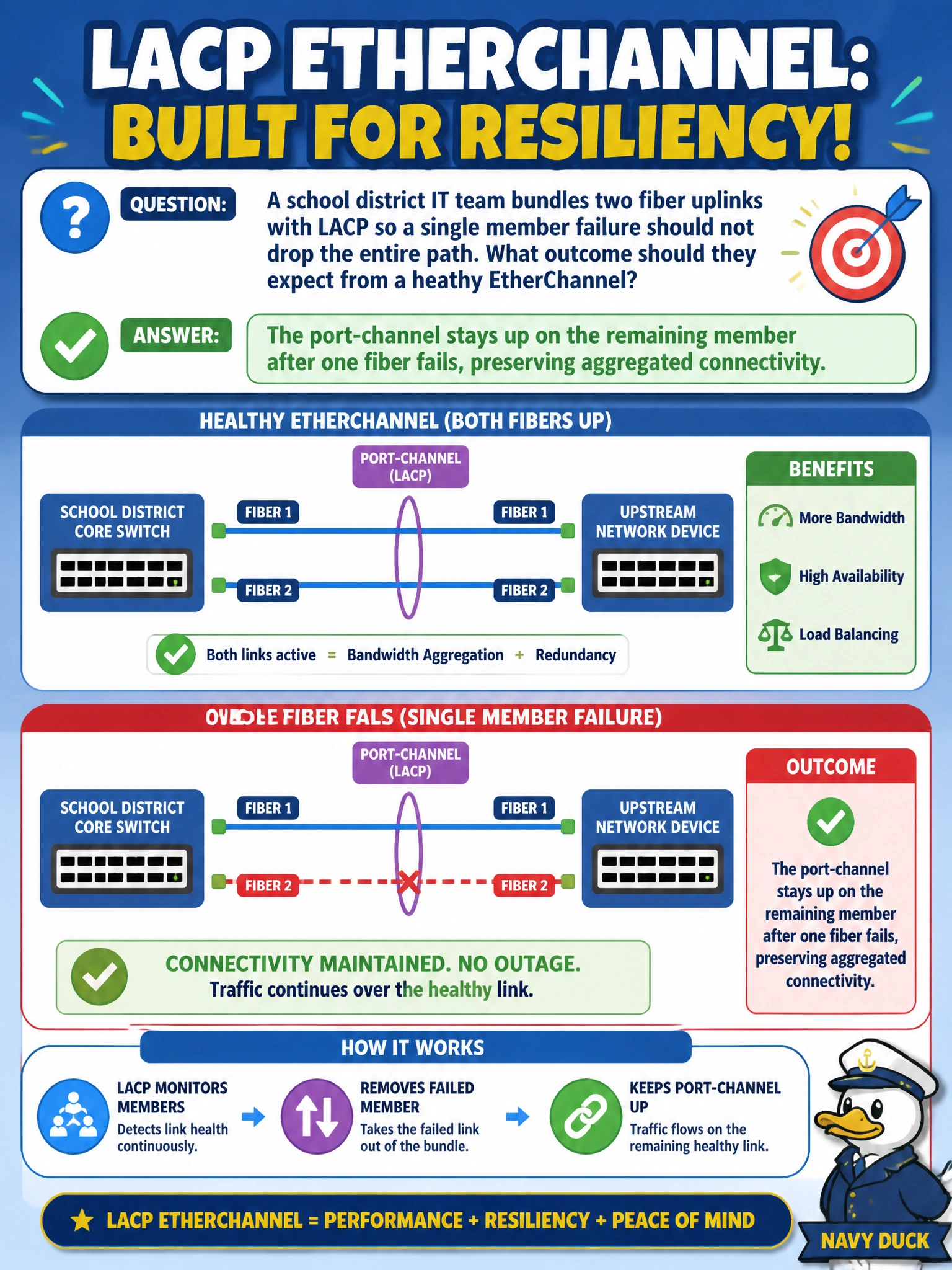
EtherChannel is duct-taping two uplinks into one logical pipe—with LACP watching the glue. Lose one fiber and the channel should keep forwarding on what’s left instead of black-holing the school.
Full Explanation
A healthy school-district LACP EtherChannel aggregates multiple physical fibers into one logical port-channel. When one member fails, remaining active members continue forwarding, so the port-channel stays up and aggregated connectivity is preserved—exactly the resilience goal of bundling two uplinks. Spanning Tree typically sees the channel as a single logical link, and LACP manages member health within that bundle rather than requiring both fibers to die before traffic can flow.
Requiring both members to fail before either fiber can carry traffic inverts EtherChannel redundancy: a proper channel is designed to survive partial member loss. Suspending the entire channel on a single CRC report is not standard healthy behavior; error thresholds and member suspension policies are more nuanced, and one bad frame does not inherently tear down a well-formed channel. EtherChannel does not convert members into VLAN-1-only access ports; members inherit the port-channel’s switching mode (often trunk) and carry the configured VLANs across the bundle.
Exam caveat: ‘channel stays up on remaining members’ assumes the bundle still meets minimum-links or platform requirements. If min-links is set higher than the surviving count, the port-channel can go down even though one fiber remains.
Operational check: verify LACP members are bundled and in sync before failure testing, pull one fiber in a maintenance window, confirm the port-channel remains up and traffic continues, check counters and logs for the failed member, and restore the fiber while watching rebundling.