
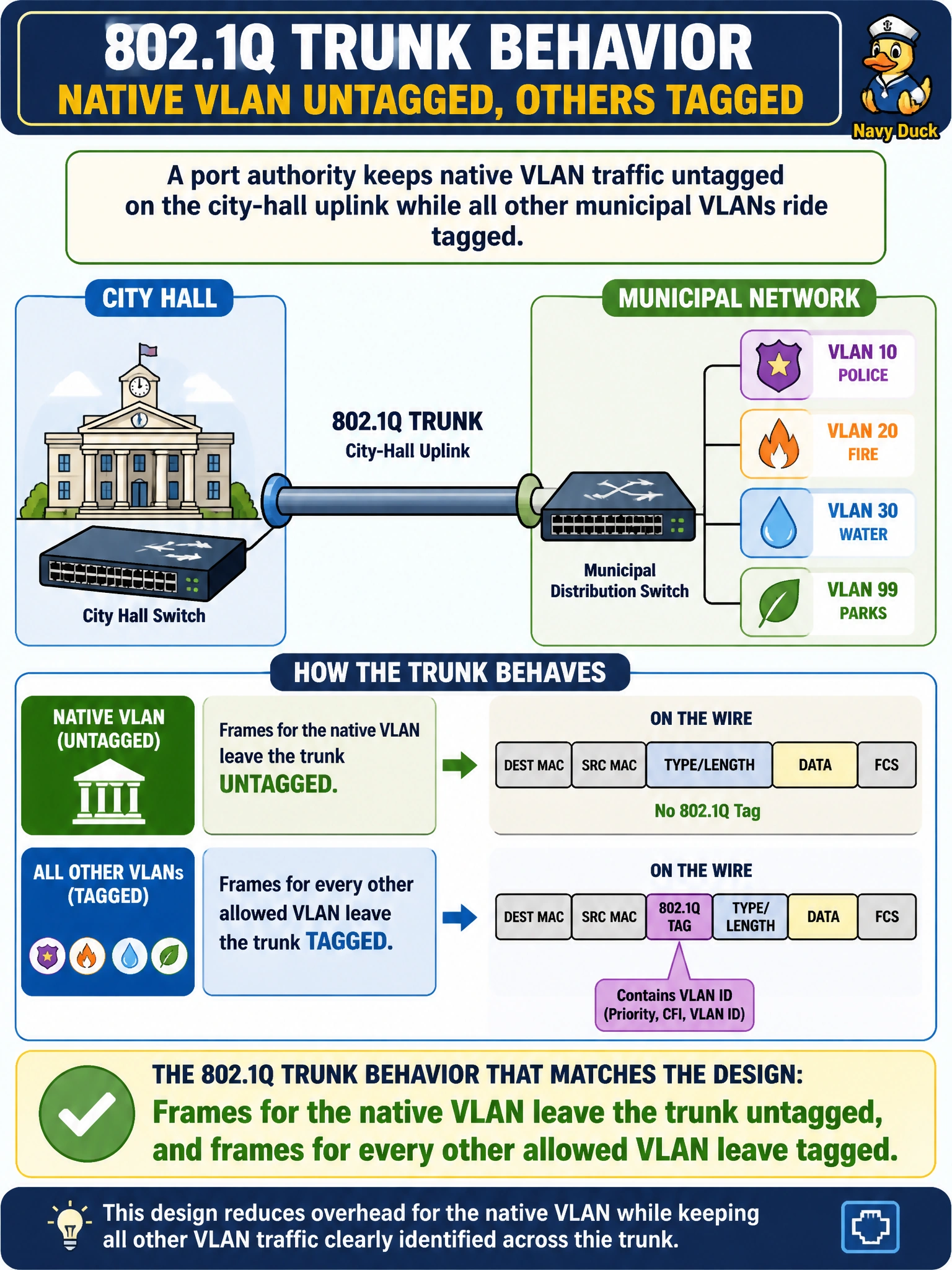
A port authority keeps native VLAN traffic untagged on the city-hall uplink while all other municipal VLANs ride tagged. Which 802.1Q trunk behavior matches that design?
Select an answer to reveal the explanation.
Short Explanation
Think of the native VLAN as the unlabeled box on a shipping pallet—everything else gets a barcode sticker. On an 802.1Q trunk, that unlabeled traffic is the native VLAN; the rest go out tagged so the far switch knows which VLAN they belong to.
Full Explanation
On a port-authority 802.1Q trunk toward city hall, the native VLAN is the one VLAN whose frames leave the uplink untagged while every other allowed municipal VLAN carries an 802.1Q tag. That is the standard IEEE 802.1Q behavior the stem describes: untagged native traffic plus tagged non-native traffic sharing one physical link. Both ends must agree on the same native VLAN ID so each switch maps untagged frames into the same broadcast domain. When that agreement holds, civic traffic on the dedicated native VLAN and tagged department VLANs coexist correctly on the trunk.
Claiming every VLAN including the native must be tagged confuses 802.1Q with optional tagging modes or QinQ-style designs; classic 802.1Q native traffic is untagged by definition. Saying only voice VLANs can be untagged invents a rule that does not exist—native VLAN selection is a trunk configuration choice, not a voice-only privilege, and data VLANs are commonly tagged on trunks. Double-tagging native frames misstates normal trunk behavior and describes an attack or provider tunneling pattern, not how a correctly configured municipal trunk forwards native traffic.
Exam caveat: native VLAN mismatch between trunk ends is a frequent CCNA trap. Untagged frames still arrive, but each switch assigns them to a different VLAN, which can create unexpected bridging and security exposure even though the link shows up/up.
Operational check: on both trunk ends verify matching native VLAN IDs, confirm allowed VLAN lists include the intended municipal VLANs, capture or monitor that non-native frames are tagged, and document which civic VLAN is native so future moves do not silently reintroduce VLAN 1 as the unlabeled path.