
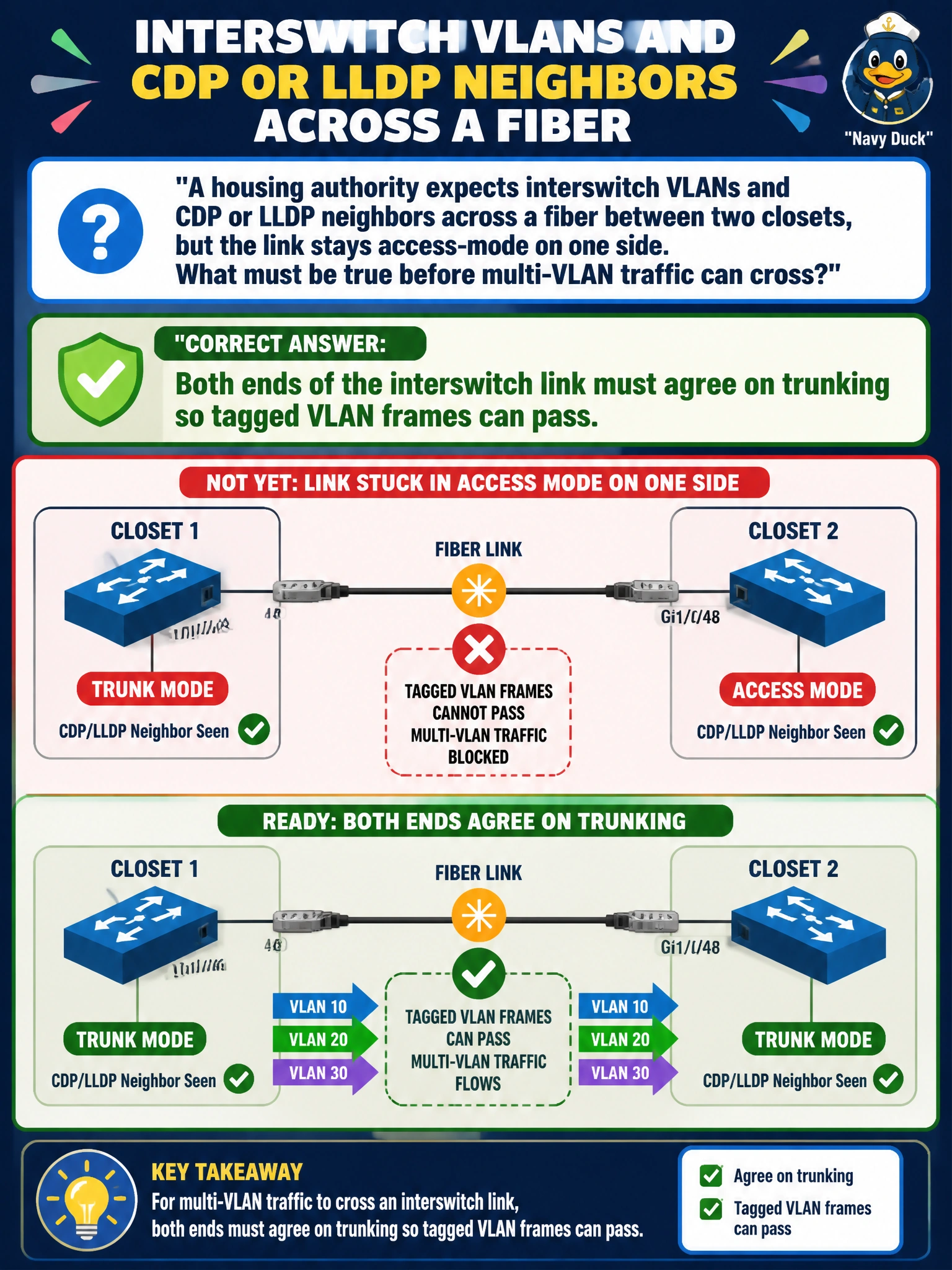
A housing authority expects interswitch VLANs and CDP or LLDP neighbors across a fiber between two closets, but the link stays access-mode on one side. What must be true before multi-VLAN traffic can cross?
Select an answer to reveal the explanation.
Short Explanation
A trunk is a two-way handshake of expectations—if one end tags and the other only speaks single-VLAN access, the conversation falls apart. Get both sides into trunk mode (and matching allowed/native settings) before you chase CDP ghosts.
Full Explanation
For the housing-authority fiber between closets, multi-VLAN traffic crosses only when both ends of the interswitch link operate as trunks that agree on encapsulation and allowed VLANs. An access-mode interface on one side accepts a single untagged VLAN and does not correctly process the peer’s tagged frames for additional VLANs, so interswitch VLAN extension fails even if the fiber light is good. CDP or LLDP may still report a neighbor because discovery rides the physical link; discovery does not create trunk agreement. Both sides must be trunks before tagged municipal VLANs can pass between buildings.
The claim that only one switch needs trunking because the far end learns VLANs from CDP fails conceptually: CDP advertises identity and capabilities, it does not provision 802.1Q encapsulation or allowed VLAN lists. Access mode with a matching native VLAN 1 still leaves one side single-VLAN; matching VLAN 1 does not turn an access port into a multi-VLAN trunk. LLDP alone cannot force trunk mode—trunking is an interface operational mode (static or negotiated DTP where used), not a side effect of neighbor discovery.
Exam caveat: a link that shows a CDP/LLDP neighbor yet fails multi-VLAN traffic is a classic symptom of access-versus-trunk mismatch. Do not treat neighbor presence as proof that trunks are correctly formed.
Operational check: compare switchport mode and trunk status on both ends, verify encapsulation and native/allowed VLANs match, confirm the port-channel or physical members are trunking if bundled, and retest a tagged VLAN that exists on both switches after correcting the access-side misconfiguration.