
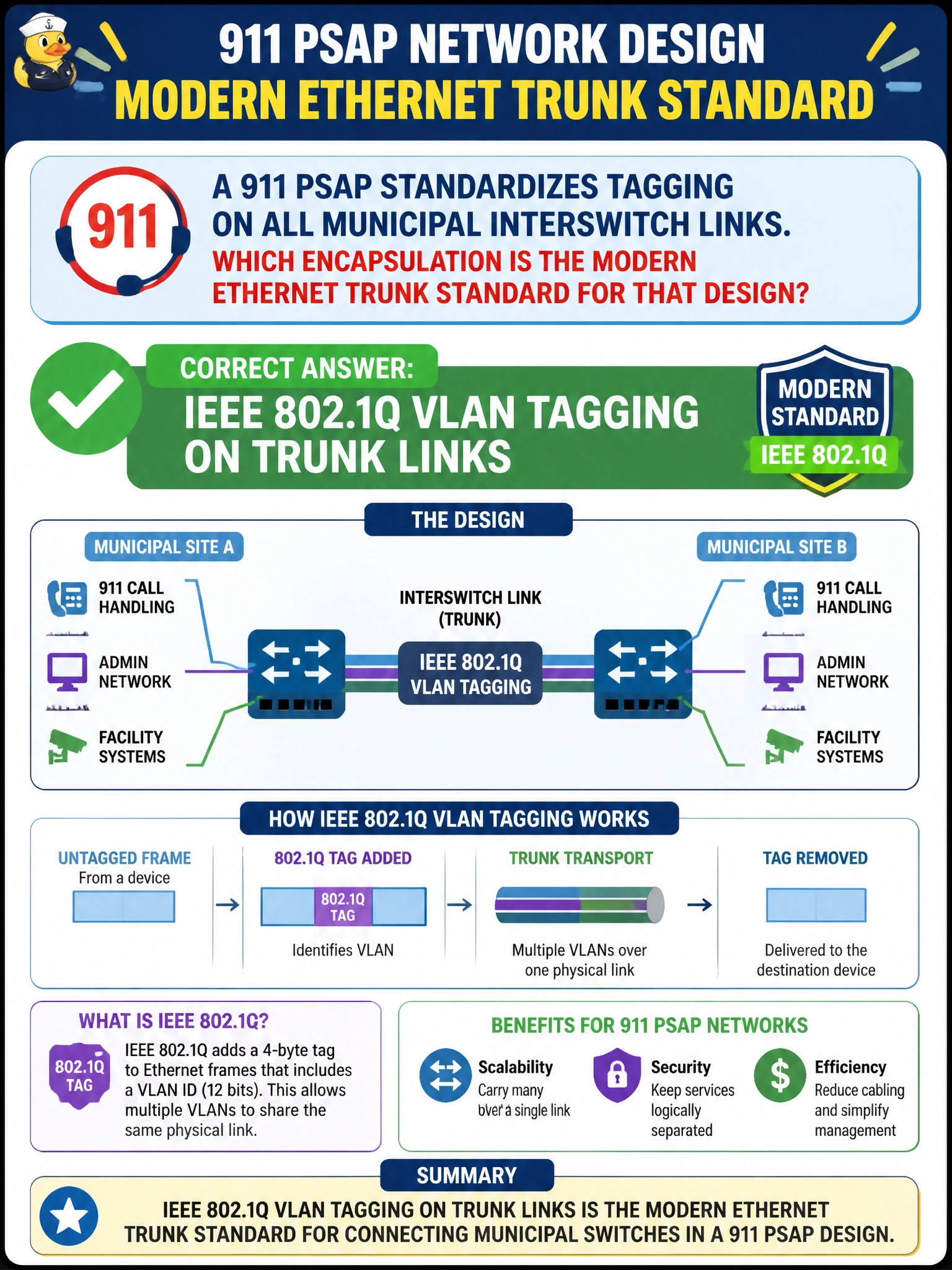
A 911 PSAP standardizes tagging on all municipal interswitch links. Which encapsulation is the modern Ethernet trunk standard for that design?
Select an answer to reveal the explanation.
Short Explanation
802.1Q is the sticky label language everyone speaks on modern trunks. Put the VLAN ID in the tag and the next switch knows which lane the frame belongs to. ISL is the old proprietary story; 802.1Q is the standard for municipal uplinks.
Full Explanation
IEEE 802.1Q is the modern Ethernet trunk standard that inserts a VLAN tag so a 911 PSAP can carry multiple municipal VLANs across interswitch links with interoperable tagging. Standardizing on 802.1Q gives consistent native/tagged behavior, broad multi-vendor support, and the VLAN ID field switches use to keep departments separated on shared fiber or copper uplinks. For contemporary campus designs, 802.1Q is the expected encapsulation answer—not legacy proprietary trunking. That recognition is a core CCNA interswitch topic. ISL as the only encapsulation permitted on Cisco and non-Cisco mixes is outdated and incorrect for mixed environments; ISL is legacy Cisco-proprietary and not the modern standard. HDLC bridged framing with no VLAN field belongs to serial/WAN contexts and does not provide Ethernet VLAN tagging for campus trunks. PPPoE session tags negotiated per MAC on every access port are broadband/session mechanisms, not the municipal interswitch VLAN trunk standard. Exam caveat: if a question contrasts ISL versus 802.1Q, pick 802.1Q for current Ethernet trunks. Operational check: confirm both ends of each PSAP trunk use 802.1Q, matching native VLAN and allowed lists, and validate tagged departmental VLANs forward while reviewing that no side is still negotiating obsolete ISL.