
A municipal hospital campus sees risk when native VLAN IDs differ at each end of a trunk. What is the concern with that native VLAN mismatch?
Select an answer to reveal the explanation.
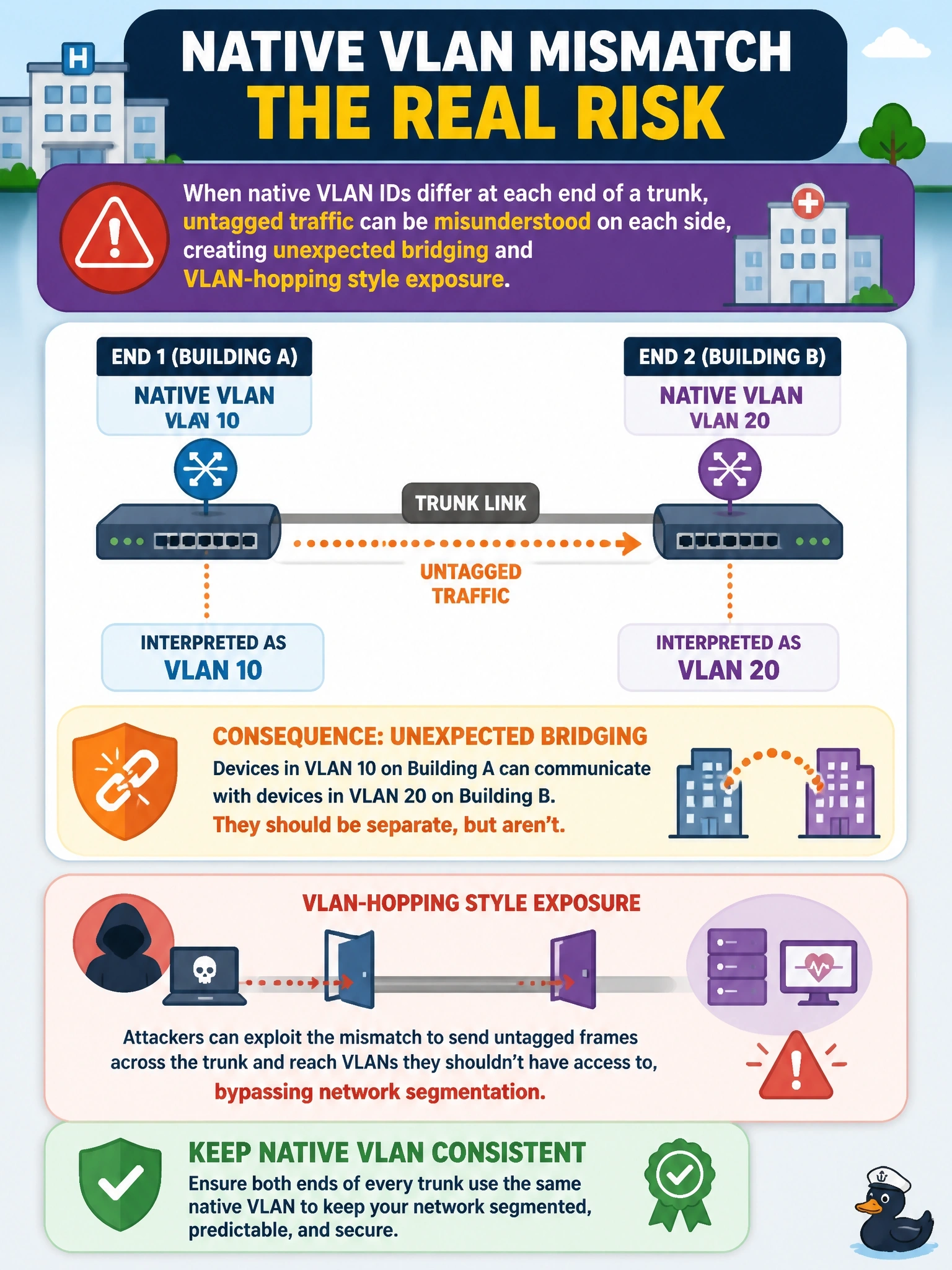
Short Explanation
Native VLAN is the untagged lane, so if each end thinks that lane is a different department, frames walk into the wrong office. You'll create unexpected bridging and VLAN-hopping style exposure when untagged traffic is misunderstood. Match natives on purpose, preferably off VLAN 1.
Full Explanation
On 802.1Q trunks, native VLAN traffic is untagged; if a municipal hospital configures different native VLAN IDs on each end, each switch interprets untagged frames as belonging to a different VLAN. That mismatch can bridge traffic unexpectedly between domains and is classically discussed as a VLAN-hopping style exposure when attackers or mispatches inject untagged frames. The operational concern is therefore misunderstood untagged traffic and inconsistent bridging. Matching native VLANs on both ends (preferably a dedicated unused VLAN, not VLAN 1) closes the gap. The claim that OSPFv2 automatically forms full adjacencies on every access VLAN when natives differ invents a Layer 3 control-plane side effect that native mismatch does not cause; OSPF adjacency rules are separate from trunk native VLAN alignment. The claim that the trunk stops forwarding all tagged VLANs and permanently converts to an access port overstates failure modes—tagged VLANs may still forward while untagged handling is wrong. The claim that EtherChannel LACP priorities reset to zero until both natives equal VLAN 1 confuses link aggregation timers/priorities with native VLAN configuration. Exam caveat: native VLAN mismatch is a security and connectivity foot-gun; double-tagging hopping discussions assume inconsistent or default native handling—keep natives matched and non-user. Operational check: show interfaces trunk on both hospital ends and confirm Native VLAN matches; set a dedicated unused native VLAN consistently, prune it from access user ports, and retest untagged and tagged forwarding after the change.