
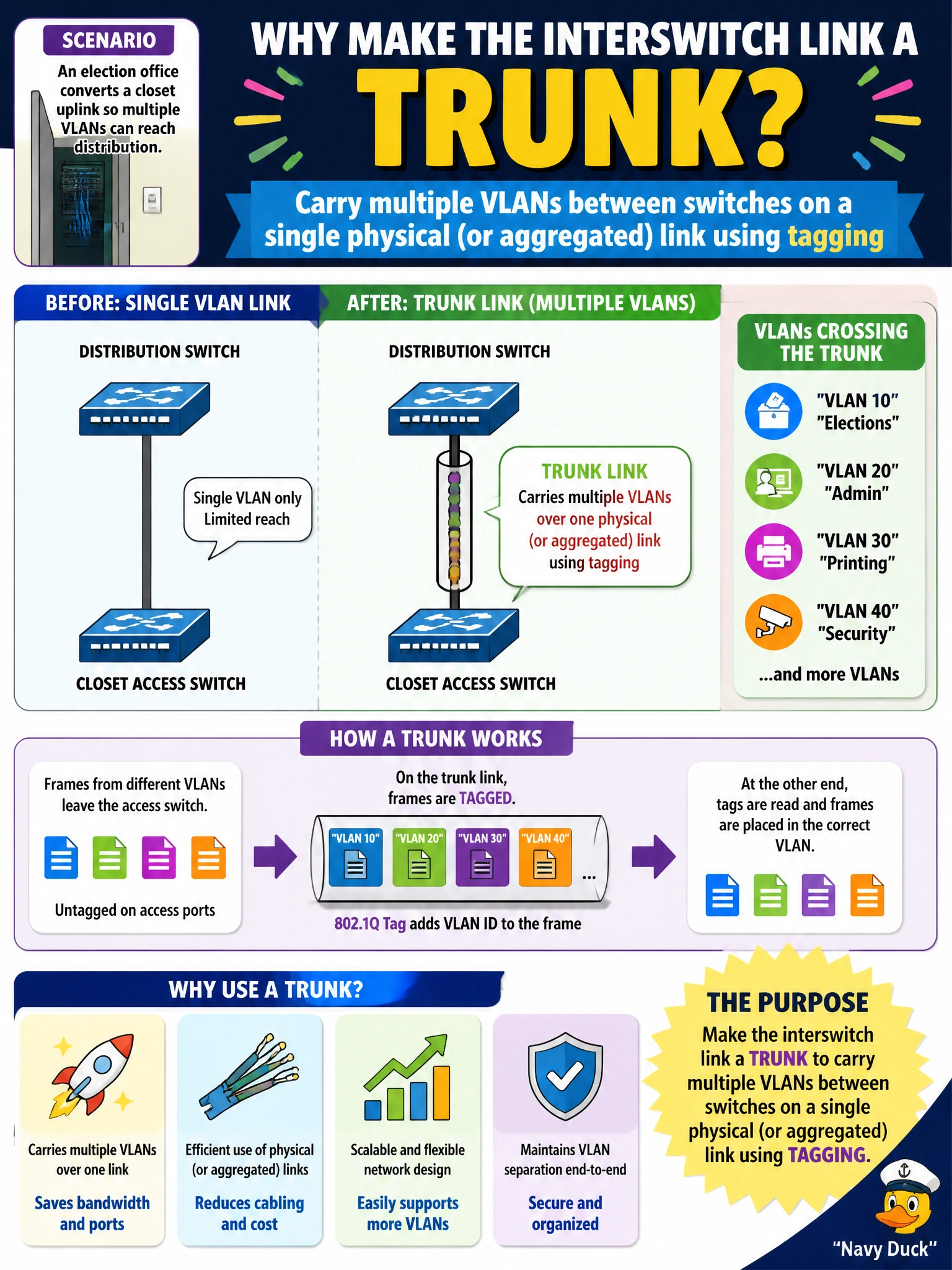
An election office converts a closet uplink so multiple VLANs can reach distribution. What is the purpose of making that interswitch link a trunk?
Select an answer to reveal the explanation.
Short Explanation
A trunk is a multi-lane highway between closets—many VLANs share one uplink with tags keeping the lanes straight. Access ports are single-lane driveways to desks. When election VLANs must all reach distribution, trunk the uplink.
Full Explanation
Making the election-office closet uplink a trunk exists to carry multiple VLANs between switches on a single physical or aggregated link using tagging (802.1Q). Without trunking, each VLAN would need its own interswitch cable or would stop at the closet boundary; with trunking, several departmental election VLANs share the uplink while tags preserve separation toward distribution. That is the purpose of interswitch trunks in campus Network Access design. Access ports remain the one-VLAN edge toward end hosts; trunks are the multi-VLAN highway between switches. Forcing every VLAN into access mode so only one MAC can use the uplink contradicts multi-VLAN transport and misunderstands access versus trunk roles. Replacing Spanning Tree with static host routes on access switches mixes L2 loop prevention with L3 host routing and is not why uplinks are trunked. Converting the uplink into a Layer 3 EtherChannel that ignores VLAN tags describes routed port-channels, which intentionally do not carry L2 VLANs the way a trunk does. Exam caveat: EtherChannel can be Layer 2 trunked or Layer 3 routed—tagging multiple VLANs requires the L2 trunk form. Operational check: set the uplink to trunk, allow the election VLANs, confirm both ends agree on encapsulation/mode, and verify multiple VLAN IDs show as active on the trunk before election-day load arrives.