
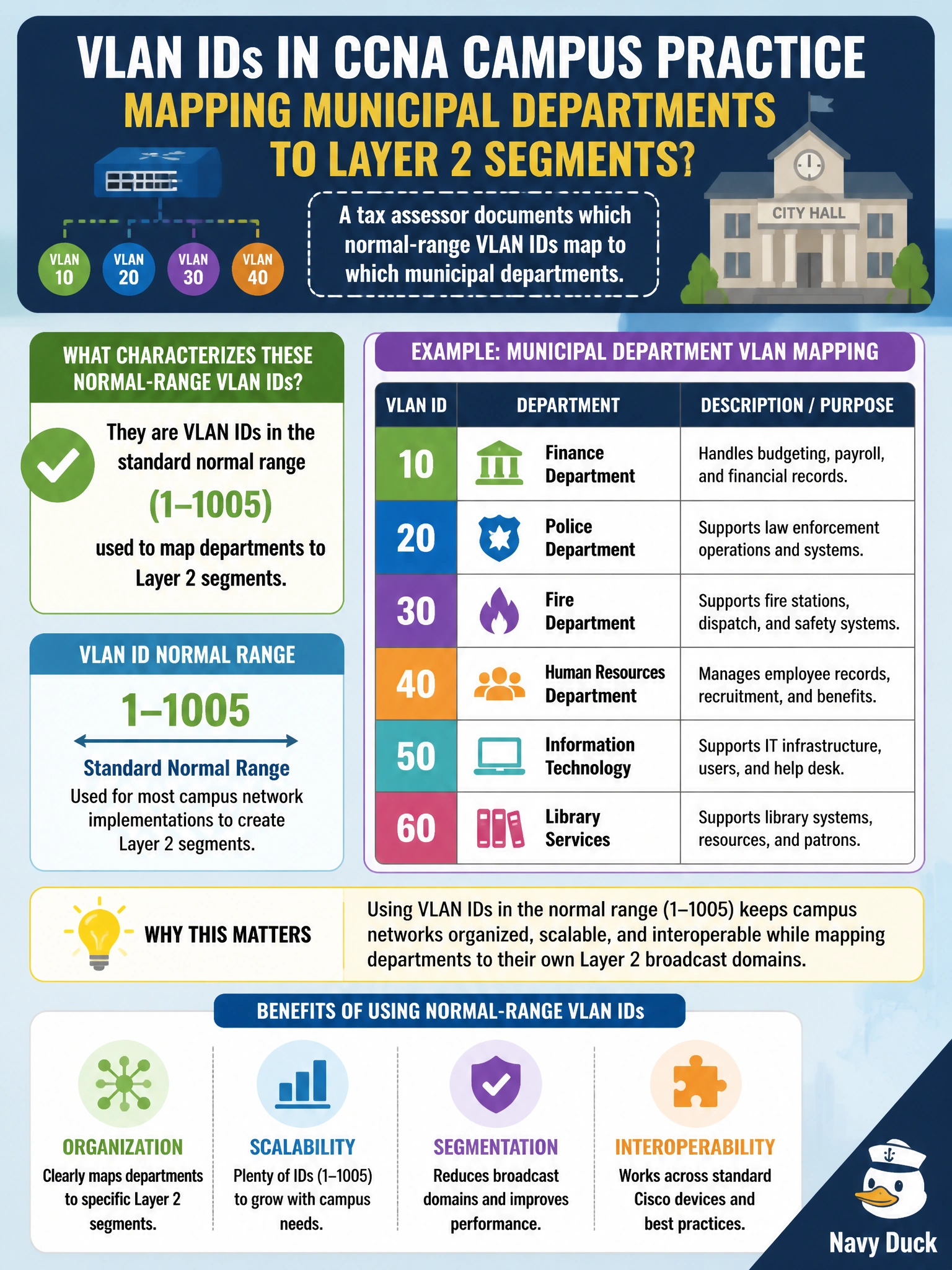
A tax assessor documents which normal-range VLAN IDs map to which municipal departments. What characterizes those normal-range VLAN IDs in CCNA campus practice?
Select an answer to reveal the explanation.
Short Explanation
Normal-range VLAN IDs are the everyday department numbers on the campus switch—think desks and printers, not exotic extended-only tricks. Document which ID belongs to assessors, clerks, and guests so humans can follow the map. It is inventory discipline for standard VLAN space.
Full Explanation
In CCNA campus practice, normal-range VLAN IDs are the standard identifiers—commonly 1 through 1005 on Cisco switches—used to map municipal departments to Layer 2 segments for desks, printers, and similar access roles. The tax assessor’s documentation exercise is operational inventory: which ID belongs to which department so humans and automation agree on segmentation. Extended-range VLANs exist for larger designs, but “normal-range” specifically points at that everyday standard space used across Ethernet access switches. Knowing the range and its departmental mapping use is the fundamentals point. Restricting them to only even numbers between 2000 and 4094 reserved for voice misstates both the normal range and voice VLAN practice. Claiming they exist solely on wireless controllers and cannot be used on Ethernet switches is false—normal-range VLANs are core Ethernet switch constructs. Requiring every VLAN ID to equal the switch management VRF ID to be “normal-range” confuses VRF routing virtualization with VLAN ID numbering. Exam caveat: remember normal vs extended ranges; extended (1006–4094) availability can depend on VTP/config mode, but normal-range departmental use is the baseline story. Operational check: maintain a living VLAN plan that lists normal-range IDs to departments, verify those IDs exist on access and distribution switches, and audit for undocumented IDs or leftover default-VLAN user assignments in assessor closets.