
Stormwater sees inter-VLAN traffic fail until an SVI or router-on-a-stick comes online. What does that outage demonstrate?
Select an answer to reveal the explanation.
Short Explanation
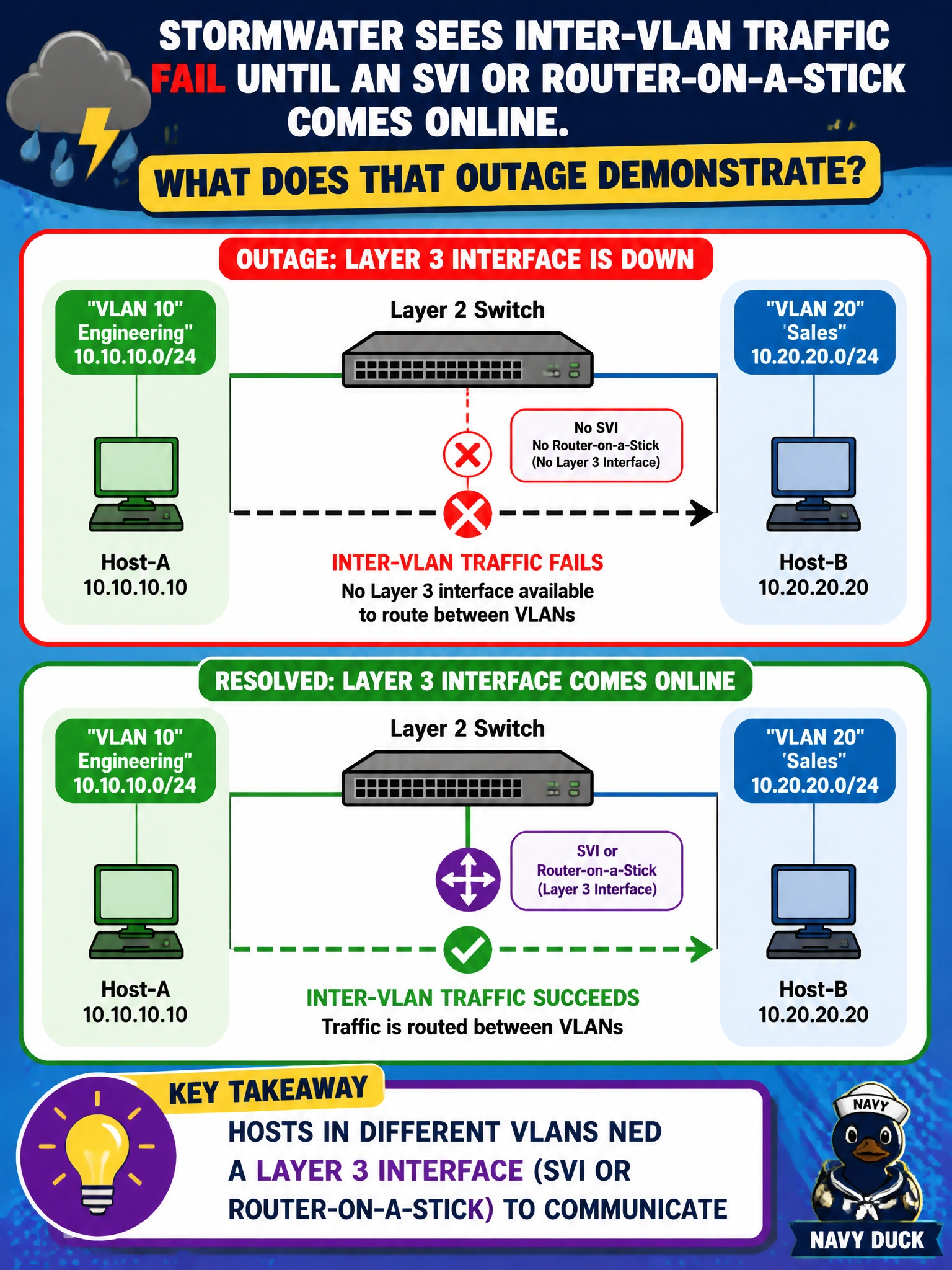
Two VLANs without a router is two islands with no ferry. Turn up an SVI or router-on-a-stick and the ferry starts running. Trunks carry the VLANs; Layer 3 actually forwards between them.
Full Explanation
Stormwater’s outage—inter-VLAN traffic failing until an SVI or router-on-a-stick comes online—demonstrates that hosts in different VLANs need a Layer 3 interface to communicate. Trunks can deliver multiple VLANs between switches, and switching within each VLAN can look healthy, yet packets still cannot move between subnets without a router function. Bringing up the SVI or router subinterfaces restores the gateway path and inter-VLAN forwarding. That dependency is the classic inter-VLAN routing lesson for municipal campuses. Trunks alone always routing between VLANs without any Layer 3 interface is the misconception the symptom disproves. Disabling MAC address aging before any VLAN can forward frames invents a nonexistent prerequisite; aging is unrelated to inter-VLAN routing. Requiring identical gateway MAC addresses burned into flash for both VLANs is mythology—each SVI has its own MAC, and identical burned values are not the design rule. Exam caveat: distinguish “VLAN carried on a trunk” from “VLAN routed”—the first is L2 transport; the second needs L3. Operational check: when inter-VLAN fails, check SVI/admin status and IP on each VLAN interface, confirm hosts’ default gateways, verify routing between SVIs, and only then dig into trunks; bringing the L3 interface up should correlate with restored stormwater cross-VLAN flows.