
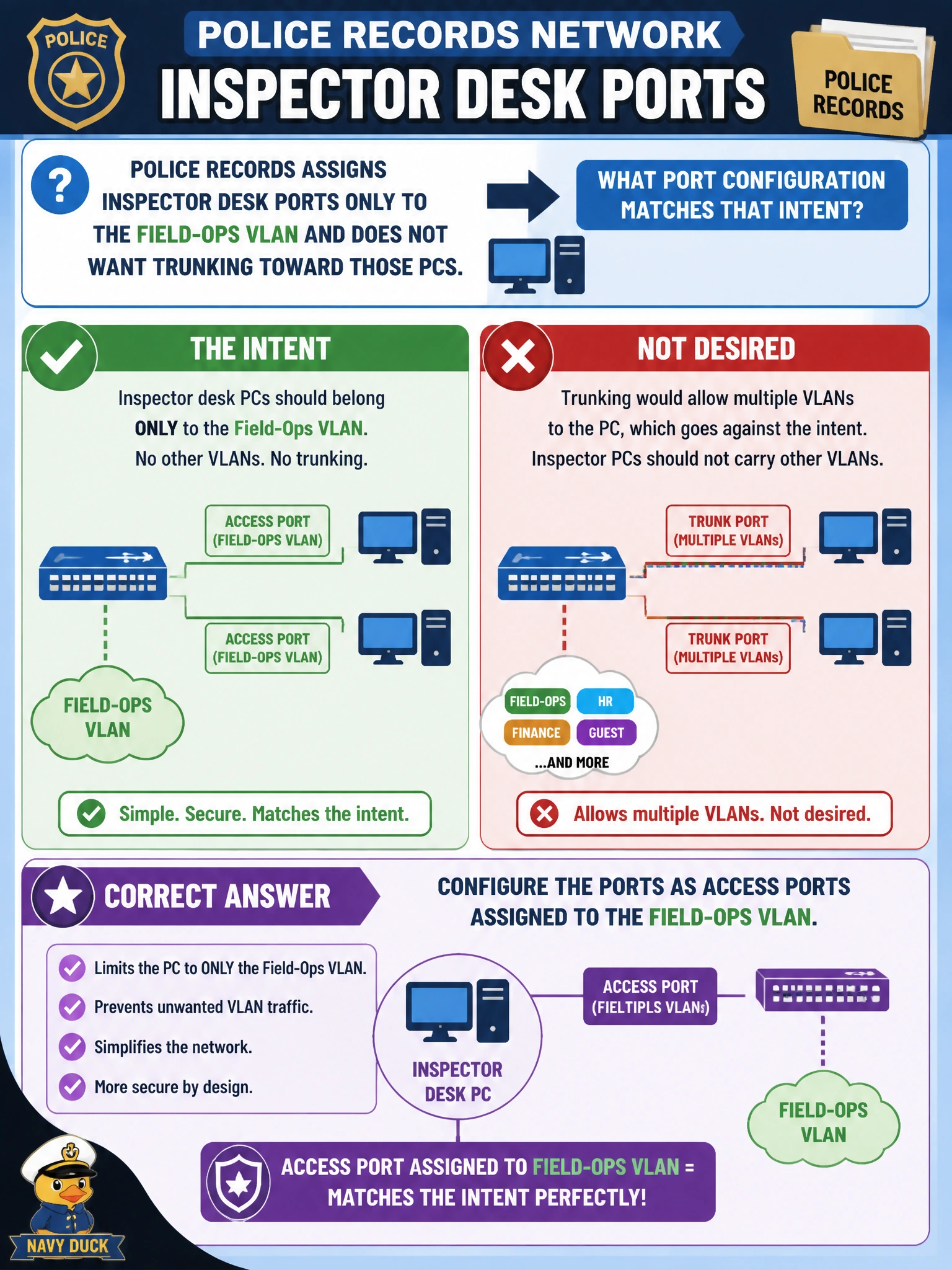
Police records assigns inspector desk ports only to the field-ops VLAN and does not want trunking toward those PCs. What port configuration matches that intent?
Select an answer to reveal the explanation.
Short Explanation
Desk PCs get a single membership badge—an access port stuck in the field-ops VLAN. No trunk carnival of tags toward a regular workstation. Keep the edge simple: access VLAN, done.
Full Explanation
Police records’ intent—inspector desks only in the field-ops VLAN with no trunking toward those PCs—matches access-port configuration: switchport mode access and switchport access vlan <field-ops>. An access port presents a single untagged VLAN membership to the endpoint, which is the correct least-privilege edge for ordinary workstations that do not need to carry multiple tagged municipal VLANs. Keeping the edge simple reduces misconfiguration risk and prevents a compromised PC from seeing trunked VLANs it should never touch. That pattern is standard Network Access design for civic desks. Configuring the ports as trunks that allow VLANs 1–4094 toward each inspector PC violates the no-trunking intent and massively widens Layer 2 exposure. Routed no-switchport interfaces with secondary addresses only turn the edge into Layer 3 ports, which is a different design and not “access VLAN assignment” for PC switching. SPAN destination configuration mirrors traffic for analysis; it does not assign inspectors to field-ops for normal data access and would disrupt ordinary connectivity if used as the desk mode. Exam caveat: access versus trunk is an edge-intent question—match the port mode to whether the connected device should see one VLAN or many. Operational check: verify mode access and the field-ops VLAN on each inspector port, confirm no voice/trunk extras unless required, and check that show interfaces switchport reports operational access mode with the expected VLAN.