
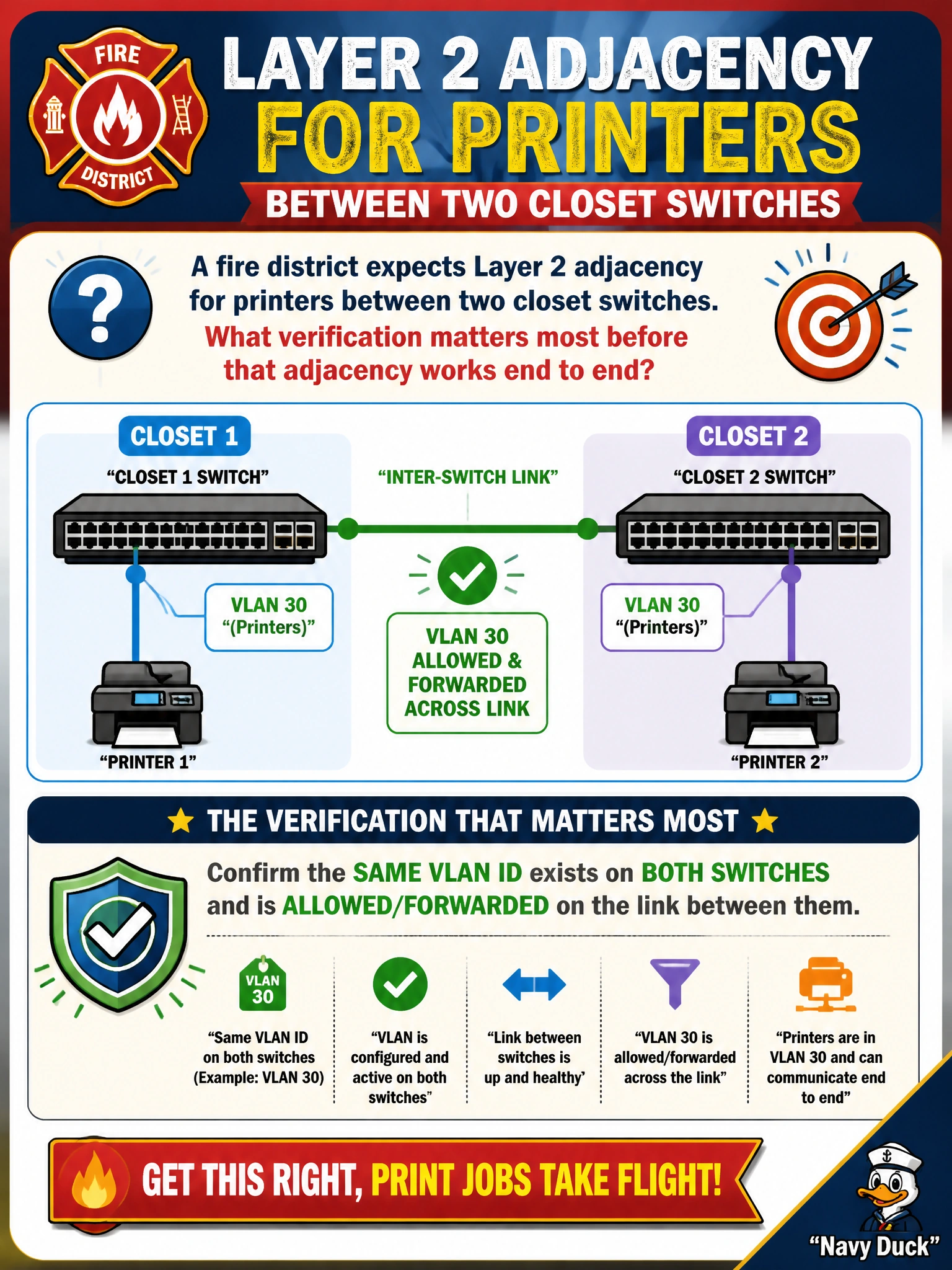
A fire district expects Layer 2 adjacency for printers between two closet switches. What verification matters most before that adjacency works end to end?
Select an answer to reveal the explanation.
Short Explanation
If one closet calls it VLAN 50 and the other never created VLAN 50, the printers are on islands. Same VLAN ID on both switches, carried on the uplink—that is the checklist. Names can differ; the ID and the path cannot be imaginary.
Full Explanation
Layer 2 adjacency for fire-district printers between two closet switches depends first on VLAN continuity: the same VLAN ID must exist on both switches and must be allowed/forwarded on the link between them (almost always a trunk). If one closet never created the VLAN or the uplink prunes it, printers remain local-only even though cabling looks fine. Verification therefore prioritizes VLAN database consistency and trunk allow lists before chasing exotic protocol settings. Names may differ; the numeric ID and the forwarding path must align. Mismatched VLAN names that somehow hash to the same STP priority are irrelevant theater—STP priority does not synchronize VLAN IDs, and name strings are not the membership key. Giving each printer a unique OSPF process ID matching its closet number invents a Layer 3 control-plane requirement for a Layer 2 adjacency problem. Disabling DHCP snooping globally so VLAN IDs can synchronize is false: DHCP snooping is a security feature and does not distribute VLAN IDs between switches. Exam caveat: VTP or manual config may create the VLAN, but the exam still expects you to verify the ID exists and is allowed on the interswitch link. Operational check: show vlan brief on both closets, show interfaces trunk (or equivalent) for allowed VLANs, confirm the printers’ access ports are in that ID, then test ARP/connectivity across closets before declaring Layer 2 adjacency healthy.