
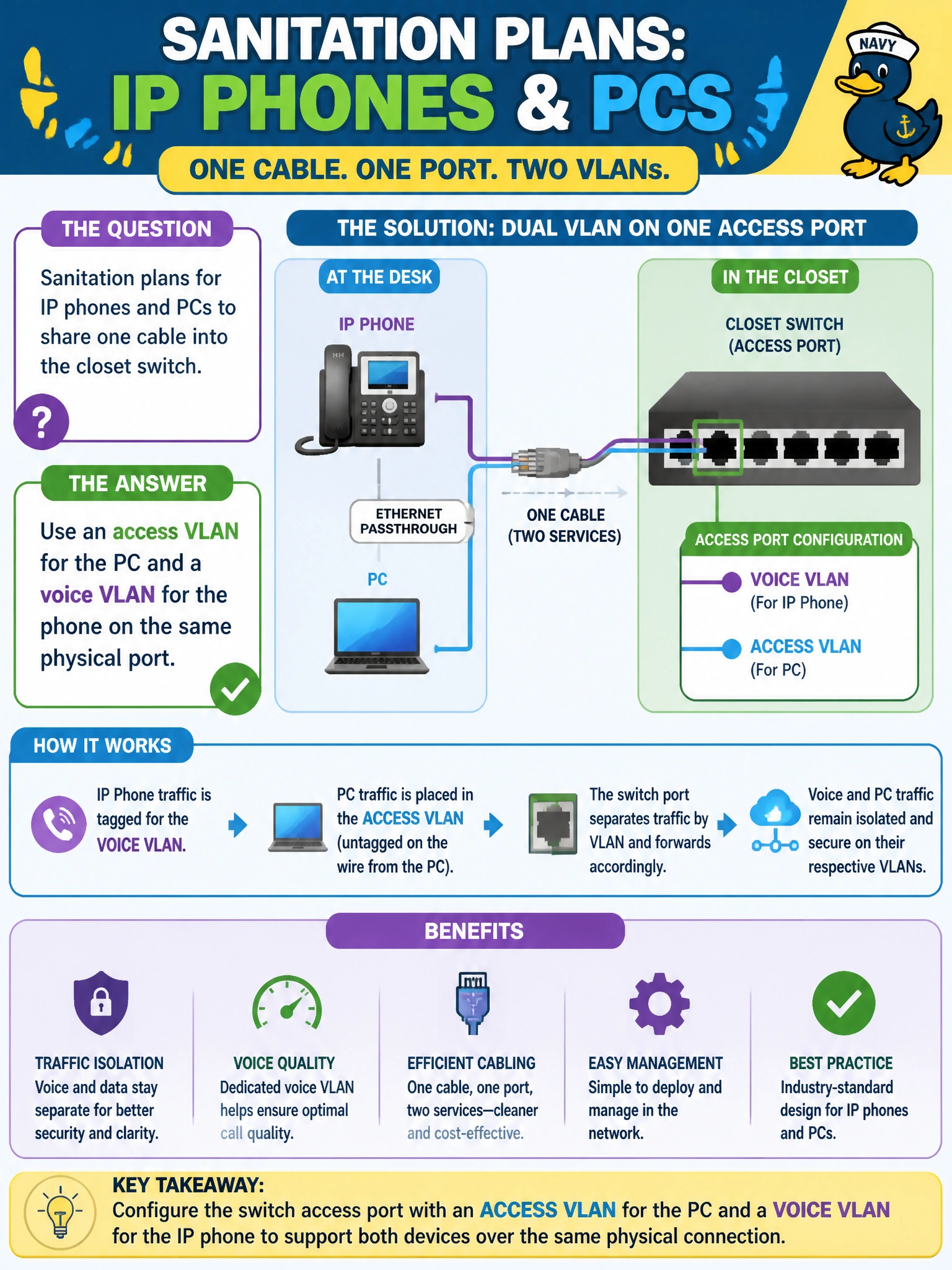
Sanitation plans for IP phones and PCs to share one cable into the closet switch. Which VLAN design supports that coexistence on the access port?
Select an answer to reveal the explanation.
Short Explanation
You can carry two conversations over the same patch cord: the PC uses the access VLAN, and the phone uses the voice VLAN. This shared-port design avoids a second desk drop while keeping voice and data separate; disabling VLANs or requiring separate ports makes the installation harder.
Full Explanation
Sanitation’s one-cable phone-plus-PC design uses an access VLAN for the PC and a voice VLAN for the phone on the same physical access port. The PC remains in the data access VLAN while the phone tags into the voice VLAN, allowing shared copper without merging voice and data into one broadcast domain. This is the standard access/voice VLAN pattern when dual drops are unavailable. Power may still come from PoE, but the VLAN design is dual-VLAN membership on one access port. Using only a native VLAN trunk, with no access VLAN or voice VLAN configured, abandons the intended access-plus-voice model and leaves the phone and PC without the required VLAN assignments. Requiring separate switch ports rejects the shared-cable requirement; one access port can support both devices with the appropriate VLAN configuration. Disabling VLANs entirely collapses segmentation and is the opposite of sound campus design. Exam caveat: a voice VLAN on an access port is the expected pattern, not a native-VLAN-only trunk. Operational check: configure the access and voice VLANs, confirm the phone learns its voice VLAN through CDP or LLDP as applicable, verify that the PC gets data DHCP and the phone uses voice signaling, and ensure distribution trunks allow both VLANs toward the sanitation closets.