
Building permits clerks in VLAN 20 must reach a file server in VLAN 30. What is required for that communication?
Select an answer to reveal the explanation.
Short Explanation
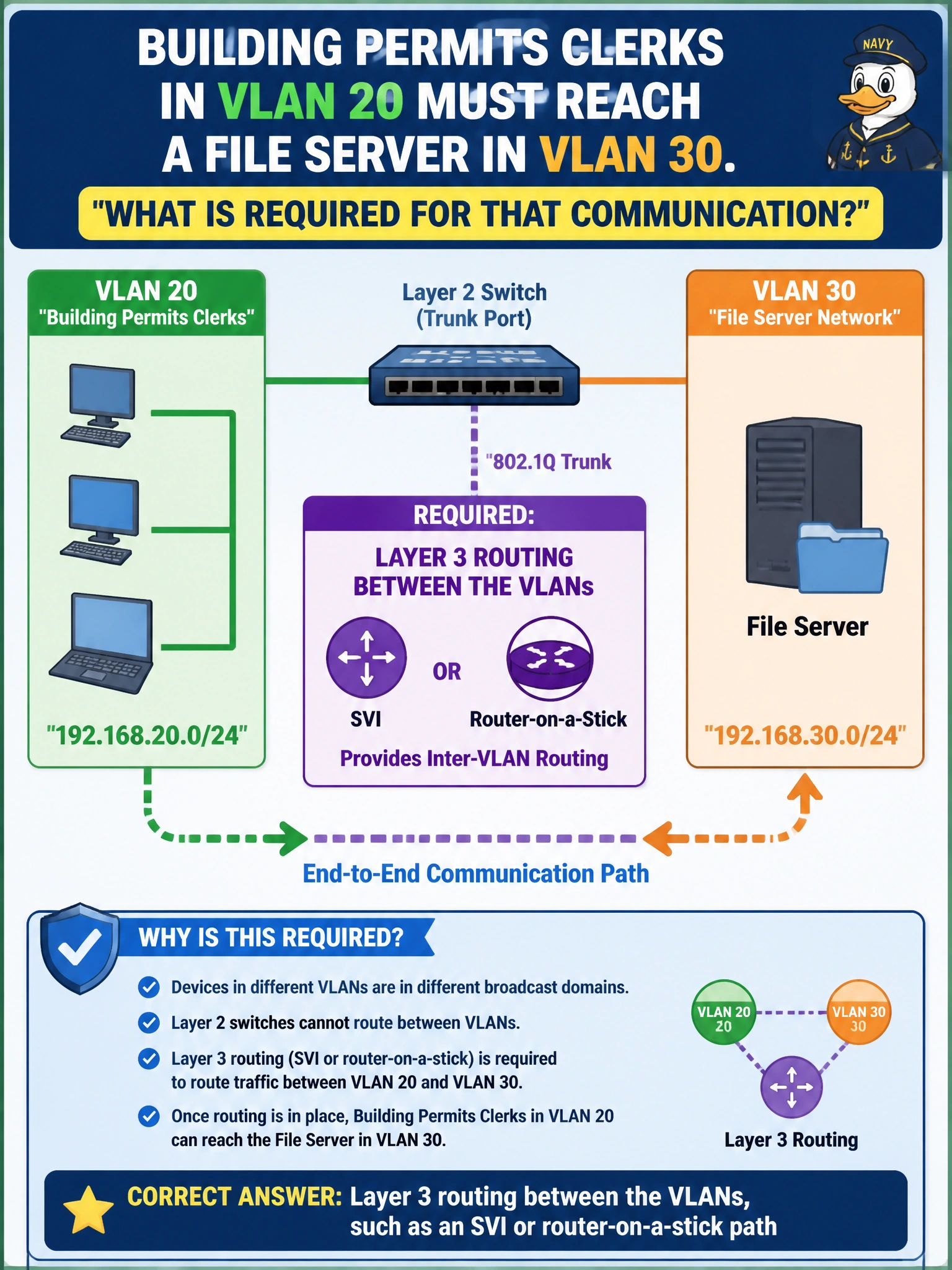
Different VLANs are different neighborhoods—walking does not cross the river without a bridge. You need Layer 3 (an SVI or router-on-a-stick) to route between VLAN 20 and VLAN 30. Flooding tricks and CDP chatter are not inter-VLAN routing.
Full Explanation
Building-permits clerks in VLAN 20 and a file server in VLAN 30 occupy separate Layer 2 broadcast domains, so communication requires Layer 3 routing between those VLANs—commonly an SVI on a multilayer switch or a router-on-a-stick subinterface with matching gateway configuration on each subnet. Trunks may carry both VLANs to distribution, but carrying is not routing; without an L3 interface and a route between the subnets, inter-VLAN traffic fails even when switching inside each VLAN works. Municipal designs therefore place SVIs (or router subinterfaces) in the path and apply ACLs as policy requires. That L3 dependency is the core inter-VLAN routing objective. Identical access VLAN assignment so both sides become one collision domain collapses the intended segmentation and misstates collision versus broadcast domains; it is not the correct way to connect VLAN 20 to VLAN 30 while keeping them separate. Disabling the MAC address table so frames flood between all VLANs is not a real inter-VLAN mechanism and would break normal switching. Relying on CDP alone to bridge VLAN 20 into VLAN 30 confuses a neighbor discovery protocol with routing or bridging of user data. Exam caveat: same switch fabric can still need routing—VLAN ID difference, not physical chassis count, drives the L3 requirement. Operational check: confirm SVIs or router subinterfaces are up for VLAN 20 and 30, hosts use the correct gateways, and a permits PC can reach the file server’s IP while traceroute shows the L3 hop; verify ACLs allow the required application ports.