
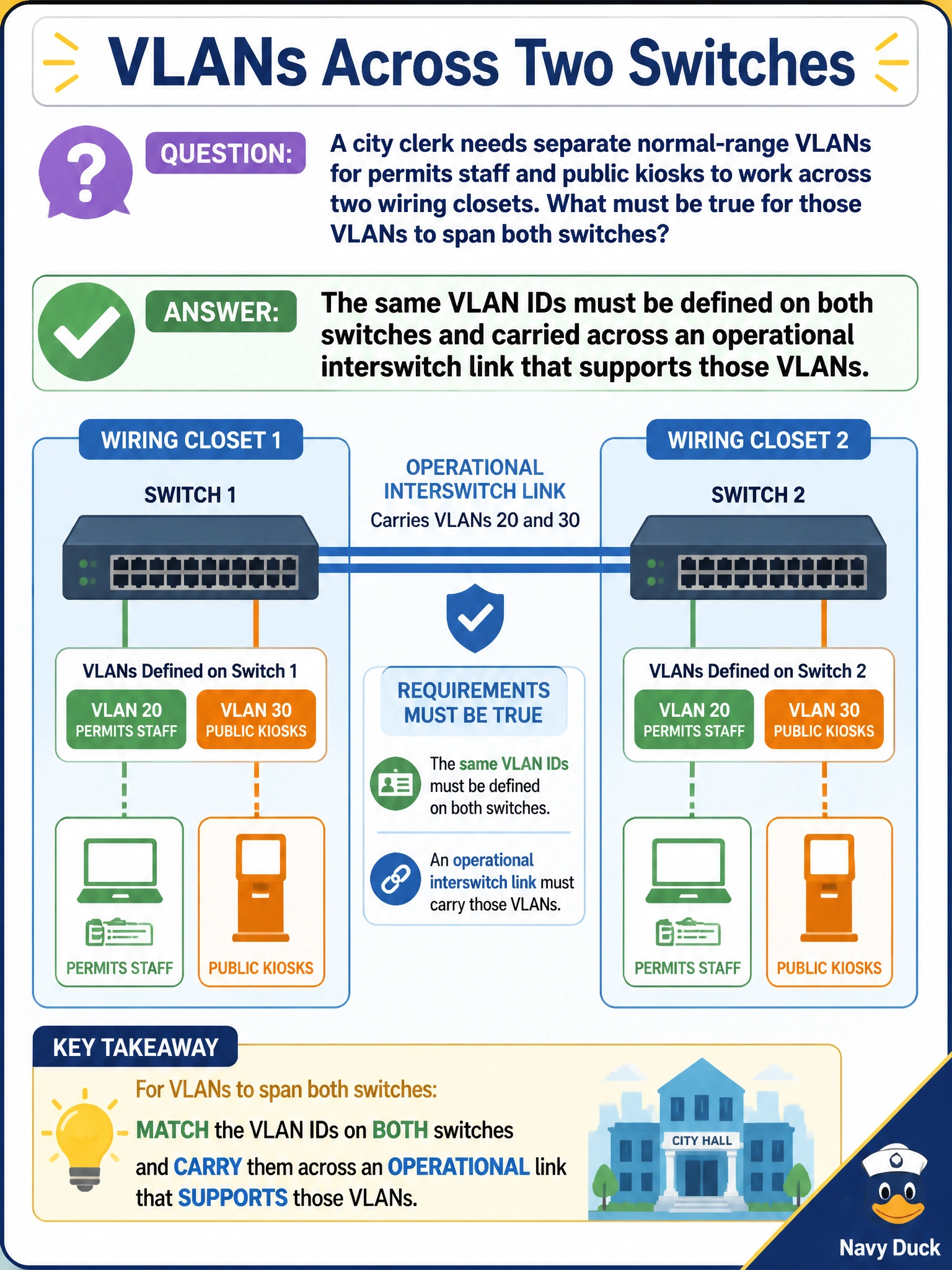
A city clerk needs separate normal-range VLANs for permits staff and public kiosks to work across two wiring closets. What must be true for those VLANs to span both switches?
Select an answer to reveal the explanation.
Short Explanation
VLANs are like department color codes—both closets have to agree that “blue” means permits. Define the same IDs on each switch and make sure the uplink actually carries them. Without that shared language and path, the two floors stay strangers.
Full Explanation
For permits staff and public-kiosk VLANs to span two wiring closets, the same VLAN IDs must exist on both switches and an operational interswitch link must carry those VLANs (typically an 802.1Q trunk that allows them). Layer 2 adjacency across closets is a shared vocabulary problem: mismatched IDs or a link that does not forward the VLAN leaves each closet as an island even if local switching works. City-clerk designs therefore standardize VLAN numbering and verify trunk allow lists end to end. Without that consistency, “the same department VLAN” is only a name on a spreadsheet. Unique overlapping VLAN IDs that remap at the uplink invent a translation scheme that standard campus Ethernet does not provide by default—IDs must match for a continuous VLAN. Claiming only the native VLAN can ever span more than one switch is false; tagged VLANs routinely span on trunks. Asserting VLANs span automatically through DNS once switches share a management VRF confuses name resolution and management routing with data-plane VLAN extension. Exam caveat: VLAN names can differ; VLAN IDs must match for the broadcast domain to be the same across switches. Operational check: show vlan brief on both closets for the permits and kiosk IDs, confirm the uplink is trunking and allows those IDs, and test Layer 2 reachability (for example ARP/ping via the gateway path awareness) between endpoints in each closet on the same VLAN ID.