
A museum campus predicts that a broadcast ARP request will reach every host in the same VLAN. What switching concept supports that prediction?
Select an answer to reveal the explanation.
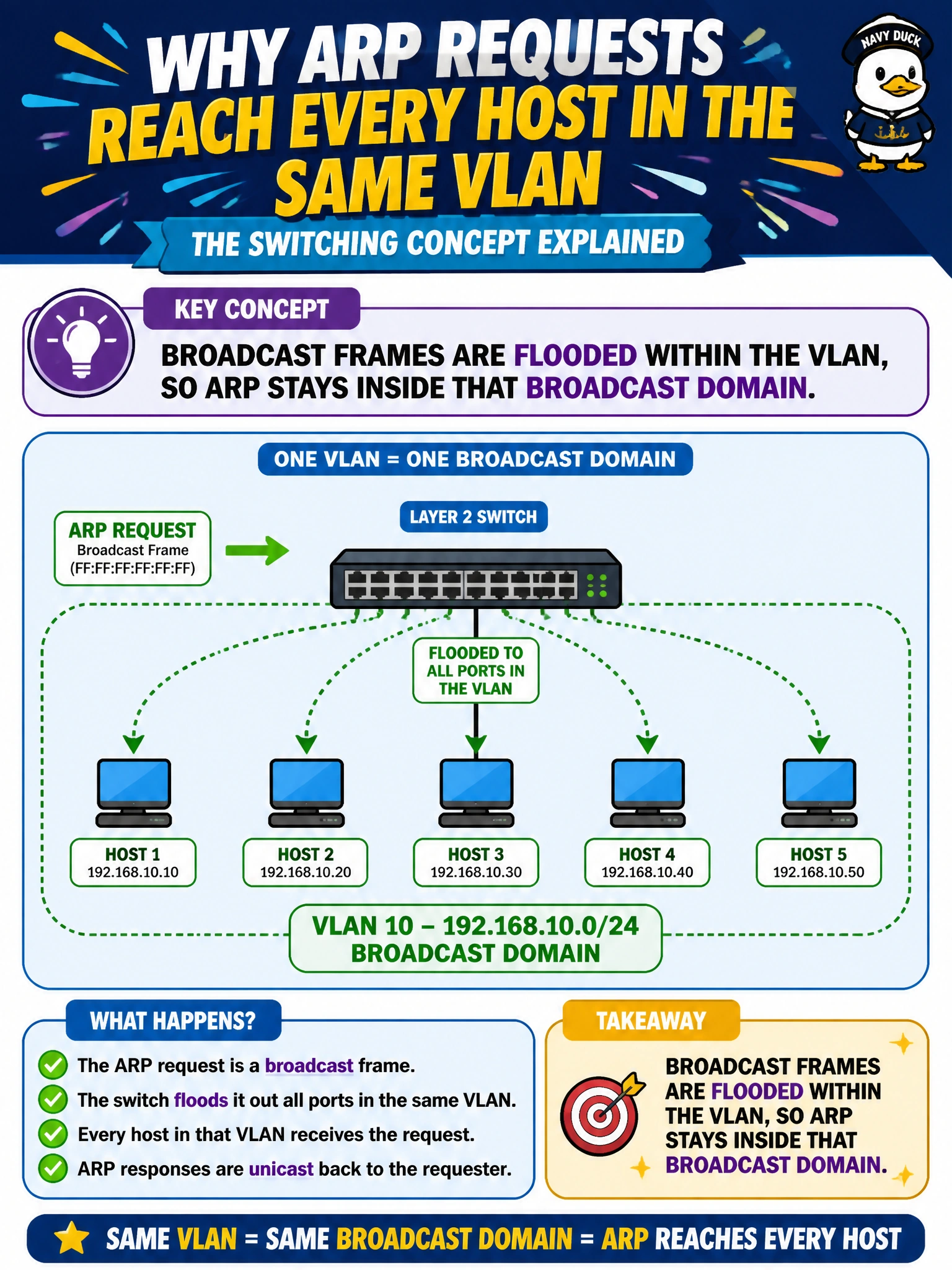
Short Explanation
A VLAN is like one big open-plan office—when someone yells “who has this IP?”, everyone in that room hears it. ARP broadcasts flood the VLAN broadcast domain, not the whole city and not just the STP root. Different VLANs are different rooms with closed doors.
Full Explanation
Broadcast frames are flooded within a VLAN’s broadcast domain, so a museum-campus ARP request reaches every host in that same VLAN (subject to ordinary switch flooding rules) and does not automatically cross into other VLANs without a router. ARP relies on that Layer 2 broadcast behavior to resolve IP-to-MAC mappings inside the subnet. Predicting campus-wide ARP reachability therefore means predicting VLAN membership and broadcast-domain scope, not inventing special tunnels or STP-only delivery paths. This is foundational switching and IP on-link behavior for municipal LANs. Automatic translation of ARP broadcasts into unicast GRE tunnels between buildings is not default campus switching behavior and would require explicit overlay design. Claiming broadcasts always stop at the first access port denies how switches flood broadcasts to other ports in the VLAN. Forwarding ARP only to the STP root bridge and ignoring other switches misunderstands STP (loop prevention) versus flooding (delivery within the active topology). Exam caveat: VLANs bound broadcast domains—large flat VLANs amplify ARP/broadcast load; segmentation reduces that noise. Operational check: capture or debug ARP on multiple access ports in the same VLAN to confirm the request is seen broadly, then verify a host in a different VLAN does not receive it unless routed; review VLAN size if ARP storms appear during busy exhibit hours.