
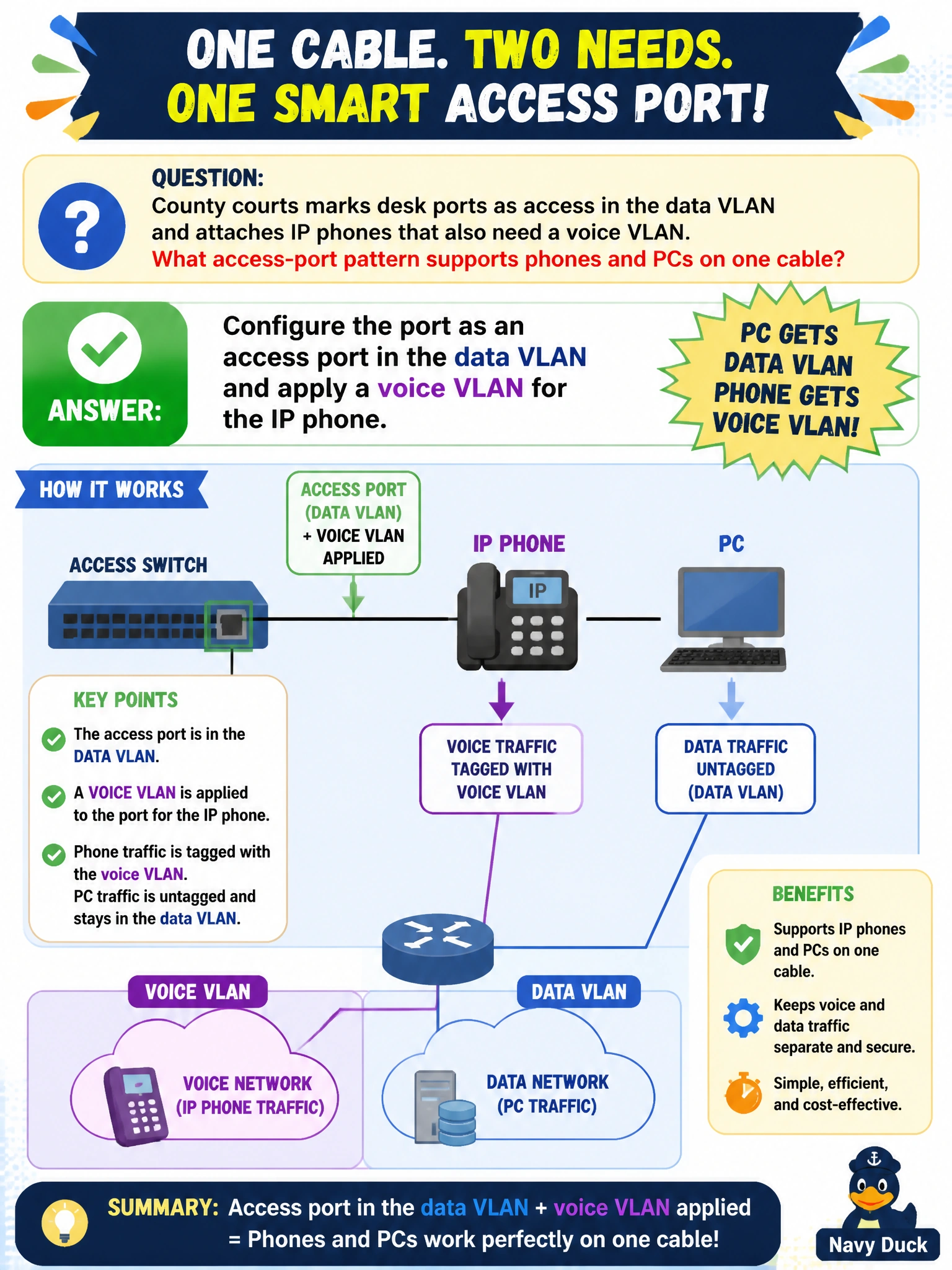
County courts marks desk ports as access in the data VLAN and attaches IP phones that also need a voice VLAN. What access-port pattern supports phones and PCs on one cable?
Select an answer to reveal the explanation.
Short Explanation
One cable, two lanes: the PC rides the access data VLAN while the phone tags onto the voice VLAN. That classic access-plus-voice pattern keeps desks simple without turning every jack into a wide-open trunk. PoE still matters for power, but the VLAN story is data access plus voice.
Full Explanation
The CCNA-aligned access-port pattern for county courts is an access port in the data VLAN plus a voice VLAN for the IP phone on the same physical cable. The PC typically uses untagged traffic in the access (data) VLAN while the phone tags voice frames into the voice VLAN, preserving a simple edge policy without opening every municipal VLAN toward the desk. That design supports one drop for both devices, which is how civic closets avoid dual home-runs to every workstation. PoE may power the phone, but the VLAN answer is access-plus-voice, not “make every jack a full trunk.” Configuring every desk port as an 802.1Q trunk that allows all municipal VLANs with no access VLAN over-exposes the edge and is not the intended phone-plus-PC pattern. Disabling PoE so phones need a second copper drop ignores both power and VLAN design goals and fails the one-cable requirement. Placing phones only in VLAN 1 and PCs only in the native VLAN of a routed port mixes default-VLAN bad practice with routed-port semantics and does not implement a proper voice VLAN on an access edge. Exam caveat: voice VLAN on an access port is not the same as a user-facing trunk that allows all VLANs—do not equate the two on the exam. Operational check: verify switchport mode access, access VLAN = data, voice VLAN configured, phone registers and tags correctly, PC gets a data DHCP lease, and the trunk allow list toward distribution still carries both VLANs as intended.