
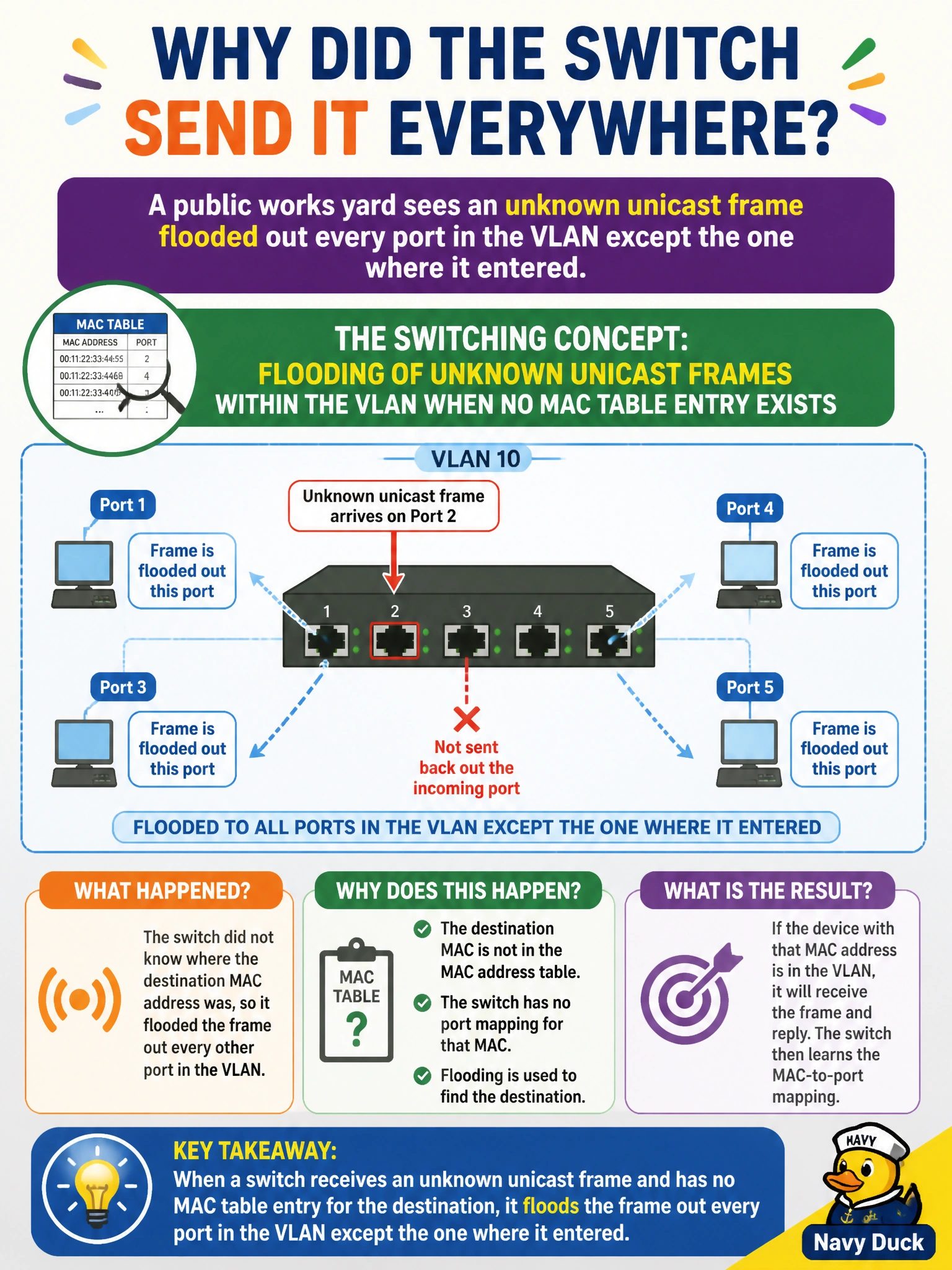
A public works yard sees an unknown unicast frame flooded out every port in the VLAN except the one where it entered. What switching concept explains that?
Select an answer to reveal the explanation.
Short Explanation
If the desk clerk does not recognize the name on the envelope, they shout it down every hallway in that floor—except the door it came in. Unknown unicast gets flooded inside the VLAN until someone answers and the MAC is learned. It is not routing and it is not OSPF paperwork.
Full Explanation
Unknown unicast flooding occurs when the destination MAC is absent from the MAC table: the public-works switch cannot pick a single egress port, so it floods the frame out all ports in that VLAN except the ingress port, staying inside the broadcast domain. Flooding continues until some reply or other traffic lets the switch learn the destination’s location. This is Layer 2 delivery uncertainty, not Layer 3 routing, and it explains bursts of traffic on quiet ports when devices are new, aged out, or silently moved. Understanding flooding is essential for troubleshooting unexpected load in a municipal yard VLAN. Inter-VLAN routing because the MAC was unknown is incorrect—unknown unicast stays within the VLAN; routing is a Layer 3 function between subnets/VLANs. Rewriting the frame as an OSPF LSA before egress confuses switching with routing-protocol messaging. EtherChannel hashing that always duplicates every unknown frame twice invents a bonding behavior that is not the definition of unknown-unicast flooding. Exam caveat: unknown unicast, broadcast, and multicast are flooded in the VLAN; known unicast is not—memorize that triad. Operational check: clear or wait out the MAC entry for a test destination, send unicast frames, and observe flooding on other VLAN ports; after the destination replies, confirm learning stops the flood and traffic pins to one port.