
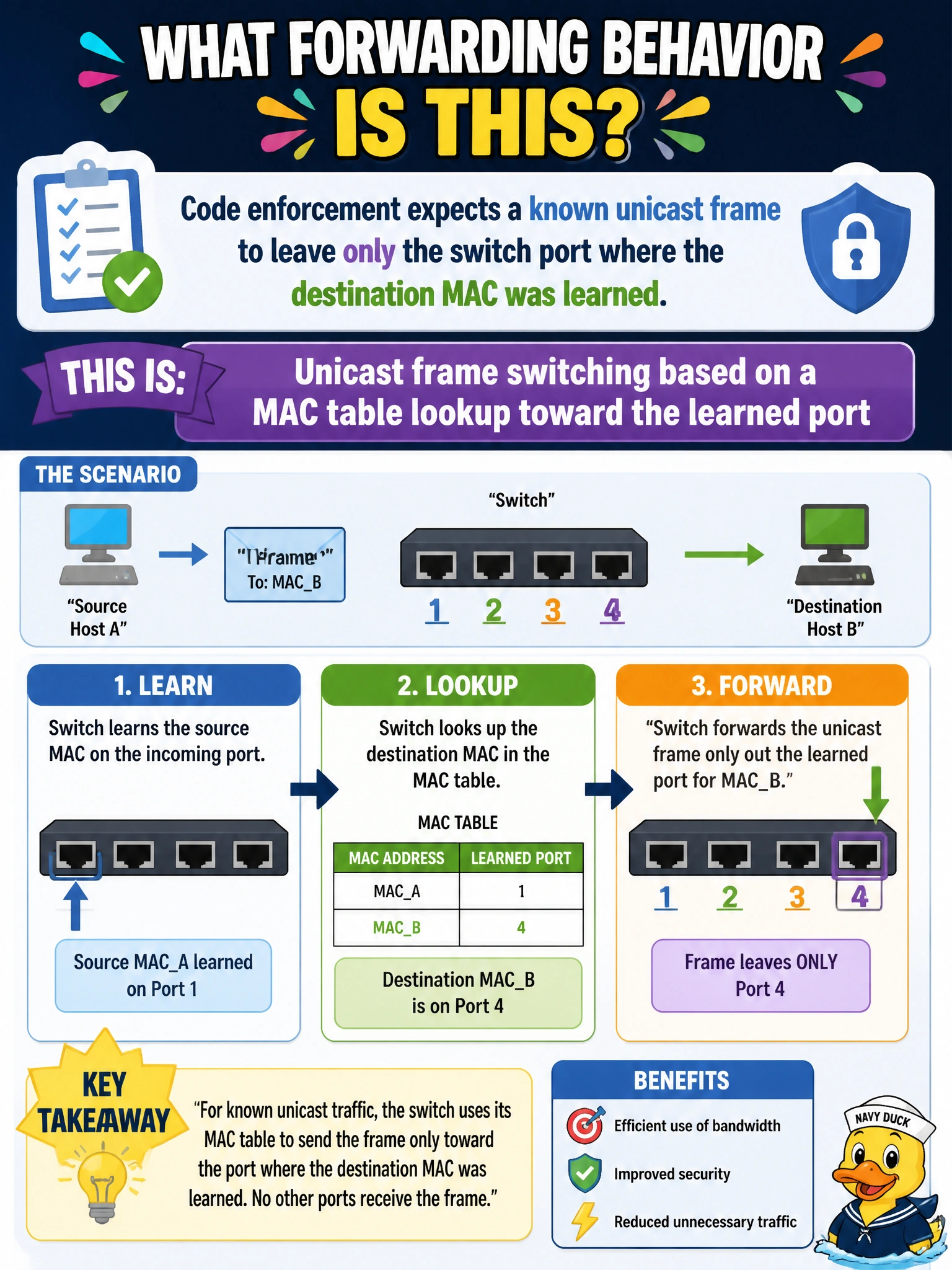
Code enforcement expects a known unicast frame to leave only the switch port where the destination MAC was learned. What forwarding behavior is that?
Select an answer to reveal the explanation.
Short Explanation
Once the switch knows which door owns the destination badge, it sends the package only that way—no hallway shouting. Known unicast is a MAC-table lookup to the right port. Flooding is for the unknown and the shouty broadcast cases.
Full Explanation
Known unicast switching means the destination MAC is already present in the MAC address table, so code enforcement’s frame is forwarded only out the learned egress port rather than flooded across the VLAN. The switch performs a MAC-table lookup, selects the associated interface, and preserves bandwidth and privacy relative to flooding. That selective egress is the everyday behavior operators expect once endpoints have spoken and been learned. It is the contrast case to unknown unicast and broadcast handling inside the same broadcast domain. Broadcast replication to every VLAN on the campus misstates both scope and frame type: broadcasts flood within a VLAN/broadcast domain, and this scenario is known unicast, not broadcast. Mandatory GRE tunneling before local delivery invents an overlay requirement that campus Layer 2 switching does not impose for ordinary unicast. Dropping unicast because Layer 2 switches never forward unicast is simply false—forwarding known unicast is a primary switch function. Exam caveat: “known” versus “unknown” unicast is a frequent exam distinction—known goes to one port; unknown is flooded in the VLAN. Operational check: confirm the destination MAC is listed in show mac address-table on the expected port, generate traffic, and verify SPAN or interface counters show egress only on that port rather than on every access port in the VLAN.