
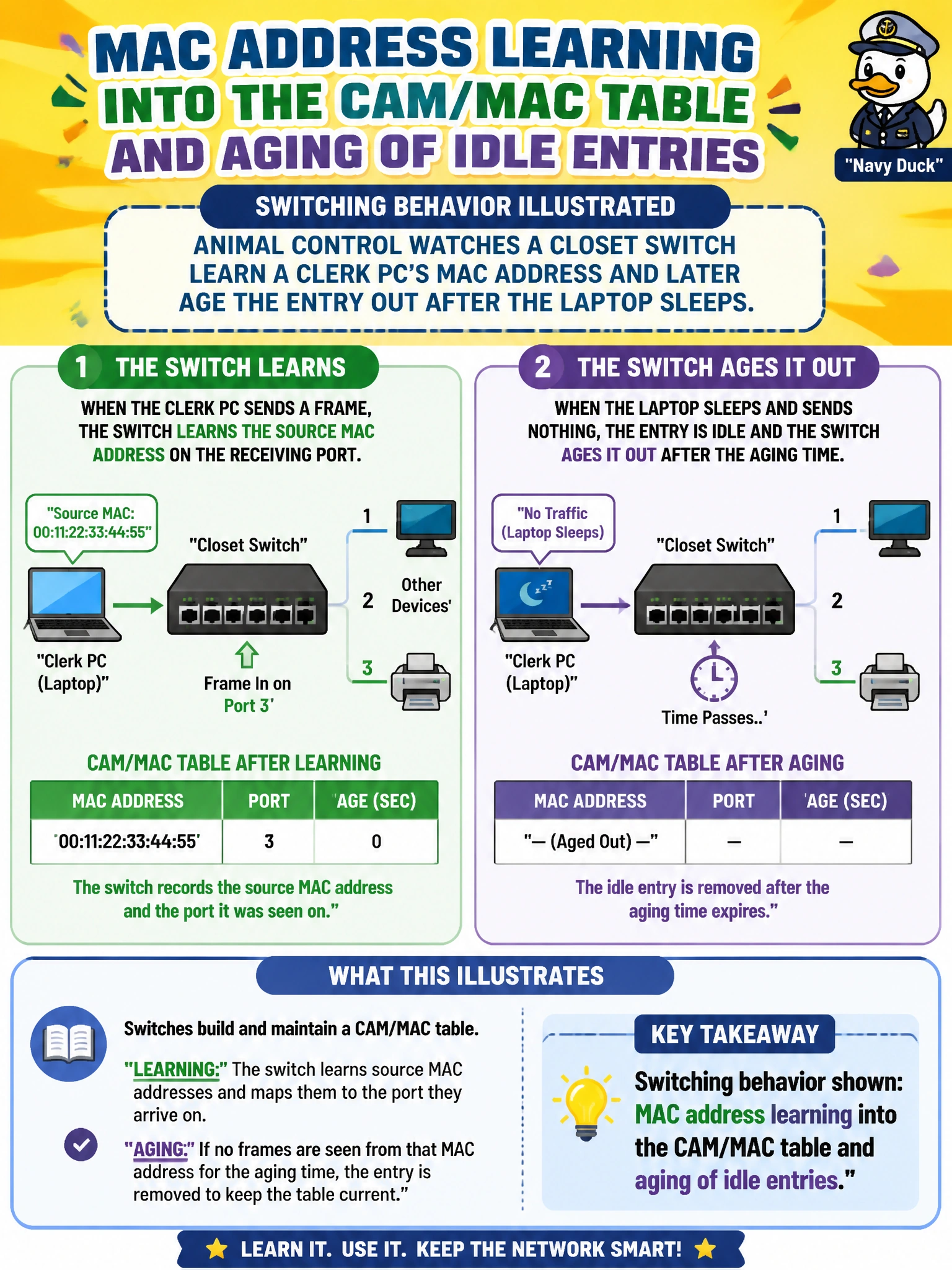
Animal control watches a closet switch learn a clerk PC’s MAC address and later age the entry out after the laptop sleeps. What switching behavior does that illustrate?
Select an answer to reveal the explanation.
Short Explanation
The switch’s MAC table is like a front-desk visitor log—it writes down who showed up on which door, then erases quiet names after they leave. Learning puts the clerk’s MAC on a port; aging clears it when the laptop goes quiet. That is everyday Layer 2 switching, not routing protocol magic.
Full Explanation
Animal control’s closet switch illustrates classic Ethernet learning and aging: when the clerk PC transmits, the switch records the source MAC into the CAM/MAC address table bound to the ingress port (and VLAN), enabling later known-unicast forwarding toward that port. After the laptop sleeps and stops sending frames, the idle timer expires and the entry ages out, freeing table space and preventing permanent reliance on a stale location if the device moves. Learning builds the forwarding map dynamically; aging keeps that map fresh. That behavior is fundamental Layer 2 switching, independent of routing-protocol area design. Automatic creation of a new OSPF area when a laptop sleeps confuses Layer 2 MAC table maintenance with Layer 3 dynamic routing and does not occur. Conversion of an access port into a routed subinterface by default is not what MAC learning does—port mode is an explicit configuration choice. Permanent pinning of every client MAC to VLAN 1 until reboot contradicts aging and invents an incorrect VLAN-1 permanence rule. Exam caveat: known unicast forwarding depends on a populated MAC table; after aging, the next frame to that destination may flood until relearning occurs. Operational check: use show mac address-table to confirm the clerk MAC appears on the expected port after traffic, then verify the entry disappears after idle aging (or clear it deliberately) and reappears when the laptop resumes sending frames.