
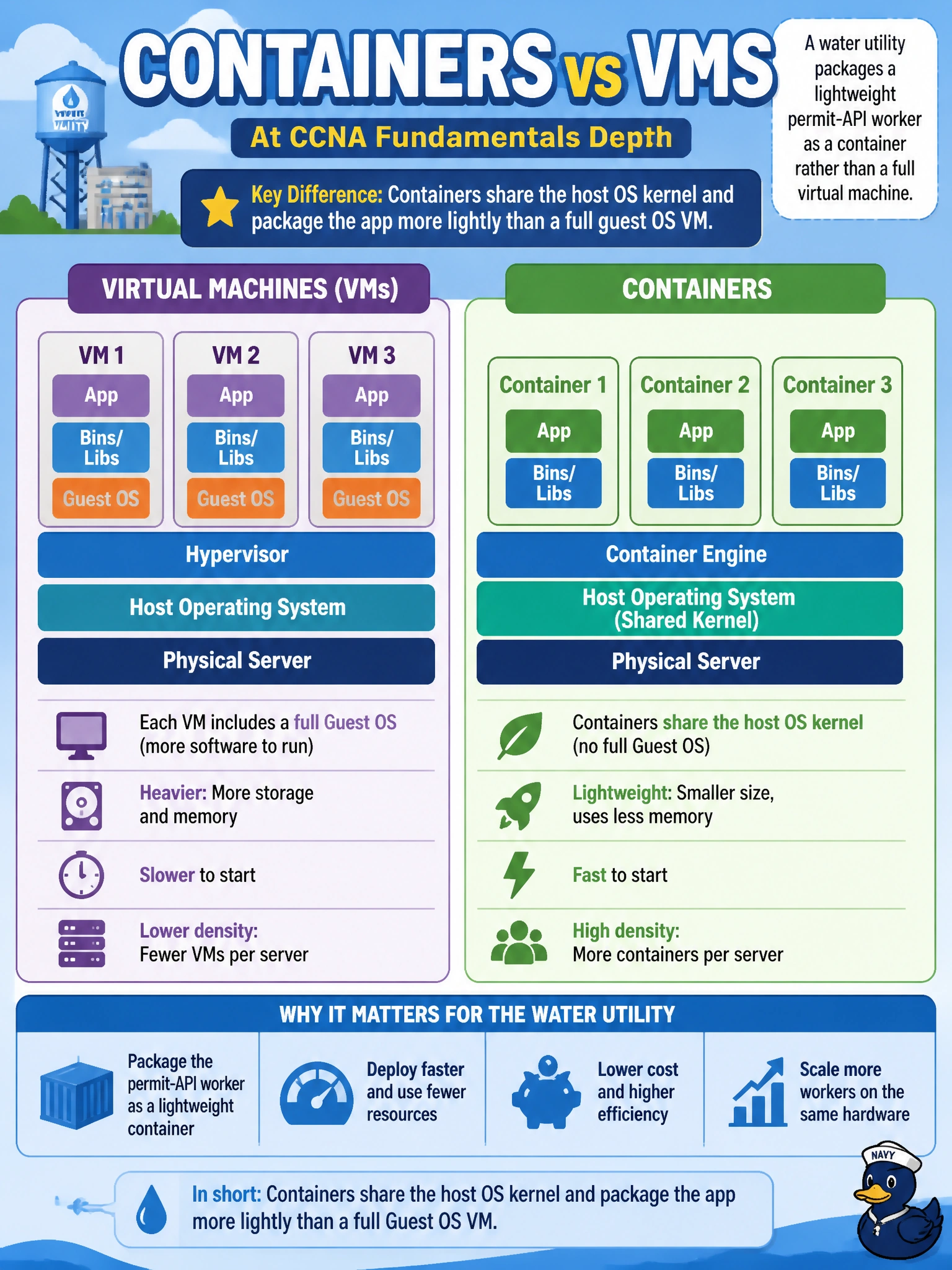
A water utility packages a lightweight permit-API worker as a container rather than a full virtual machine. At CCNA fundamentals depth, how do containers differ from VMs?
Select an answer to reveal the explanation.
Short Explanation
A VM is like giving each app its own tiny house with its own kitchen; a container is more like apartments sharing the building’s utilities. Containers ride the host OS kernel and stay lean, while VMs haul a full guest operating system. For a small permit API, that lighter package is usually plenty.
Full Explanation
At CCNA fundamentals depth, containers differ from virtual machines primarily in OS packaging: a container shares the host operating system kernel and ships the application plus its user-space dependencies as a lighter unit, whereas a typical VM includes a full guest operating system on virtualized hardware. For a water-utility permit-API worker, that shared-kernel model reduces image size, boot time, and overhead when full guest-OS isolation is unnecessary. Isolation still exists via namespaces and control groups, but the architectural contrast the exam emphasizes is shared host kernel versus per-VM guest OS. Choosing containers is an application packaging decision on the compute host, not a rewrite of campus routing or wireless control modes. Requiring a dedicated physical NIC per process with no shared kernel reverses the model—containers commonly share host networking constructs and definitely share the kernel; dedicated NICs are an optional design choice, not a defining rule. Claiming containers replace OSPF with static routes on every municipal edge router confuses compute packaging with control-plane routing and is unrelated to how permit APIs are shipped. Restricting containers to autonomous-mode APs without a controller invents a wireless dependency that does not exist; containers run on hosts/orchestrators, not as a function of lightweight AP mode. Exam caveat: associate-level questions want the kernel-sharing contrast; deep orchestration, microVM, or security-isolation debates are out of scope unless explicitly asked. Operational check: confirm the permit-API container image runs on the intended host OS kernel version, validate resource limits and published ports, and ensure the worker’s network path to upstream APIs still traverses the same municipal firewalls and DNS the VM-based design used.