
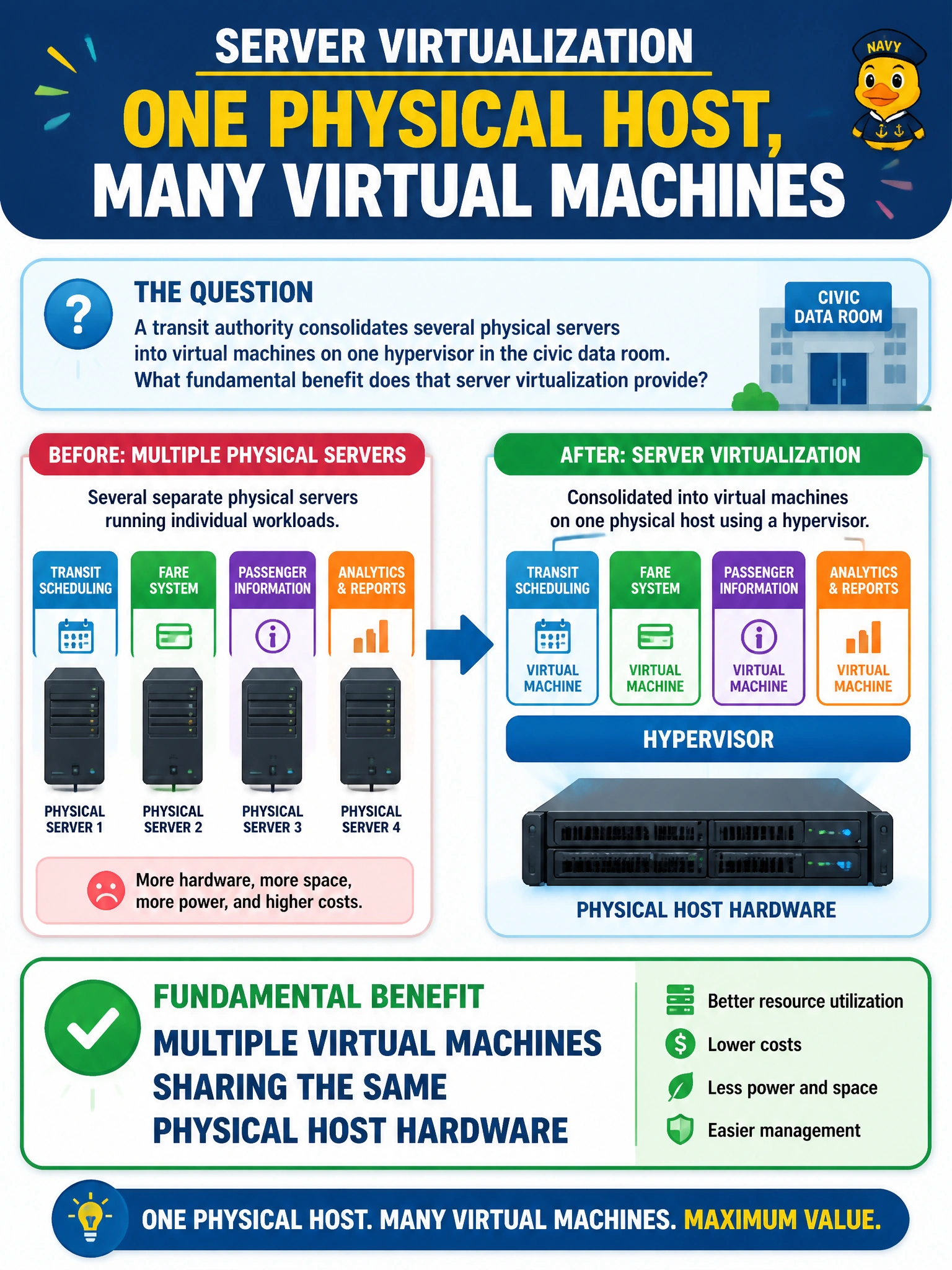
A transit authority consolidates several physical servers into virtual machines on one hypervisor in the civic data room. What fundamental benefit does that server virtualization provide?
Select an answer to reveal the explanation.
Short Explanation
Think of the hypervisor like a civic garage that parks several city vans in one bay. Virtualization lets many guest machines share one physical server instead of buying a rack for every app. You still need networks and addressing—the win is packing more workloads onto shared hardware.
Full Explanation
Server virtualization’s fundamental benefit is consolidation: multiple virtual machines share one physical host under a hypervisor so the transit authority can run several civic workloads without dedicating a separate chassis to every application. Guests receive virtual CPU, memory, and storage abstractions while the hypervisor schedules those resources on the same underlying hardware, which improves rack density, power efficiency, and operational flexibility in the civic data room. Networking, storage, and addressing still exist—virtualization changes how compute is packaged, not whether the building still needs switches and IP design. That shared-host model is the core CCNA-level definition of server virtualization. Automatic conversion of copper desk drops into single-mode fiber is a cabling media project, not a hypervisor feature; virtualization does not retarget physical layer plant. Elimination of Layer 2 switching is incorrect because VMs still need Ethernet connectivity (often via virtual switches uplinked to campus switches). Replacement of IPv4 with token-ring MAC bridging mixes unrelated historical LAN technology into a modern virtualization question and is not a benefit of consolidating servers onto a hypervisor. Exam caveat: know the benefit (shared physical host) separately from high-availability add-ons—HA clustering, live migration, and backups are related practices, not the definition of virtualization itself. Operational check: inventory which transit apps share each hypervisor, confirm virtual NICs attach to the intended port groups/VLANs, and document host capacity and failure domain so rack consolidation does not silently create a single point of failure for multiple civic services.