
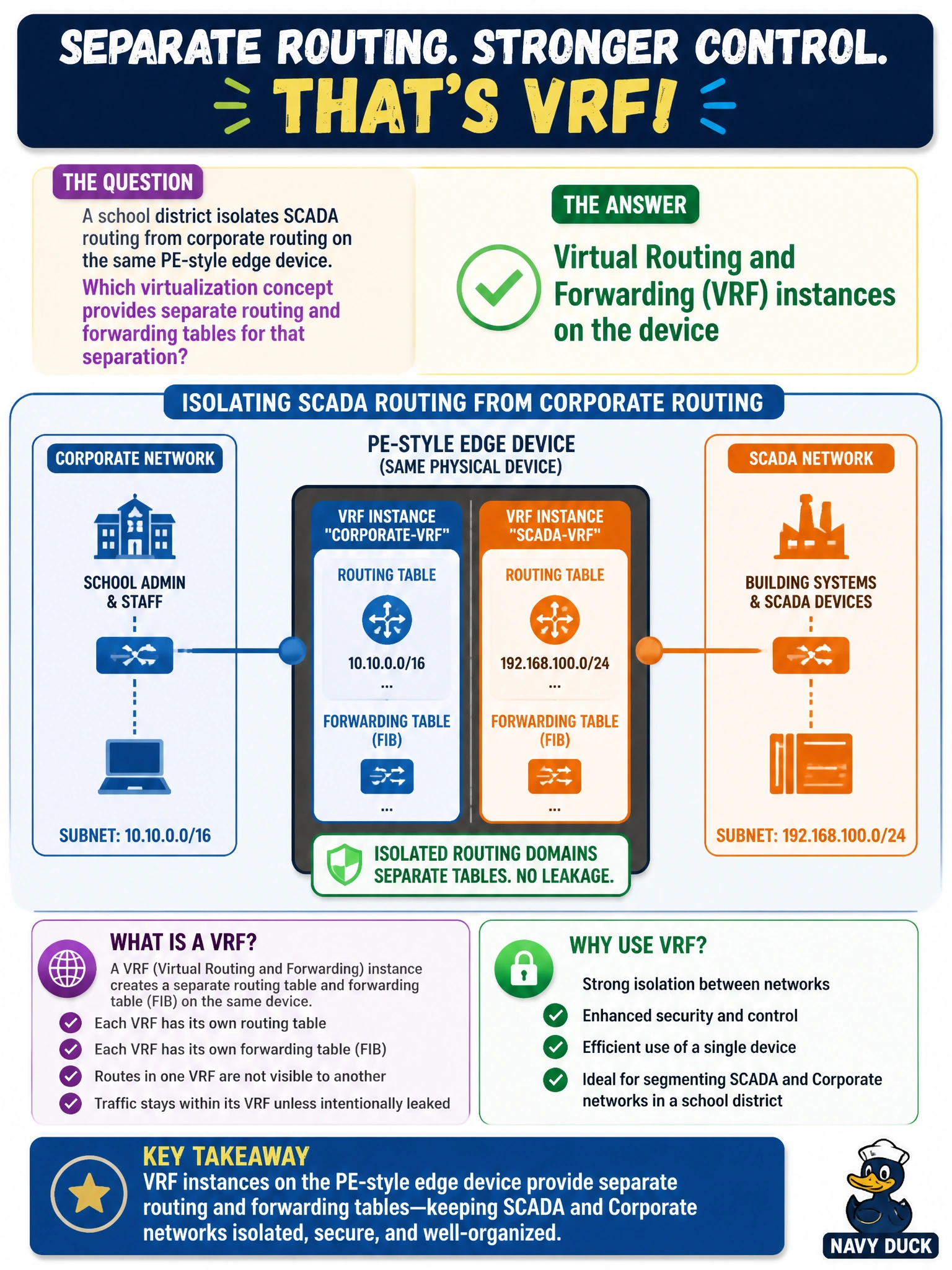
A school district isolates SCADA routing from corporate routing on the same PE-style edge device. Which virtualization concept provides separate routing and forwarding tables for that separation?
Select an answer to reveal the explanation.
Short Explanation
You can think of VRFs as separate road atlases on the same router: one for SCADA and one for corporate traffic. Each keeps its own routing and forwarding table, while PortFast, native VLAN 1 tagging, and spanning-tree root priority do not create that separation.
Full Explanation
Virtual Routing and Forwarding (VRF) provides separate routing and forwarding tables on one device, allowing the school district to isolate SCADA routing from corporate routing on a shared PE-style edge platform. Each VRF maintains its own routing and forwarding context and interface membership, preventing SCADA prefixes from mixing into corporate forwarding, and vice versa. This control-plane and data-plane separation is the virtualization concept used for routing on shared hardware. PortFast accelerates spanning-tree transition on access ports; it does not create separate routing tables for SCADA and corporate traffic. Native VLAN tagging of SCADA frames as VLAN 1 is a Layer 2 trunk configuration and does not create independent routing tables; routing remains shared unless VRFs are configured. Setting spanning-tree root priority affects the Layer 2 topology election, not IP routing domains, so it cannot partition routing tables. Exam caveat: VRF is Layer 3 routing-table virtualization; do not confuse it with VLANs, which define Layer 2 broadcast domains. Practical check: verify that SCADA and corporate interfaces belong to distinct VRFs, confirm that device commands show separate routing tables, and test that a SCADA prefix is not reachable from the corporate VRF unless an intentional route leak or shared-services path is configured and documented.