
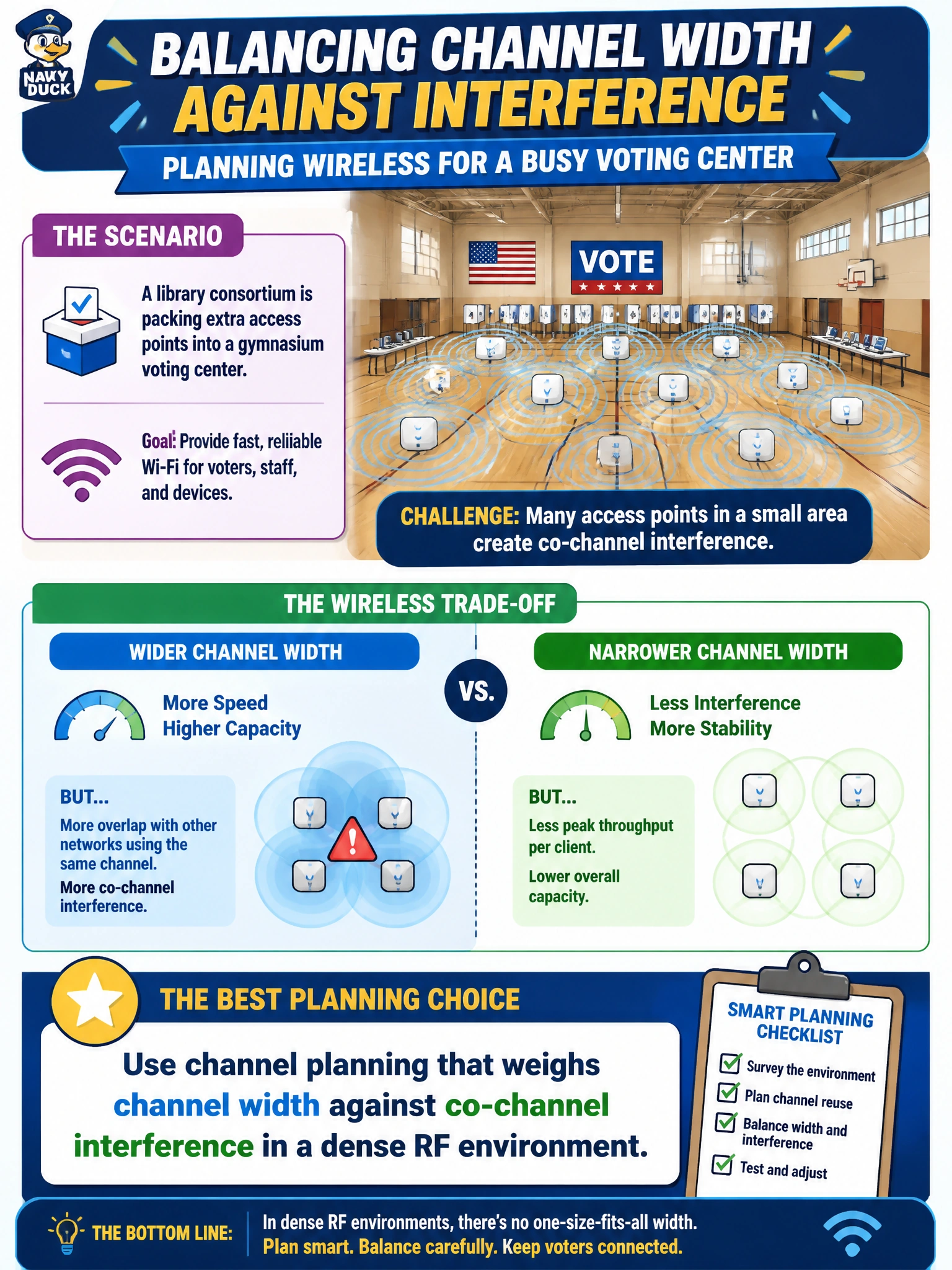
A library consortium is packing extra access points into a gymnasium voting center and must balance channel width against interference. What planning choice best matches that wireless trade-off?
Select an answer to reveal the explanation.
Short Explanation
Picture the gymnasium as a crowded radio parking lot: wider channels are bigger spaces that use more of the lot. When you pack APs into a voting center, channel planning helps you balance channel width against interference instead of maximizing every radio.
Full Explanation
In a dense library-consortium voting gymnasium, RF planning is a capacity-versus-contention decision: wider channels can raise per-BSS throughput, but each consumes more of the limited unlicensed spectrum and increases the area where co-channel and adjacent-channel energy can collide. With extra access points sharing one room, channel planning should weigh channel width against co-channel interference rather than maximizing width on every radio. Narrower widths, or carefully planned mixes of width and reuse, leave more non-overlapping channels and can improve airtime fairness and reduce retransmissions under high client density. Disabling SSID broadcast does not stop radios from overlapping in frequency; it only hides the network name and can complicate client onboarding without fixing spectrum contention. Replacing access points with Layer 3 switches addresses switching and routing topology, not RF channel reuse; Layer 3 hardware cannot create more clean airtime. Configuring every access point for the 900 MHz SCADA telemetry band is not a valid public Wi-Fi redesign for this density and confuses operational technology spectrum with enterprise 2.4/5/6 GHz planning. Exam caveat: wider is not always better; density and co-channel interference can matter more than a single client’s peak rate. Practical check: after adding APs, review survey or controller metrics for channel utilization, co-channel neighbor counts, and retry rates, and confirm that channel assignments and widths fit the AP count rather than defaulting every radio to maximum width.