
Emergency management requires that permit tablets not send traffic in the clear on municipal Wi-Fi. What wireless principle addresses that need?
Select an answer to reveal the explanation.
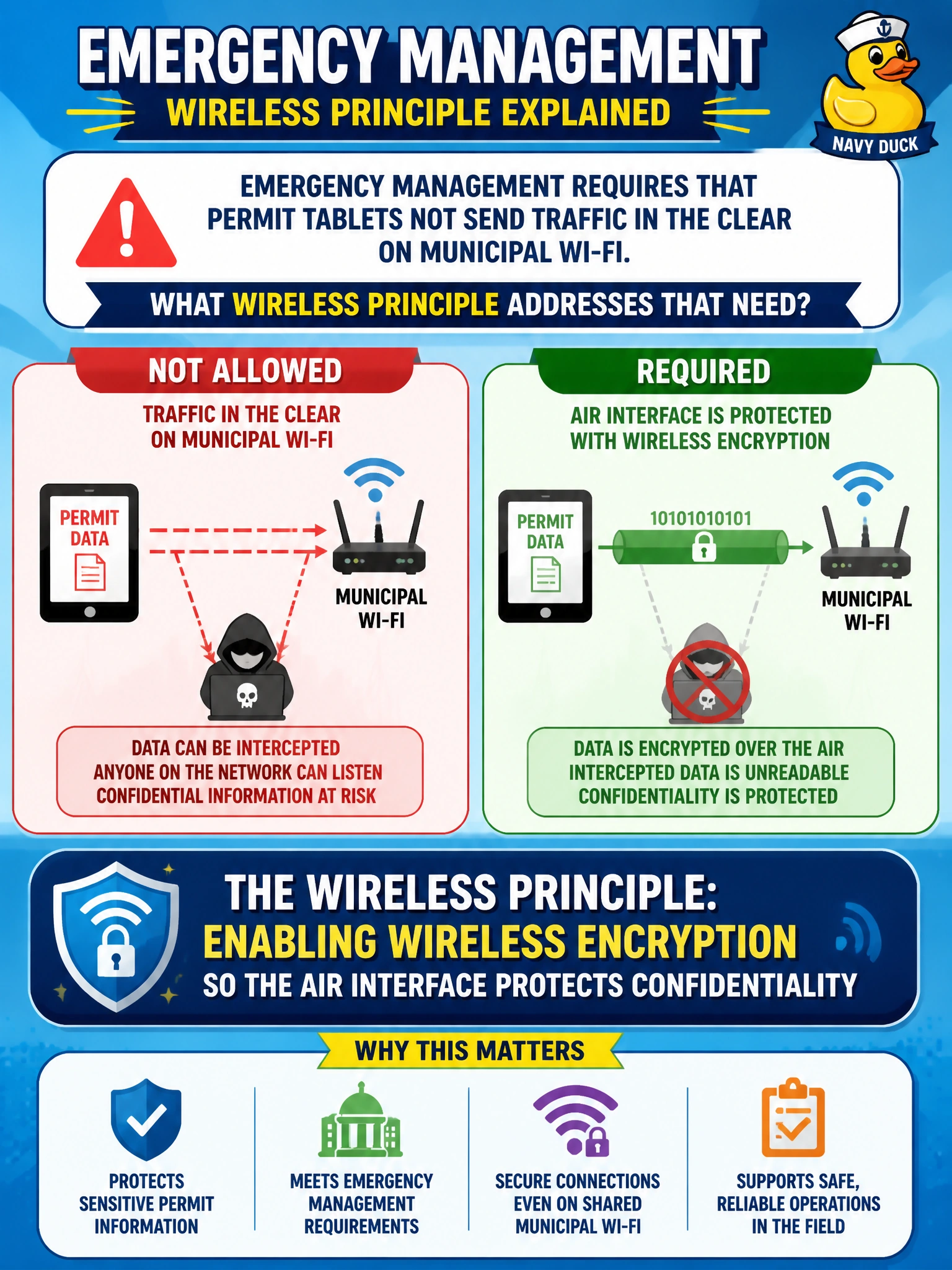
Short Explanation
Open Wi-Fi is a postcard; encryption is an envelope. Turn on WLAN encryption so permit tablets are not chatting in the clear over the air — public IP addresses do not magically scramble frames.
Full Explanation
Emergency management requires that permit tablets not send traffic in the clear on municipal Wi-Fi. The wireless principle that addresses confidentiality on the air interface is enabling wireless encryption—modern WPA2 or WPA3 personal or enterprise as policy requires—so 802.11 frames are protected against casual eavesdropping on the RF medium. Encryption ensures that association to the municipal SSID does not equal plaintext exposure of permit-application traffic.
Disabling all SSIDs so encryption is unnecessary removes the service rather than securing it. Using longer Ethernet cords instead of any wireless encryption abandons the mobility requirement and dodges the RF confidentiality problem. Assigning public IPv4 addresses to every tablet does not encrypt wireless frames; Layer-3 addressing is unrelated to Layer-2 air-interface crypto.
Exam caveat: open or unencrypted SSIDs expose traffic on the air; encryption plus strong authentication is the WLAN confidentiality control. Do not confuse public IP assignment with frame encryption.
Operational check for permit tablets: join the encrypted municipal SSID, verify the client reports WPA2 or WPA3, confirm with authorized testing that payloads are not plaintext on the air, and enforce policy that open guest networks never carry sensitive permit workflows. Rotate PSKs or use 802.1X per city security standards.