
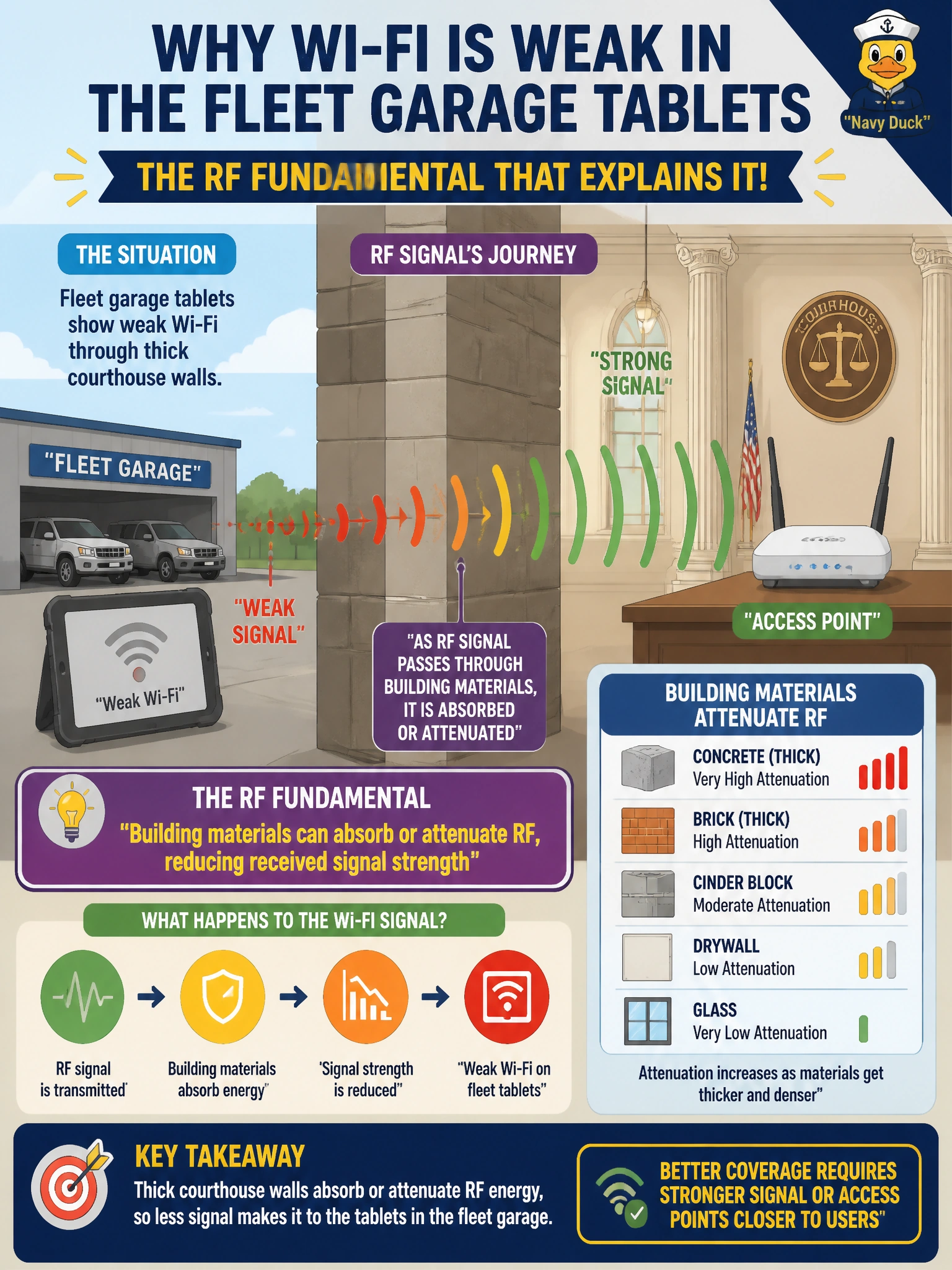
Fleet garage tablets show weak Wi-Fi through thick courthouse walls. Which RF fundamental best explains the coverage problem?
Select an answer to reveal the explanation.
Short Explanation
Thick walls eat radio energy like a sponge — that is absorption/attenuation, not a subnet mask conspiracy. Move APs, add APs, or rethink channels/power; do not blame IPv6 for drywall.
Full Explanation
Fleet garage tablets show weak Wi-Fi through thick courthouse walls. Radio-frequency energy is absorbed and attenuated by building materials—concrete, brick, metal studs, mesh, coated glass—so received signal strength declines and throughput or reliability suffers. That RF fundamental best explains coverage complaints when access points and clients are separated by dense walls rather than open atrium space inside the municipal complex.
Ethernet collision domains expanding when Wi-Fi signal weakens mixes wired CSMA/CD history with RF coverage and is not the explanatory mechanism. IPv6 unique-local addresses blocking all 5 GHz transmissions invents a Layer-3 addressing cause for a physical RF problem. A /30 WAN mask preventing RF from passing through drywall confuses IP subnetting with electromagnetic propagation through construction materials.
Exam caveat: weak signal through walls maps to attenuation, absorption, or obstruction. Remediate with AP placement, additional APs, band selection, or antenna and power patterns—not by changing unrelated IP masks or blaming IPv6.
Operational check for the fleet garage and courthouse path: measure RSSI and SNR on both sides of the wall, heat-map the area, relocate or add APs, and retest tablet association and application performance. Document materials that repeatedly kill signal so future AP designs account for courthouse construction.