
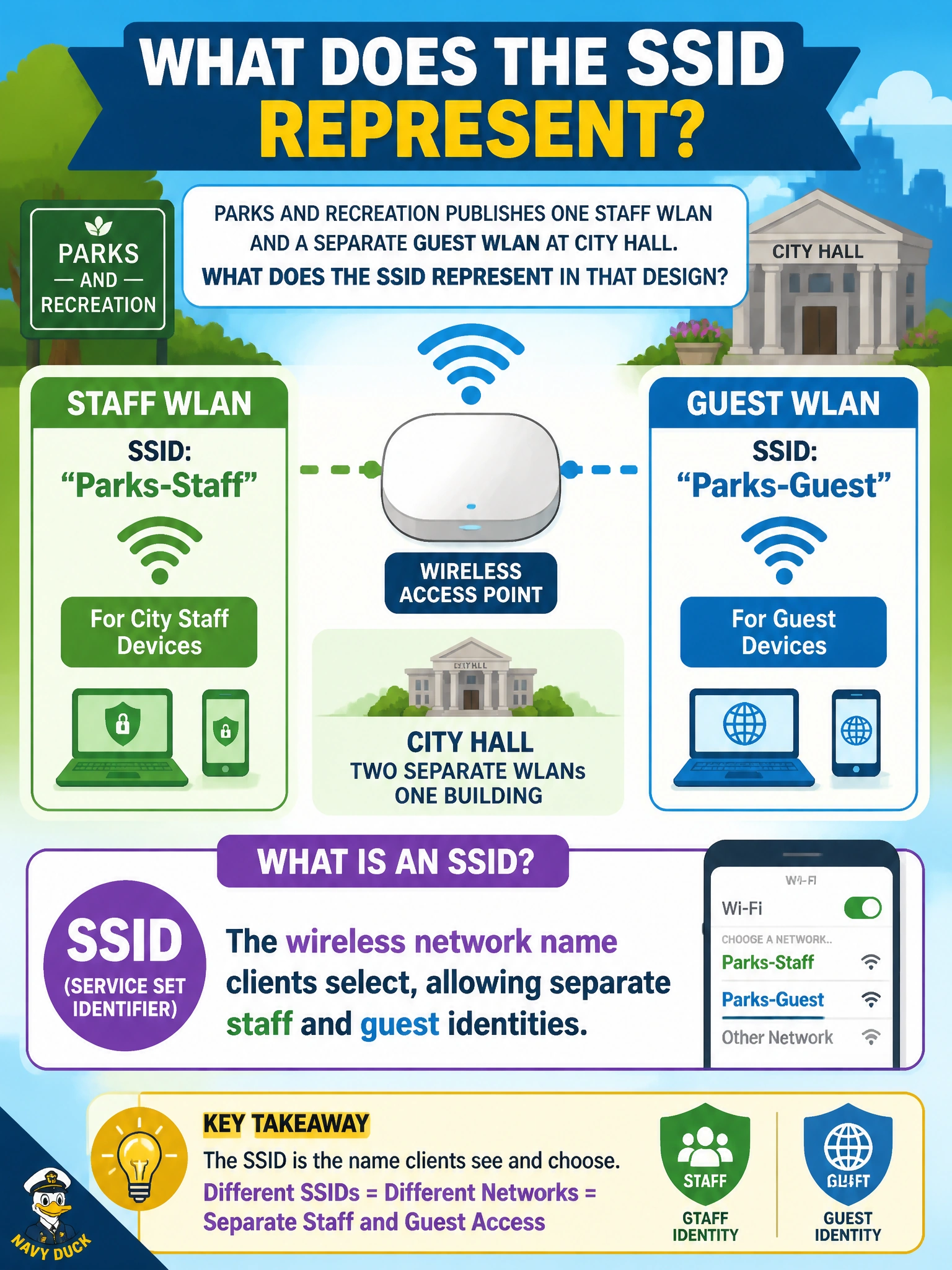
Parks and recreation publishes one staff WLAN and a separate guest WLAN at city hall. What does the SSID represent in that design?
Select an answer to reveal the explanation.
Short Explanation
SSID is simply the Wi-Fi network’s name on the picker list — staff sees one, guests see another. It is not a cable pinout, OSPF area, or PoE class.
Full Explanation
Parks and recreation publishes one staff WLAN and a separate guest WLAN at city hall. The SSID (Service Set Identifier) is the wireless network name that client devices display and that users select. Publishing two SSIDs allows separate staff and guest identities, authentication methods, VLANs, and policy profiles while still sharing the same RF infrastructure and controllers as designed for the building.
The copper pinout standard used on console cables is a cabling or serial-console concern, not a WLAN name. The OSPF area ID assigned to a wireless LAN controller confuses routing-protocol hierarchy with Wi-Fi advertising. The PoE power class negotiated by IP phones is a power-budget attribute on wired ports, not an SSID.
Exam caveat: SSID is the network name clients join; BSSID is the AP radio MAC address for a particular BSS. Do not swap those terms under exam pressure, and remember multiple SSIDs can map to different VLANs.
Operational check at city hall: confirm both SSIDs beacon, staff authenticates to the staff SSID and lands on the staff VLAN, guests join the guest SSID with appropriate ACL or captive portal, and client pickers show the correct network names. Mis-mapped SSID-to-VLAN bindings are a common municipal guest/staff cross-connect issue.