
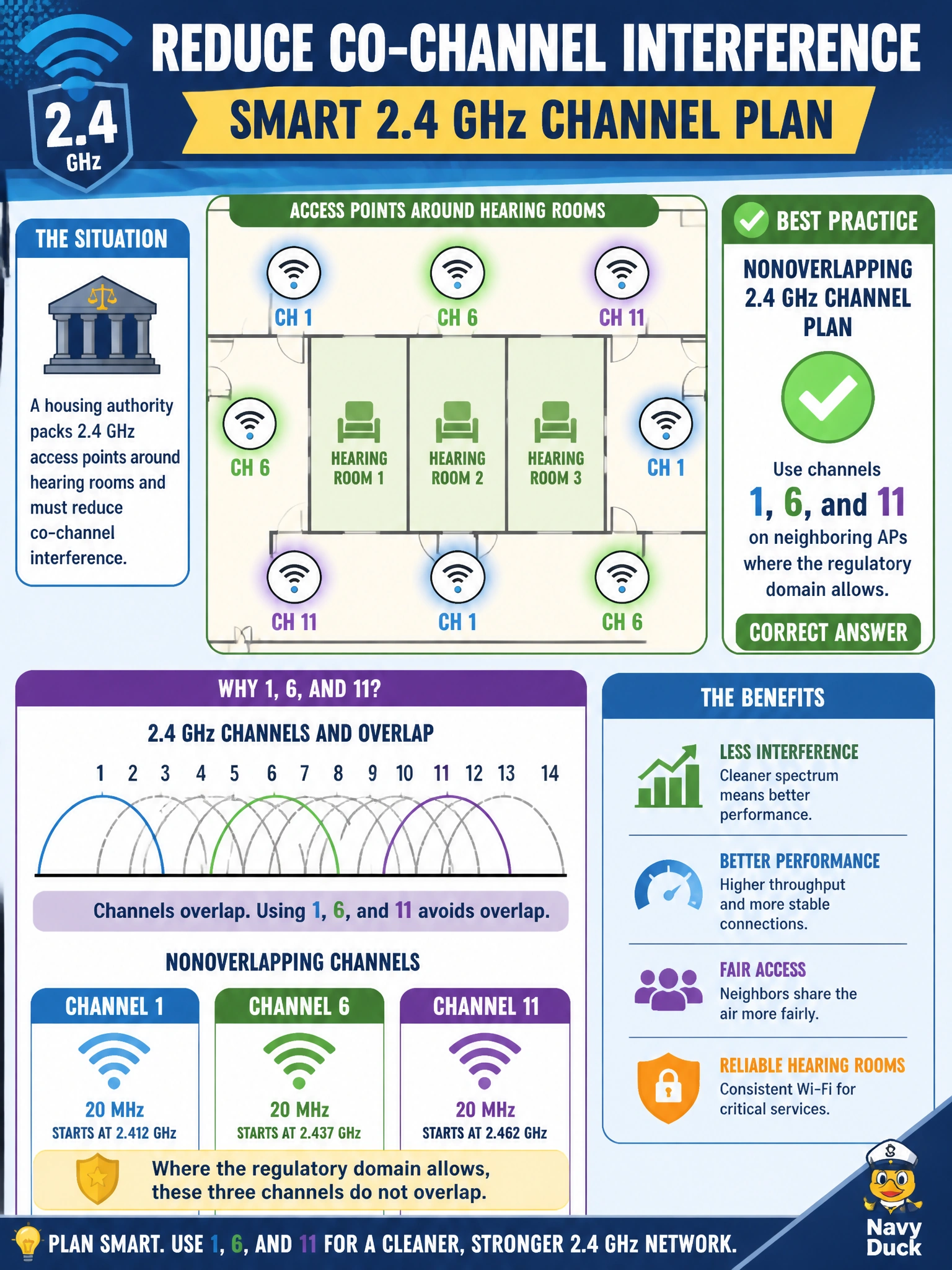
A housing authority packs 2.4 GHz access points around hearing rooms and must reduce co-channel interference. Which channel plan best follows nonoverlapping 2.4 GHz practice?
Select an answer to reveal the explanation.
Short Explanation
In the crowded 2.4 GHz cafeteria, 1, 6, and 11 are the three trays that do not smash into each other. Parking APs on 1-2-3 is like overlapping loudspeakers — interference city.
Full Explanation
A housing authority packs 2.4 GHz access points around hearing rooms and must reduce co-channel interference. In the common U.S. and many similar regulatory domains, the classic nonoverlapping 2.4 GHz channel set is 1, 6, and 11. Neighboring APs should use different members of that triad so their roughly 20 MHz energy does not heavily overlap, which reduces co-channel and adjacent-channel interference in dense hearing-room deployments.
Using channels 1, 2, and 3 on adjacent APs maximizes spectral overlap—those channels sit on top of each other in the band. Using only channel 6 on every AP in the entire county maximizes co-channel contention everywhere clients roam. Using channels 2, 7, and 12 is not the standard nonoverlapping set taught for U.S.-style 2.4 GHz planning, and channel 12 is not universally available.
Exam caveat: 2.4 GHz effectively offers only three nonoverlapping channels in the classic model (1/6/11). 5 GHz offers many more nonoverlapping channels; do not import 5 GHz abundance into a 2.4 GHz stem.
Operational check around hearing rooms: survey with a Wi-Fi analyzer, assign 1/6/11 to neighboring APs, verify RSSI, noise, and channel utilization improve versus the old overlapping plan, and revisit power levels so cells do not overhear too aggressively on the same channel.