
An election office sees FF02::1 traffic used during Neighbor Discovery on a staff VLAN. What role does this IPv6 address type play?
Select an answer to reveal the explanation.
Short Explanation
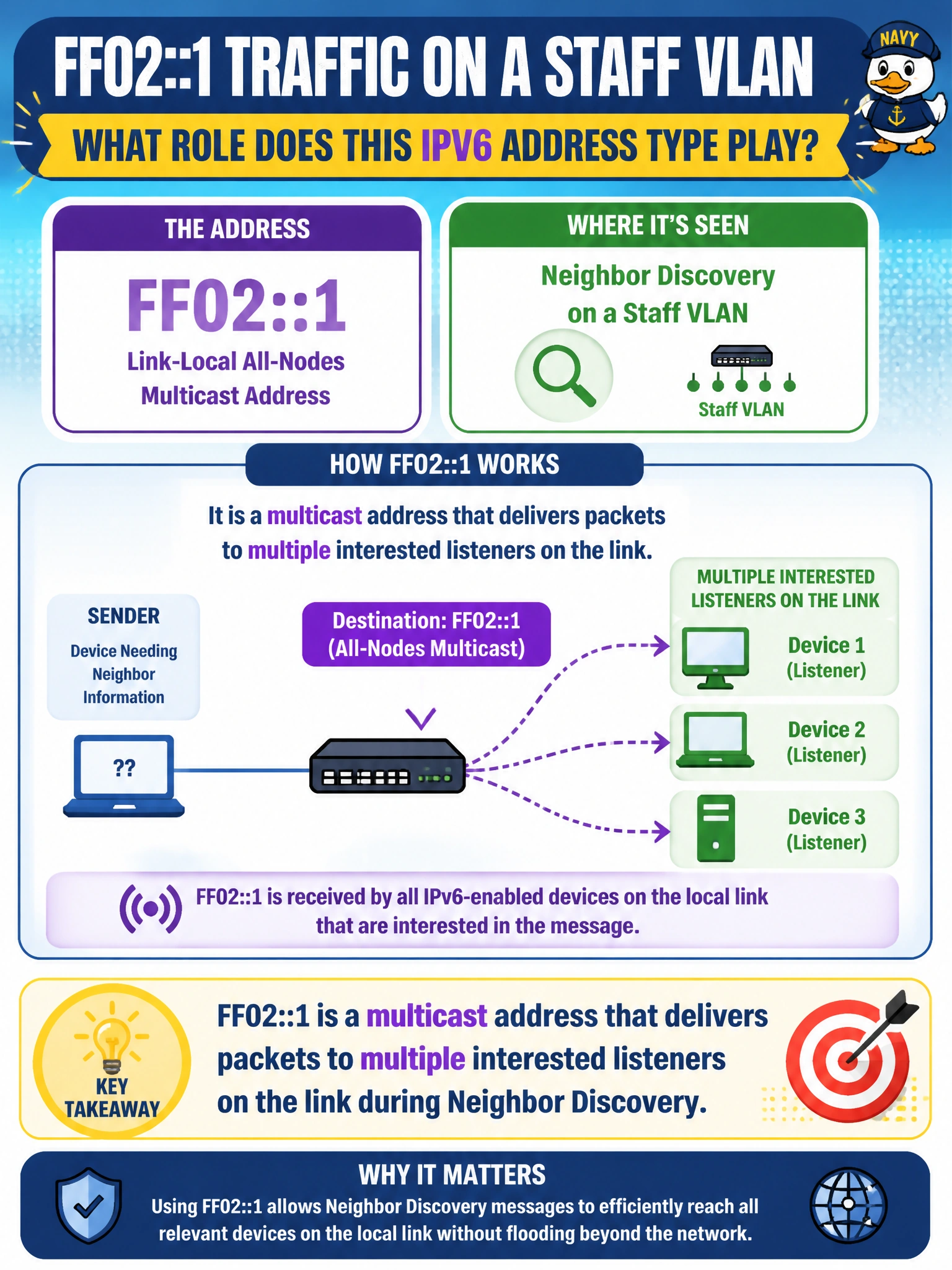
FF02::1 is the all-nodes shout on the local link — one send, many listeners. That multicast pattern is how Neighbor Discovery gathers the room, not a single PC’s unicast identity.
Full Explanation
An election office sees FF02::1 traffic used during Neighbor Discovery on a staff VLAN. FF02::1 is the all-nodes link-local multicast address: packets sent to it are delivered to all IPv6 nodes on the local link that listen to that group. Neighbor Discovery and Router Advertisement behaviors rely on multicast—including all-nodes and solicited-node groups—rather than IPv4-style broadcast, so observing FF02::1 during ND is expected for link-scoped signaling on the voting staff VLAN.
It is not a global unicast address assigned to one unique voting workstation; global unicast does not begin with FF. It is not an IPv4 private address written in IPv6 notation. It is not a unicast anycast address reserved only for default gateways; FF00::/8 is multicast space, and gateways use ordinary unicast plus multicast for RA and ND—not FF02::1 as an anycast VIP.
Exam caveat: memorize key well-known multicasts (FF02::1 all-nodes, FF02::2 all-routers) and the FF00::/8 multicast prefix. Exam stems often show FF02:: destinations in ND contexts to test that recognition.
Operational check on the staff VLAN: capture RA, NS, and NA traffic and note destinations such as FF02::1 or solicited-node multicasts; verify switches allow appropriate IPv6 ND or MLD behavior; confirm hosts respond as all-nodes listeners without treating those frames as a workstation’s unique unicast identity.