
A 911 PSAP derives a static host’s IPv6 interface identifier from MAC 00:1A:2B:3C:4D:5E using modified EUI-64. Which statement correctly describes that formation?
Select an answer to reveal the explanation.
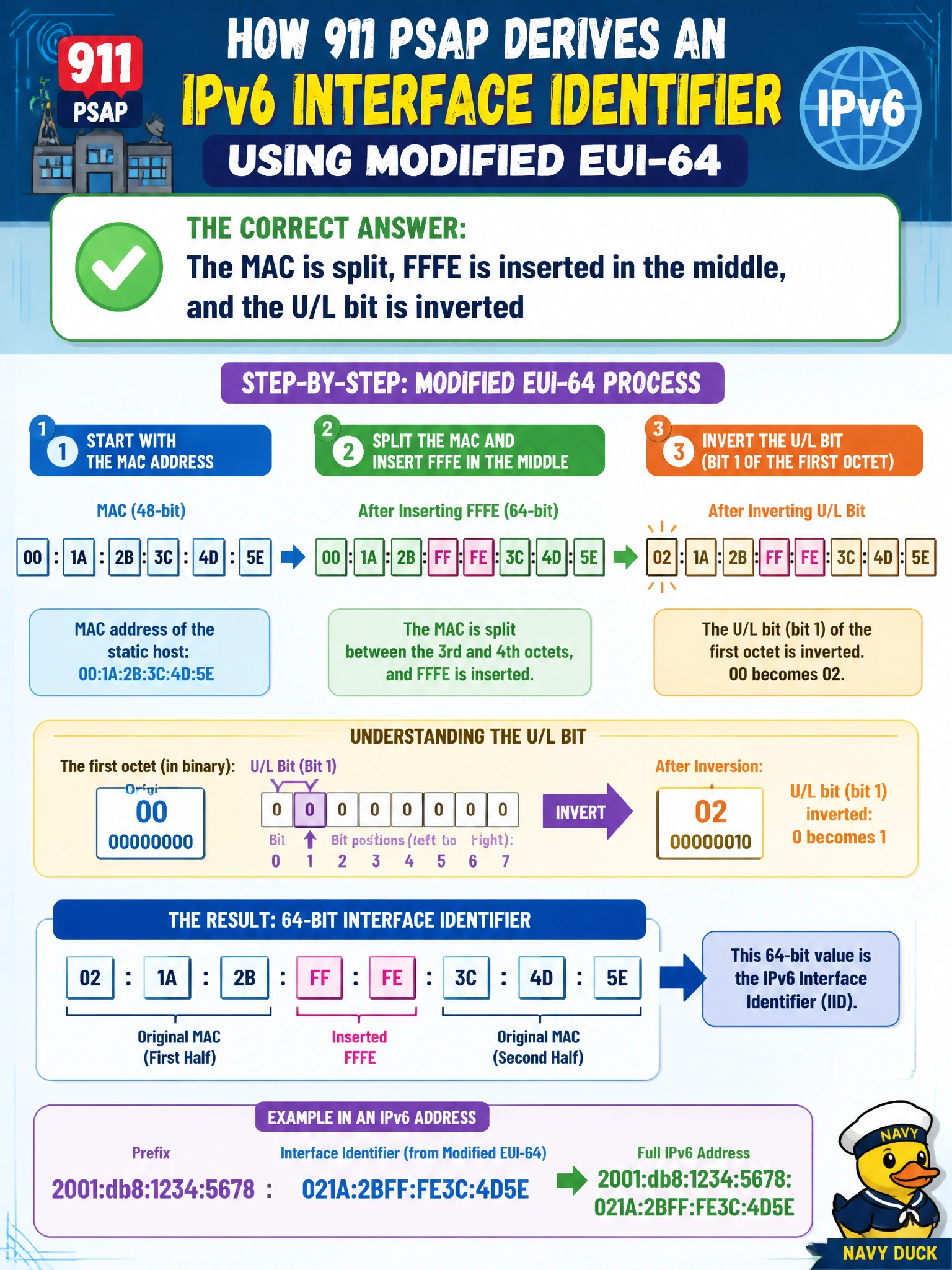
Short Explanation
Modified EUI-64 is a little MAC makeover: split the 48 bits, drop FFFE in the middle, flip the U/L bit, and you have a 64-bit interface ID. It is an IPv6 IID trick, not an IPv4 DHCP option.
Full Explanation
A 911 PSAP derives a static host’s IPv6 interface identifier from MAC 00:1A:2B:3C:4D:5E using modified EUI-64. Modified EUI-64 forms a 64-bit interface identifier from a 48-bit MAC by splitting the MAC into two 24-bit halves, inserting FFFE in the middle, and inverting the Universal/Local (U/L) bit in the first octet. That produces the classic IID historically used for SLAAC, even though privacy extensions are common on modern clients.
Using the MAC unchanged as the low-order 48 bits with no inserted bits skips the mandatory FFFE insertion and U/L flip. Setting the entire 128-bit address equal to the 48-bit MAC omits prefix structure and IID expansion entirely. Claiming modified EUI-64 only applies to IPv4 DHCP option 82 circuits confuses an IPv6 IID algorithm with an unrelated IPv4 DHCP relay-agent option used for circuit identification.
Exam caveat: know the three mechanical steps—split, insert FFFE, invert U/L—and be ready to compute an example IID from a given MAC. Privacy addresses may differ from EUI-64 on real endpoints.
Operational check for the PSAP static host: compute the expected IID from 00:1A:2B:3C:4D:5E (U/L inversion turns 00 into 02, yielding an IID of 021A:2BFF:FE3C:4D5E), combine it with the planned /64 prefix, configure the address, and verify Neighbor Discovery reaches it. Document whether privacy IIDs are disabled for that static role.