
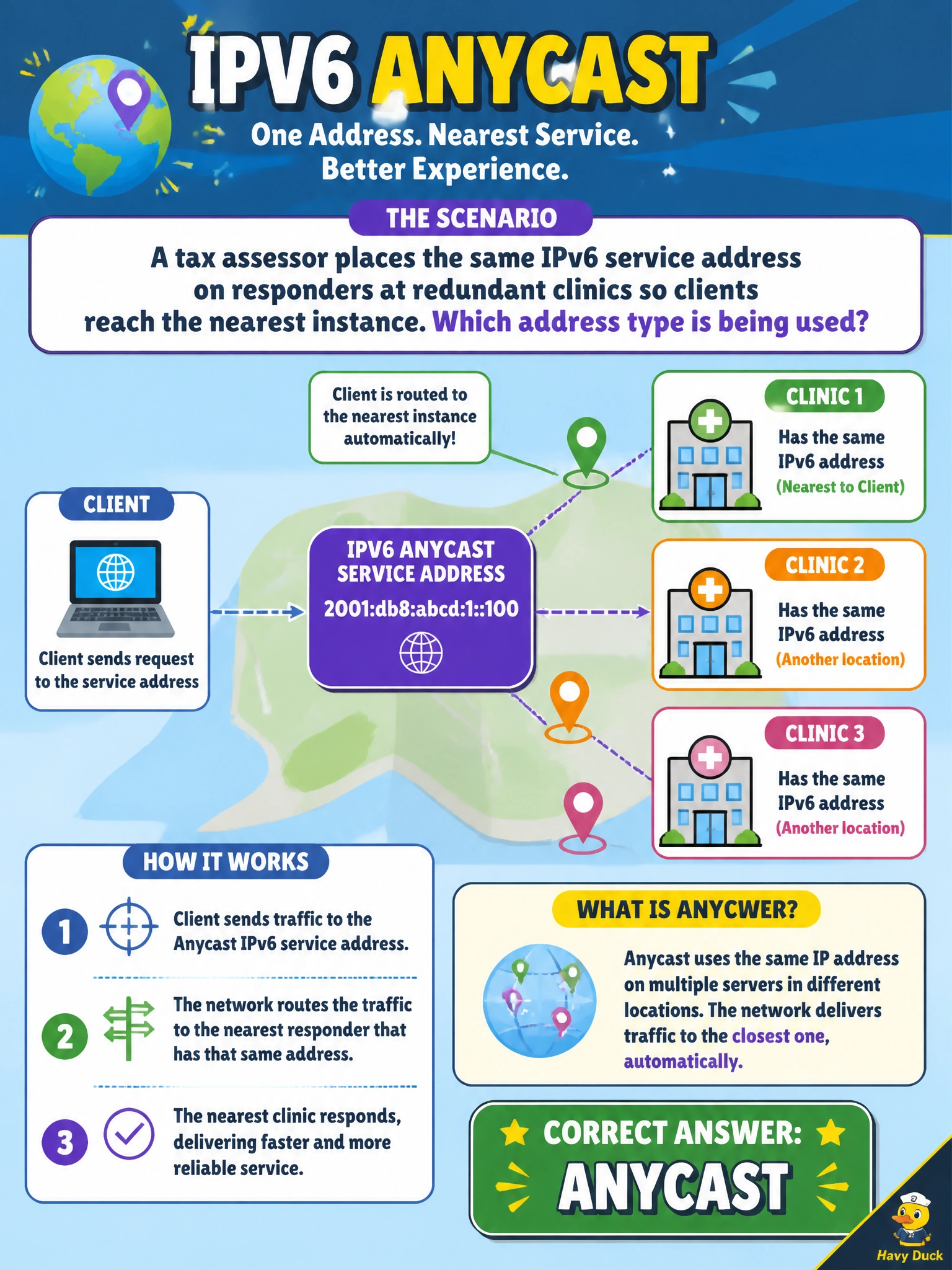
A tax assessor places the same IPv6 service address on responders at redundant clinics so clients reach the nearest instance. Which address type is being used?
Select an answer to reveal the explanation.
Short Explanation
Anycast is one shared address worn by several helpers — the network steers you to the closest clinic copy. It is not old-school broadcast and not “must be routed on the Internet.”
Full Explanation
A tax assessor places the same IPv6 service address on responders at redundant clinics so clients reach the nearest instance. That pattern is anycast: one unicast address is configured on multiple hosts or service instances, and routing delivers packets to the topologically nearest or best-metric copy. Municipal designs use it for shared service VIPs, recursive DNS, and similar high-availability patterns stretched across clinics.
Broadcast is an IPv4 and Layer 2 concept of delivering to all nodes; IPv6 does not use broadcast the same way, and the stem describes one shared service address with nearest delivery—not flood-to-all. Link-local multicast only describes FF02::/16 group delivery on a single link, not a shared unicast service identity across clinics. Unique-local addressing that must be Internet-routed contradicts unique-local’s internal scope and is not the definition of anycast.
Exam caveat: anycast reuses unicast address architecture with multiple providers of the same address; selection is by routing metrics, not by joining a multicast group. Distinguish anycast versus multicast versus broadcast carefully in CCNA wording.
Operational check: configure the shared service address on both clinic responders, advertise or host-route it appropriately, and path-check from clients to confirm they land on the nearer clinic. Fail one instance and verify traffic shifts cleanly to the remaining responder.