
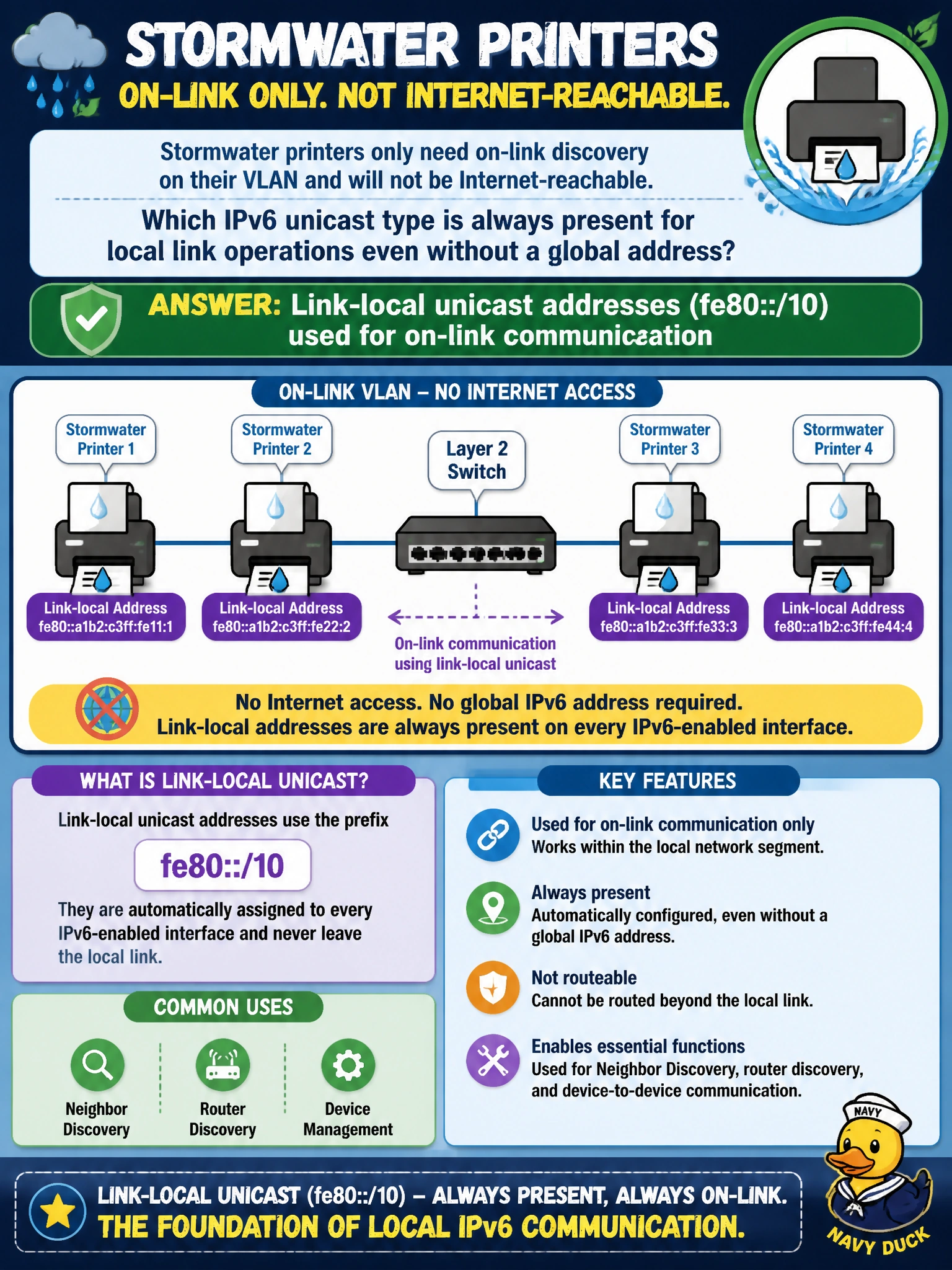
Stormwater printers only need on-link discovery on their VLAN and will not be Internet-reachable. Which IPv6 unicast type is always present for local link operations even without a global address?
Select an answer to reveal the explanation.
Short Explanation
You can rely on link-local addresses for printer discovery: every IPv6-enabled interface gets an fe80:: address for on-link communication, even without a global address. That’s just what you need when the printers stay on their VLAN.
Full Explanation
Stormwater printers need on-link discovery on their VLAN but should not be Internet-reachable. IPv6 still requires an address for Neighbor Discovery and local communication; link-local unicast addresses in fe80::/10 fill that role and are automatically configured on every IPv6-enabled interface. Their scope is limited to the link, so they let printers communicate for discovery and printing without giving them a global Internet identity. Global unicast addresses in 2000::/3 provide provider-routable identities, so they are unnecessary when the printers must remain non-Internet-reachable by design. IPv4-mapped ::ffff:0:0/96 addresses represent IPv4 addresses in an IPv6 format; they are not the standard, always-present IPv6 unicast address for on-link operations. Anycast is not typically assigned to routers for reaching nearby DNS root servers: that description misstates its use, and anycast is not what printers need for ordinary local communication. Exam caveat: link-local addresses are mandatory and automatic on IPv6 interfaces; do not mistake the absence of a global address for the absence of an IPv6 address. Link-local traffic is not forwarded across routers. Practical check: on the stormwater VLAN, confirm each printer has an fe80:: address, test ping6 between a printer and the SVI using the zone or interface index required by the operating system, and ensure policy does not accidentally assign a global address or default route if Internet reachability is forbidden.