
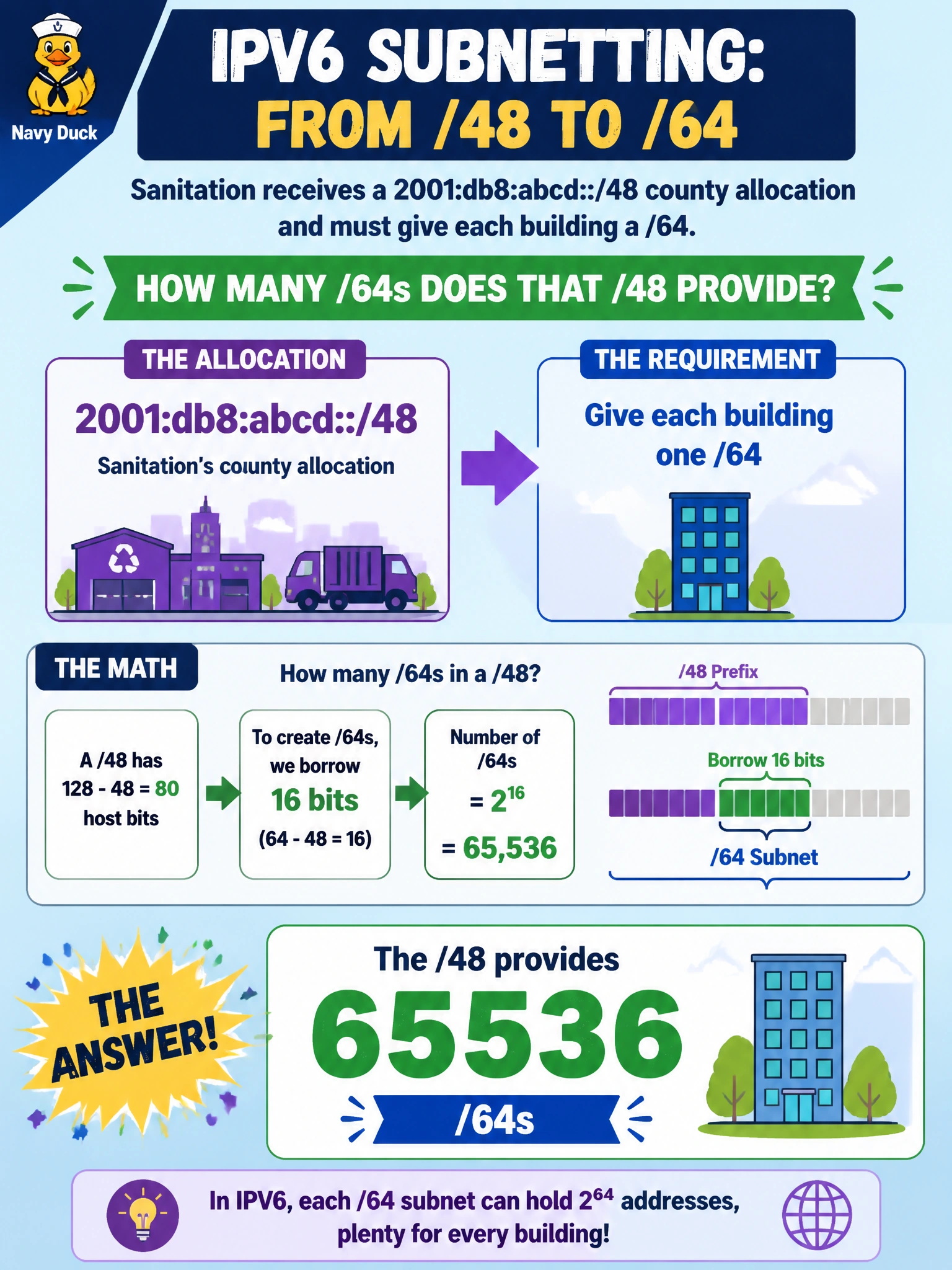
Sanitation receives a 2001:db8:abcd::/48 county allocation and must give each building a /64. How many /64s does that /48 provide?
Select an answer to reveal the explanation.
Short Explanation
From /48 to /64 you get 16 extra subnet bits — 2^16. That is 65,536 building-sized /64s from one county /48, which is plenty of room to grow the sanitation campus map.
Full Explanation
Sanitation receives a 2001:db8:abcd::/48 county allocation and must give each building a /64. The number of subnet bits between /48 and /64 is 16 (64 − 48 = 16). Therefore the count of /64s available from that single county /48 is 2^16 = 65,536. That relationship is the standard IPv6 planning math when an organization receives a /48 and assigns one /64 per LAN, VLAN, or building on the municipal campus map.
Sixteen would equal 2^4, which matches only a four-bit step such as /48 to /52, not /48 to /64. Two hundred fifty-six equals 2^8 and would describe /48 carved into /56 blocks. Sixty-four is merely the destination prefix-length numeral itself, not the quantity of subnets produced. Those distractors catch candidates who confuse the prefix length with the subnet count or who miscount the bit difference under time pressure.
Exam caveat: subnet count equals 2^(longer_prefix − shorter_prefix) when moving to more-specific prefixes. Do not subtract backwards, and do not treat “/64” as “64 subnets.” Nibble-aligned plans (/52, /56, /60, /64) are common, but the raw count from /48 to /64 remains 65,536.
Operational check for the sanitation campus map: reserve building identifiers inside the 16-bit subnet field of the /48, document each building’s unique /64, and verify no two buildings share the same 16-bit subnet ID. A hierarchical spreadsheet (for example site nibble + building nibble) prevents overlap as yards, clinics, and transfer stations are added over time.