
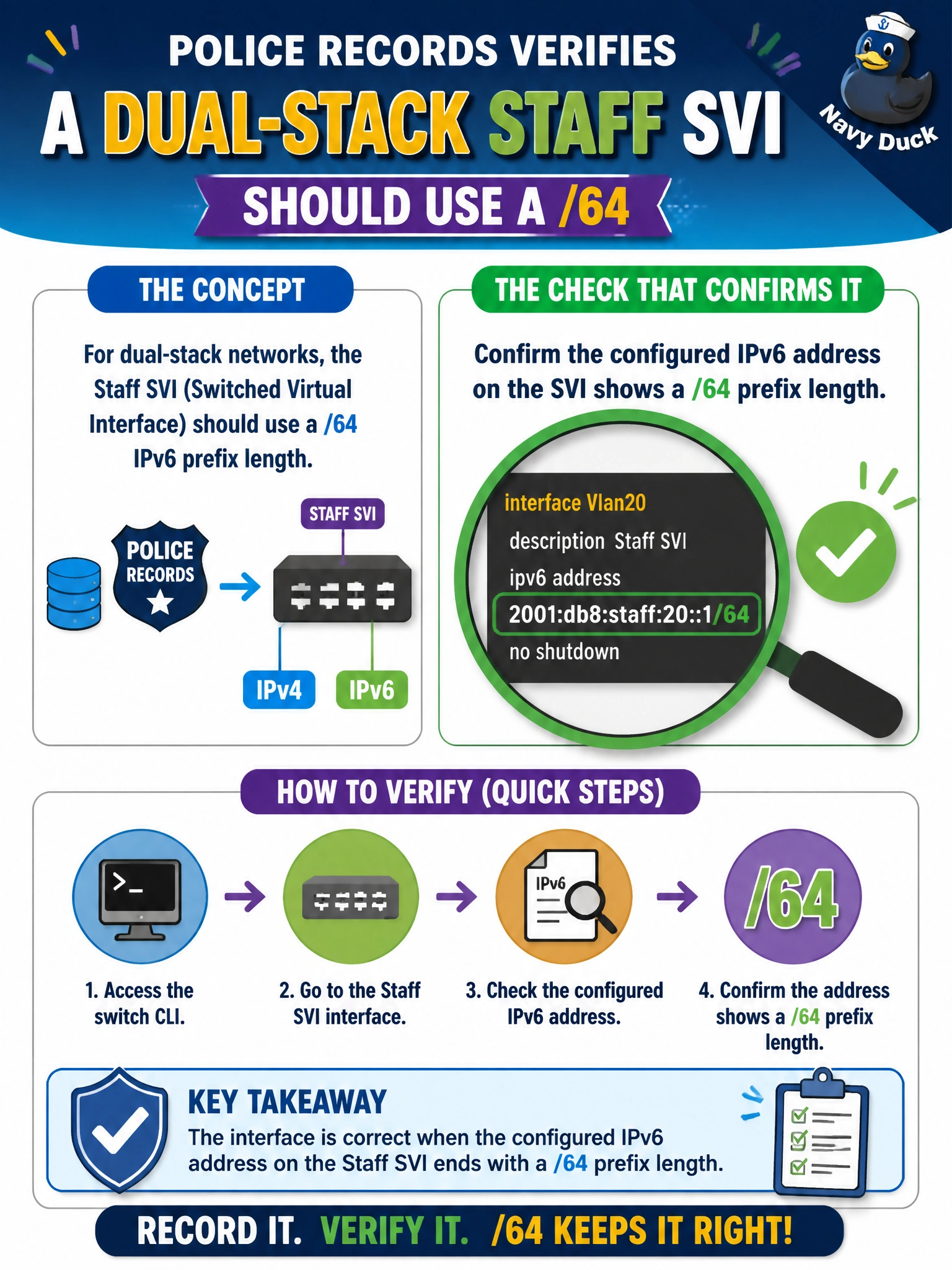
Police records verifies a dual-stack staff SVI should use a /64. Which check confirms the interface has the intended IPv6 prefix length?
Select an answer to reveal the explanation.
Short Explanation
Trust but verify: look at the SVI’s IPv6 config or status and make sure the prefix length really says /64. STP priority and IPv4 masks are different knobs — they do not prove the IPv6 prefix.
Full Explanation
Police records verifies that a dual-stack staff SVI should use a /64. The confirmation that matches the requirement is to inspect the configured IPv6 address on that SVI and verify the prefix length field is /64. On Cisco-style gear that means checking the running configuration or interface IPv6 status for an address line that explicitly includes /64 (or the equivalent mask display). That is a direct check of the intended parameter.
Confirming the interface has only an IPv4 /24 and no IPv6 address proves the dual-stack IPv6 side is missing, not that /64 is correct. Confirming the SVI is shutdown so prefix length cannot be wrong avoids validation rather than performing it—admin-down does not certify prefix length. Confirming Spanning Tree root priority equals 64 confuses STP bridge priority with IPv6 prefix length; the number 64 appearing in STP is unrelated to IPv6 /64.
Exam caveat: /64 is the standard LAN prefix length for SLAAC-friendly Ethernet segments, but the operational proof is always the interface’s IPv6 address/prefix display—not adjacent features that happen to use the number 64.
Operational check for staff VLAN: show running-config interface vlan X and show ipv6 interface vlan X; ensure the global/unique-local address shows /64; bring a test host online and confirm it learns a /64 on-link prefix. Correct any mistaken /48 or /127 applied to a user-facing SVI.